


'%3e%3cpath%20d='M26.7002%206.05468C26.7002%205.85186%2026.7636%205.68707%2026.8904%205.5603C27.0171%205.43354%2027.1788%205.37332%2027.3753%205.37966L27.9267%205.37966C28.1295%205.37966%2028.2911%205.43987%2028.4116%205.5603C28.532%205.68073%2028.5922%205.84869%2028.5922%206.06419L28.5827%2023.4206L27.8696%2025.8069C27.8506%2025.864%2027.8253%2025.9083%2027.7936%2025.94C27.7555%2025.9781%2027.7112%2025.9971%2027.6605%2025.9971C27.5844%2025.9971%2027.5242%2025.9749%2027.4798%2025.9305C27.4418%2025.8925%2027.4165%2025.8481%2027.4038%2025.7974L26.6907%2023.4301L26.7002%206.05468Z'%20fill='%23FF9334'/%3e%3cpath%20d='M18.8701%2012.6006C19.3331%2012.6006%2019.6787%2012.9599%2019.6787%2013.4092C19.6786%2013.8694%2019.3338%2014.2295%2018.8701%2014.2295H9.80762C9.33292%2014.2294%208.98744%2013.8702%208.9873%2013.4092C8.9873%2012.9591%209.33368%2012.6007%209.80762%2012.6006H18.8701ZM18.8701%208.44531C19.3313%208.44531%2019.6787%208.79114%2019.6787%209.24219C19.6785%209.70065%2019.3354%2010.0742%2018.8701%2010.0742H9.80762C9.33132%2010.0741%208.98752%209.70148%208.9873%209.24219C8.9873%208.79034%209.33542%208.44539%209.80762%208.44531H18.8701Z'%20fill='%23FF9334'/%3e%3cpath%20d='M14.0703%2016.7578C14.5315%2016.7578%2014.8789%2017.1036%2014.8789%2017.5547C14.8787%2018.0132%2014.5356%2018.3867%2014.0703%2018.3867H9.80762C9.33132%2018.3866%208.98752%2018.014%208.9873%2017.5547C8.9873%2017.1028%209.33542%2016.7579%209.80762%2016.7578H14.0703Z'%20fill='%23FF9334'/%3e%3crect%20x='5.8398'%20y='4.2402'%20width='17.12'%20height='21.92'%20rx='2.16'%20stroke='%23FF9334'%20stroke-width='2.08'/%3e%3c/g%3e%3cdefs%3e%3cclipPath%20id='clip0_11502_53292'%3e%3crect%20width='32'%20height='32'%20fill='white'/%3e%3c/clipPath%3e%3c/defs%3e%3c/svg%3e)

LIS professors and students
Preparing a lecture on the history of library technology from ancient times to the digital age.
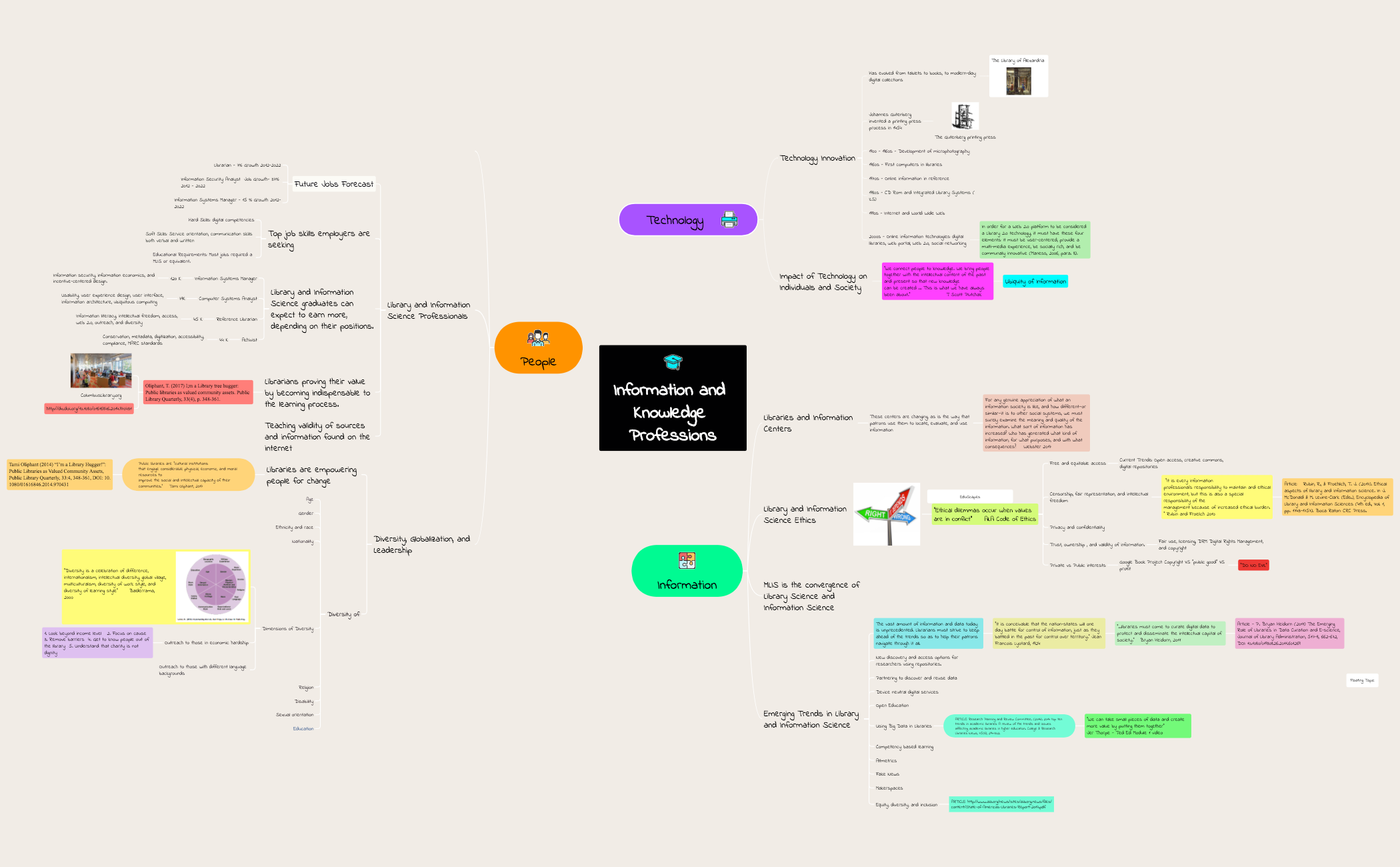
The Information and Knowledge Professions mind map template provides a comprehensive overview of the library and information science (LIS) field, covering 102 nodes across four major branches: Technology, People, Information, and EduScapes. It traces the evolution of technology from the Library of Alexandria to modern digital libraries, explores the impact on individuals and society, and details career paths such as Librarian (7% growth 2012-2022) and Information Security Analyst (37% growth). The template also delves into LIS ethics, emerging trends like makerspaces and altmetrics, and the convergence of library and information science in the MLIS degree. Key nodes include 'Technology Innovation', 'Library and Information Science Professionals', and 'Emerging Trends in Library and Information Science'. This Information and Knowledge Professions template serves as a valuable cheat sheet for students, educators, and professionals seeking a structured overview of the field.
Terms and ConditionsPreparing a lecture on the history of library technology from ancient times to the digital age.
Conducting a career workshop for MLIS students exploring job growth and required skills.
Drafting a research proposal on emerging trends like big data and makerspaces in libraries.
Open the file in Xmind and click the plus icons to expand the four major branches covering Technology, People, Information, and EduScapes.
Personalize the template by editing the 102 existing nodes or adding new branches to reflect specific career paths and emerging LIS trends.
Utilize the map as a study guide and export your final version as an image or PDF for professional presentations and sharing.
The template covers 102 nodes across four main branches: Technology, People, Information, and EduScapes. It includes historical milestones, career forecasts, ethical frameworks, and emerging trends in library and information science.
Use the 'People' branch to explore job growth projections for roles like Librarian and Information Security Analyst, and review the top hard and soft skills employers seek. Customize the nodes to add your own career goals.
Yes, the 'Library and Information Science Ethics' node covers key dilemmas such as free access, censorship, privacy, and intellectual freedom, making it a useful discussion starter for ethics courses.
Absolutely. Open the .xmind file in Xmind and modify any node—add new trends, articles, or personal notes. The template is fully customizable.
Trends include big data in libraries, altmetrics, fake news, makerspaces, equity and diversity initiatives, and competency-based learning.
The template uses a central root with four main branches radiating outward, plus a floating topic. Each branch contains sub-nodes that expand into detailed timelines, lists, and quotes.
Share your mind map templates with creators around the world and start earning from your work.

