


'%3e%3cpath%20d='M26.7002%206.05468C26.7002%205.85186%2026.7636%205.68707%2026.8904%205.5603C27.0171%205.43354%2027.1788%205.37332%2027.3753%205.37966L27.9267%205.37966C28.1295%205.37966%2028.2911%205.43987%2028.4116%205.5603C28.532%205.68073%2028.5922%205.84869%2028.5922%206.06419L28.5827%2023.4206L27.8696%2025.8069C27.8506%2025.864%2027.8253%2025.9083%2027.7936%2025.94C27.7555%2025.9781%2027.7112%2025.9971%2027.6605%2025.9971C27.5844%2025.9971%2027.5242%2025.9749%2027.4798%2025.9305C27.4418%2025.8925%2027.4165%2025.8481%2027.4038%2025.7974L26.6907%2023.4301L26.7002%206.05468Z'%20fill='%23FF9334'/%3e%3cpath%20d='M18.8701%2012.6006C19.3331%2012.6006%2019.6787%2012.9599%2019.6787%2013.4092C19.6786%2013.8694%2019.3338%2014.2295%2018.8701%2014.2295H9.80762C9.33292%2014.2294%208.98744%2013.8702%208.9873%2013.4092C8.9873%2012.9591%209.33368%2012.6007%209.80762%2012.6006H18.8701ZM18.8701%208.44531C19.3313%208.44531%2019.6787%208.79114%2019.6787%209.24219C19.6785%209.70065%2019.3354%2010.0742%2018.8701%2010.0742H9.80762C9.33132%2010.0741%208.98752%209.70148%208.9873%209.24219C8.9873%208.79034%209.33542%208.44539%209.80762%208.44531H18.8701Z'%20fill='%23FF9334'/%3e%3cpath%20d='M14.0703%2016.7578C14.5315%2016.7578%2014.8789%2017.1036%2014.8789%2017.5547C14.8787%2018.0132%2014.5356%2018.3867%2014.0703%2018.3867H9.80762C9.33132%2018.3866%208.98752%2018.014%208.9873%2017.5547C8.9873%2017.1028%209.33542%2016.7579%209.80762%2016.7578H14.0703Z'%20fill='%23FF9334'/%3e%3crect%20x='5.8398'%20y='4.2402'%20width='17.12'%20height='21.92'%20rx='2.16'%20stroke='%23FF9334'%20stroke-width='2.08'/%3e%3c/g%3e%3cdefs%3e%3cclipPath%20id='clip0_11502_53292'%3e%3crect%20width='32'%20height='32'%20fill='white'/%3e%3c/clipPath%3e%3c/defs%3e%3c/svg%3e)

High school or college students studying U.S. history
Preparing for a history exam on the women's suffrage movement in the United States
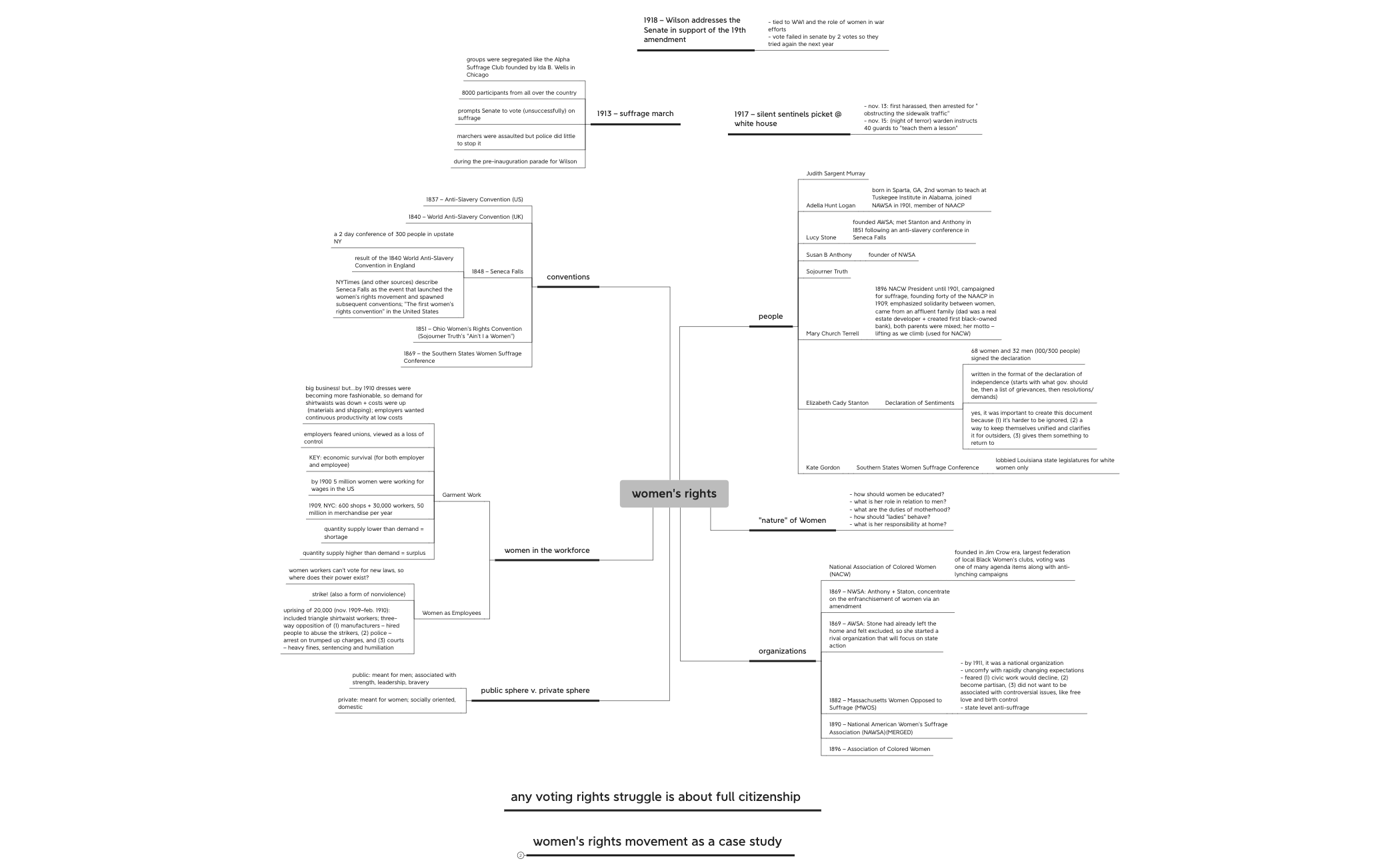
The women's rights mind map template provides a structured overview of the movement for equality, covering 70 nodes across key areas such as influential people, organizations, historical conventions, and the struggle for suffrage. This template is ideal for students, educators, and activists seeking a comprehensive cheat sheet on women's rights milestones. It includes detailed branches on the 'nature' of Women, the public sphere v. private sphere dichotomy, and pivotal events like the 1913 suffrage march and the 1917 silent sentinels picket at the White House. The template also explores the role of women in the workforce, including garment work, and examines conflicts within the movement, such as the differing strategies of the NWSA and AWSA. With its rich factual content, this mind map serves as both a study aid and a reference for understanding the fight for full citizenship.
Terms and ConditionsPreparing for a history exam on the women's suffrage movement in the United States
Designing a lesson plan for a social studies class covering the 19th Amendment and key activists
Writing a research paper on the conflicts and collaborations within the early women's rights movement
Download the .xmind file and open it to browse the comprehensive branches covering influential people, organizations, and historical conventions.
Click on specific nodes like the suffrage movement or workforce branches to add your own research notes, links, and personalized styling.
Save your progress and export the final mind map as an image or PDF to share your findings with students or fellow activists.
The template covers 70 nodes organized into branches: people, nature of women, organizations, public vs. private sphere, women in the workforce, conventions, key suffrage events (1913 march, 1917 silent sentinels), and the movement as a case study.
Open the .xmind file in Xmind, then explore each branch to learn about key figures, organizations, and events. You can add notes or links to deepen your research on topics like the 1918 Wilson address.
Yes, the Xmind template is free to download and fully editable. You can customize the nodes, add new branches, or export it as an image or PDF for study.
This branch contrasts the public sphere (associated with men, strength, leadership) with the private sphere (domestic, socially oriented for women), illustrating the societal norms the movement challenged.
Absolutely. You can edit the organization names, dates, or descriptions, and even add new groups like the Association of Colored Women to tailor the template to your study needs.
Use it for history class preparation, research on the suffrage movement, or as a visual aid for presentations on women's rights milestones and key figures.
Share your mind map templates with creators around the world and start earning from your work.

