




University professors and TESOL students
Preparing a lecture on historical language teaching methods for an applied linguistics course.
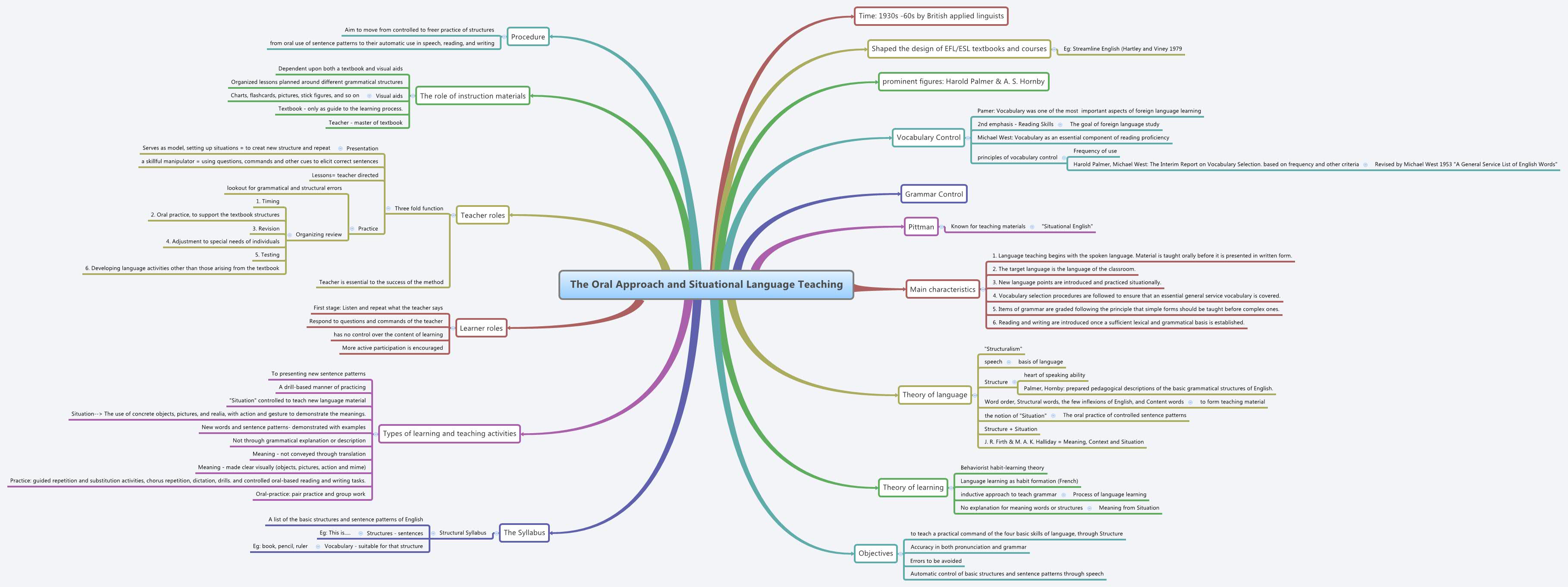
The Oral Approach and Situational Language Teaching mind map covers the historical development, key figures, and core principles of this influential EFL/ESL methodology from the 1930s-1960s. With 99 nodes across one sheet, it details prominent figures like Harold Palmer and A. S. Hornby, vocabulary control principles including Michael West's 'A General Service List of English Words', and the structural syllabus. The map explores main characteristics such as teaching spoken language orally before writing, and the theory of learning rooted in behaviorist habit-formation. Key nodes like 'Pittman' and 'Situational English' highlight practical teaching materials, while 'Procedure' outlines the move from controlled to freer practice. This template serves as a comprehensive cheat sheet for language teaching methodology students and educators.
Terms and ConditionsPreparing a lecture on historical language teaching methods for an applied linguistics course.
Designing an EFL/ESL textbook or course that follows situational language teaching principles.
Reviewing key concepts before a language teaching methodology exam.
Open the template in Xmind and navigate through the branches to explore key aspects like historical development, main characteristics, and the structural syllabus.
Personalize the mind map by adding your own teaching notes, specific textbook references, or additional details about figures like Harold Palmer and A. S. Hornby.
Use the map as a study guide to test your recall of behaviorist principles or export it as an image or PDF for classroom handouts and presentations.
The mind map covers historical context (1930s-60s), key figures like Harold Palmer and A. S. Hornby, vocabulary and grammar control, main characteristics, theory of language and learning, objectives, syllabus, activities, learner and teacher roles, instructional materials, and procedure.
It is organized as a single-sheet mind map with the root topic 'The Oral Approach and Situational Language Teaching' and branches for each major aspect: time, influence, figures, vocabulary control, grammar control, Pittman, main characteristics, theory, objectives, syllabus, activities, roles, materials, and procedure.
Yes, you can open the .xmind file in Xmind and edit any node to add notes, examples, or personal insights. You can also reorganize branches or add new ones to fit your curriculum.
Yes, the template includes a 'Procedure' branch that outlines steps from controlled to freer practice, making it useful for designing situational language teaching lessons.
The Structural Syllabus is a list of basic structures and sentence patterns of English, with vocabulary suitable for each structure (e.g., 'This is...' with words like book, pencil, ruler).
Share your mind map templates with creators around the world and start earning from your work.

