




Academic deans and curriculum committees
During annual curriculum review cycles to identify systemic barriers to innovation
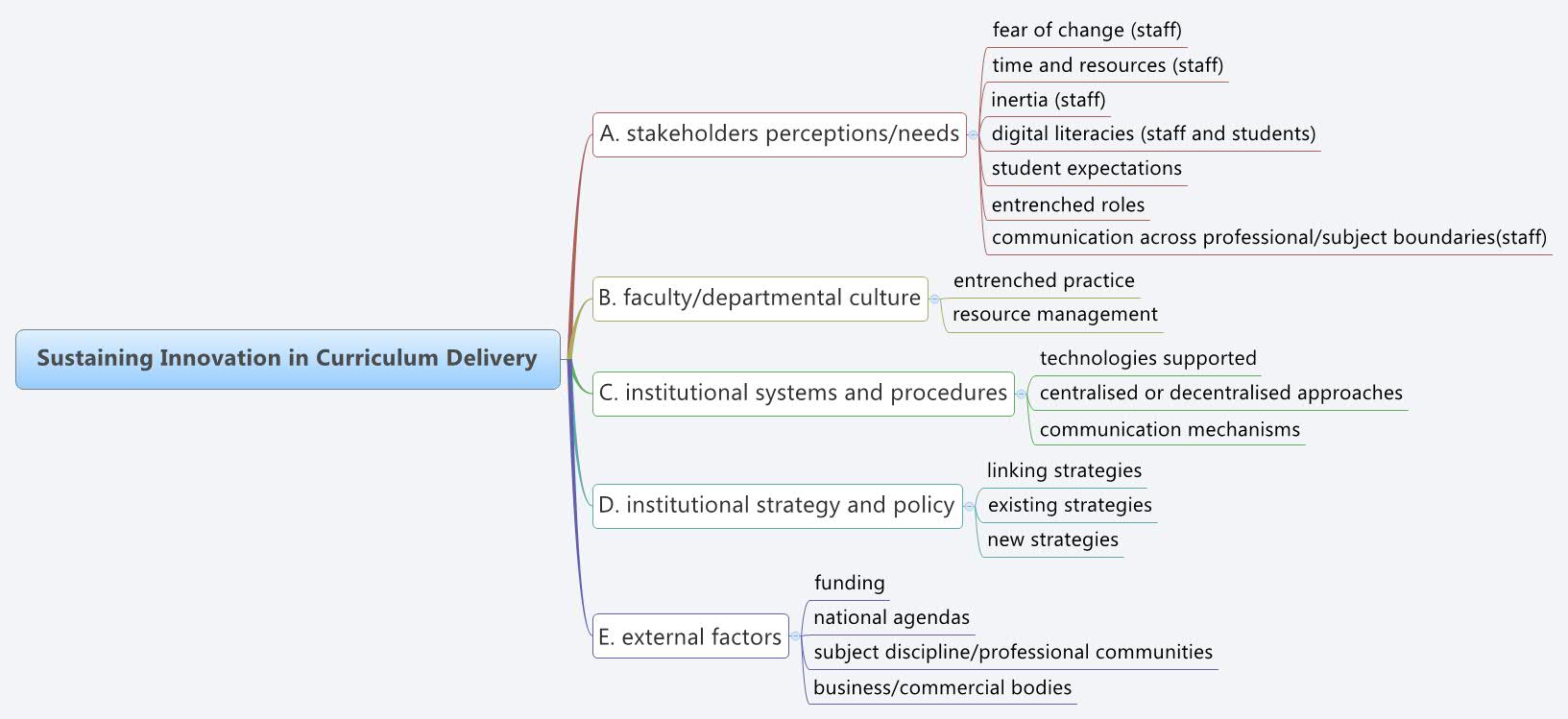
The Sustaining Innovation in Curriculum Delivery mind map template, designed for higher education leaders and curriculum developers, maps 25 factors across 5 key domains that influence long-term innovation. It covers stakeholder perceptions such as 'fear of change (staff)' and 'student expectations', faculty culture elements like 'entrenched practice', institutional systems including 'technologies supported', strategy and policy areas such as 'linking strategies', and external factors like 'funding' and 'national agendas'. This template serves as a strategic diagnostic tool to identify barriers and enablers for sustaining curriculum innovation.
利用規約During annual curriculum review cycles to identify systemic barriers to innovation
When launching a new teaching initiative to assess faculty readiness and institutional support
In strategic planning sessions to align curriculum innovation with external funding and national agendas
Launch the template in Xmind to explore the five key domains and twenty-five factors influencing long-term curriculum innovation.
Personalize the map by adding institution-specific notes, priority markers, and unique stakeholder perceptions to the existing nodes.
Use the map as a diagnostic tool during stakeholder meetings before exporting the final strategic plan as an image or PDF.
The template includes 25 nodes organized into 5 branches: stakeholders perceptions/needs, faculty/departmental culture, institutional systems and procedures, institutional strategy and policy, and external factors. Each branch lists specific factors like 'fear of change (staff)' and 'national agendas'.
Open the .xmind file in Xmind, then review each branch to identify which factors are present in your institution. Add notes or priority markers to nodes that represent significant barriers or enablers. Use the map as a discussion framework with stakeholders.
Yes, the template is fully editable in Xmind. You can add, remove, or modify nodes, change colors, attach notes, and link to external resources to tailor it to your specific context.
This branch helps you examine how existing strategies, new strategies, and the linking of strategies across departments support or hinder sustained innovation in curriculum delivery.
Absolutely. The template provides a structured overview of internal and external factors, making it ideal for facilitated workshops where teams prioritize actions to overcome barriers and leverage enablers.
あなたのマインドマップ テンプレートを世界中のクリエイターと共有して、作品から収入を得ましょう。

