


'%3e%3cpath%20d='M10%204C10%208.92857%2023%2011.5714%2023%2016.5C23%2021.4286%2010%2024.0714%2010%2029'%20stroke='%23FF9334'%20stroke-width='1.92'%20stroke-linecap='round'/%3e%3cpath%20d='M22%204C22%208.92857%209%2011.5714%209%2016.5C9%2021.4286%2022%2024.0714%2022%2029'%20stroke='%23FF9334'%20stroke-width='1.92'%20stroke-linecap='round'/%3e%3cpath%20d='M11.5%206C15.8739%206%2016.1261%206%2020.5%206'%20stroke='%23FF9334'%20stroke-width='1.92'%20stroke-linecap='round'/%3e%3cpath%20d='M9.5%2016H22.5'%20stroke='%23FF9334'%20stroke-width='1.92'%20stroke-linecap='round'/%3e%3cpath%20d='M11.5%2026.5L20.5%2026.5'%20stroke='%23FF9334'%20stroke-width='1.92'%20stroke-linecap='round'/%3e%3c/g%3e%3cdefs%3e%3cclipPath%20id='clip0_11502_53315'%3e%3crect%20width='32'%20height='32'%20fill='white'/%3e%3c/clipPath%3e%3c/defs%3e%3c/svg%3e)

Medical students and nursing candidates
Preparing for neuroanatomy practicals or medical board examinations
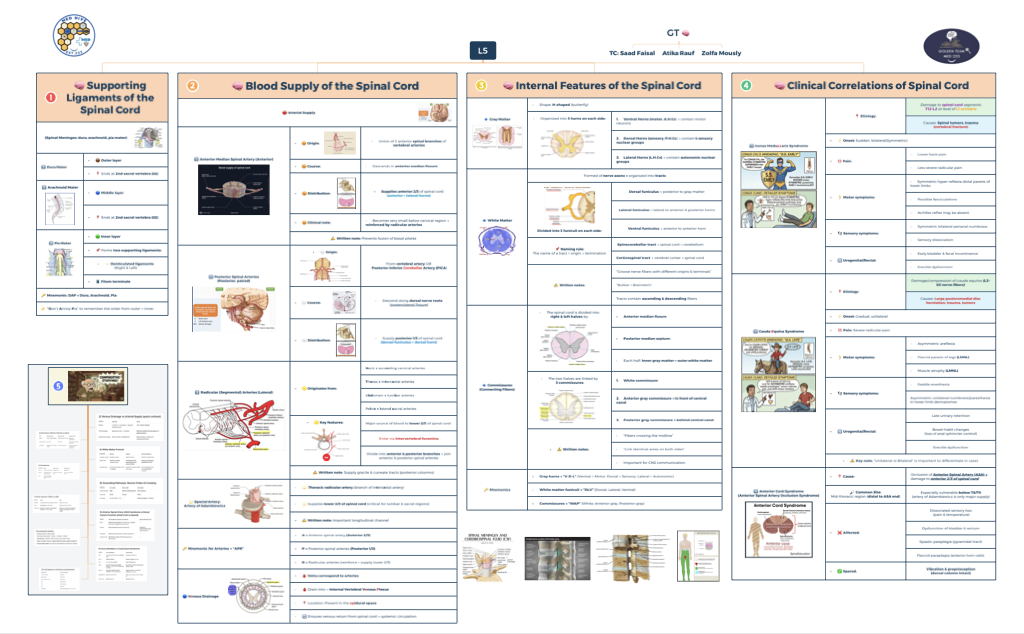
The SPINAL CORD mind map is a comprehensive neuroanatomy resource designed for medical students and healthcare professionals, covering 167 distinct nodes of anatomical and clinical data. This template provides a structured overview of the central nervous system's primary conduit, detailing the Supporting Ligaments of the Spinal Cord, vascular networks, and internal architecture. It specifically highlights the three meningeal layers—Dura Mater, Arachnoid Mater, and Pia Mater—alongside critical vascular structures like the Artery of Adamkiewicz. By integrating anatomical facts with diagnostic insights, this SPINAL CORD cheat sheet serves as a high-yield study tool for mastering the complexities of the spinal column and its associated pathologies.
使用条款Preparing for neuroanatomy practicals or medical board examinations
Explaining spinal cord injuries or vascular occlusions to patients or students
Creating a quick-reference guide for surgical residency rotations
Download the .xmind file and open it in the desktop or web application to access the full 167-node neuroanatomy structure.
Explore the four main branches covering anatomy and blood supply while utilizing the built-in mnemonic nodes for rapid memorization.
Expand the internal architecture and clinical correlation branches to study specific spinal cord syndromes and diagnostic insights.
This template covers the spinal meninges (Dura, Arachnoid, and Pia mater), the arterial supply including the radicular arteries, the internal organization of gray and white matter, and clinical syndromes such as Anterior Cord Syndrome.
The Clinical Correlations of Spinal Cord branch provides a side-by-side comparison of onset, pain levels, and motor symptoms for conditions like Cauda Equina Syndrome and Conus Medullaris Syndrome, making it ideal for differential diagnosis study.
Yes, it is specifically designed for high-yield review, utilizing mnemonics like 'DAP' for meninges and 'V-D-L' for gray horns to aid in rapid memorization of complex neuroanatomical relationships.
Absolutely. You can expand the 'Arterial Supply' or 'White Matter' branches to include more specific ascending and descending tracts or localized vascular variations relevant to your specific curriculum.
把你的思维导图模板分享给全球创作者,从你的作品中获得收益。

