


'%3e%3cpath%20d='M26.7002%206.05468C26.7002%205.85186%2026.7636%205.68707%2026.8904%205.5603C27.0171%205.43354%2027.1788%205.37332%2027.3753%205.37966L27.9267%205.37966C28.1295%205.37966%2028.2911%205.43987%2028.4116%205.5603C28.532%205.68073%2028.5922%205.84869%2028.5922%206.06419L28.5827%2023.4206L27.8696%2025.8069C27.8506%2025.864%2027.8253%2025.9083%2027.7936%2025.94C27.7555%2025.9781%2027.7112%2025.9971%2027.6605%2025.9971C27.5844%2025.9971%2027.5242%2025.9749%2027.4798%2025.9305C27.4418%2025.8925%2027.4165%2025.8481%2027.4038%2025.7974L26.6907%2023.4301L26.7002%206.05468Z'%20fill='%23FF9334'/%3e%3cpath%20d='M18.8701%2012.6006C19.3331%2012.6006%2019.6787%2012.9599%2019.6787%2013.4092C19.6786%2013.8694%2019.3338%2014.2295%2018.8701%2014.2295H9.80762C9.33292%2014.2294%208.98744%2013.8702%208.9873%2013.4092C8.9873%2012.9591%209.33368%2012.6007%209.80762%2012.6006H18.8701ZM18.8701%208.44531C19.3313%208.44531%2019.6787%208.79114%2019.6787%209.24219C19.6785%209.70065%2019.3354%2010.0742%2018.8701%2010.0742H9.80762C9.33132%2010.0741%208.98752%209.70148%208.9873%209.24219C8.9873%208.79034%209.33542%208.44539%209.80762%208.44531H18.8701Z'%20fill='%23FF9334'/%3e%3cpath%20d='M14.0703%2016.7578C14.5315%2016.7578%2014.8789%2017.1036%2014.8789%2017.5547C14.8787%2018.0132%2014.5356%2018.3867%2014.0703%2018.3867H9.80762C9.33132%2018.3866%208.98752%2018.014%208.9873%2017.5547C8.9873%2017.1028%209.33542%2016.7579%209.80762%2016.7578H14.0703Z'%20fill='%23FF9334'/%3e%3crect%20x='5.8398'%20y='4.2402'%20width='17.12'%20height='21.92'%20rx='2.16'%20stroke='%23FF9334'%20stroke-width='2.08'/%3e%3c/g%3e%3cdefs%3e%3cclipPath%20id='clip0_11502_53292'%3e%3crect%20width='32'%20height='32'%20fill='white'/%3e%3c/clipPath%3e%3c/defs%3e%3c/svg%3e)

Psychology or education professors and instructors
Preparing a lecture or workshop on self-regulated learning theories for education students.
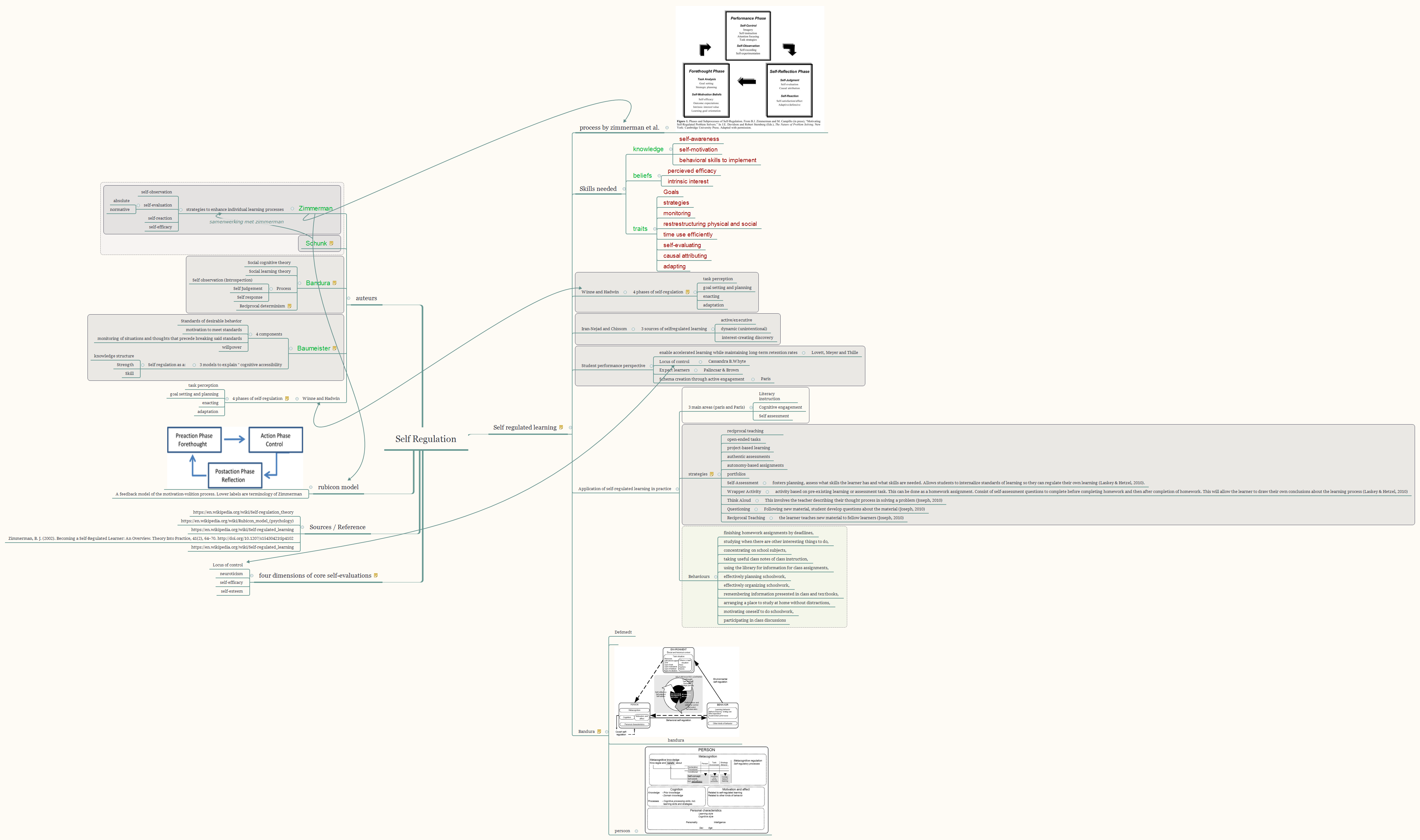
The Self Regulation mind map template provides a comprehensive overview of self-regulated learning and core self-evaluations, covering 130 nodes across key theories and models. It includes Zimmerman's process model, Winne and Hadwin's 4 phases (task perception, goal setting and planning, enacting, adaptation), and the Rubicon model. This template serves as a cheat sheet for educators, students, and researchers exploring self-regulation theory, with specific nodes like 'Locus of control' and 'self-efficacy' from the four dimensions of core self-evaluations. The map also references Bandura's social cognitive theory and Baumeister's 4 components of self-regulation, making it a valuable resource for understanding motivation and volition.
Conditions d'utilisationPreparing a lecture or workshop on self-regulated learning theories for education students.
Conducting research on motivation and volition, needing a structured overview of the Rubicon model and core self-evaluations.
Designing a study skills program for students, focusing on strategies like 'self-evaluation' and 'time use efficiently'.
Open the template in Xmind to navigate through the 130 nodes covering Zimmerman's process model, the Rubicon model, and core self-evaluations.
Click on specific branches like task perception or self-efficacy to reveal sub-nodes containing detailed theoretical components and skill requirements.
Personalize the content by adding your own research notes or images before exporting the final mind map as a PDF or image for sharing.
The template covers self-regulated learning theories (Zimmerman, Winne and Hadwin, Iran-Nejad), four dimensions of core self-evaluations, the Rubicon model, and key authors like Bandura and Baumeister, with 130 nodes in total.
Open the .xmind file in Xmind, then explore branches like 'Self regulated learning' to review Zimmerman's process, skills needed, and practical applications such as 'reciprocal teaching' and 'project-based learning'.
Yes, the template is fully editable in Xmind (desktop or web). You can customize nodes, add notes, and export as PDF or image for printing.
They are Locus of control, neuroticism, self-efficacy, and self-esteem. These are central to understanding individual differences in self-regulation.
Key authors include Zimmerman, Schunk, Bandura, Baumeister, Winne and Hadwin, and Iran-Nejad, with links to their theories and models.
Partagez vos modèles de cartes mentales avec des créateurs du monde entier et commencez à gagner avec votre travail.

