




Beginner data science students or self-learners
Starting to learn R from scratch and needing a structured overview of the language's ecosystem and basic syntax.
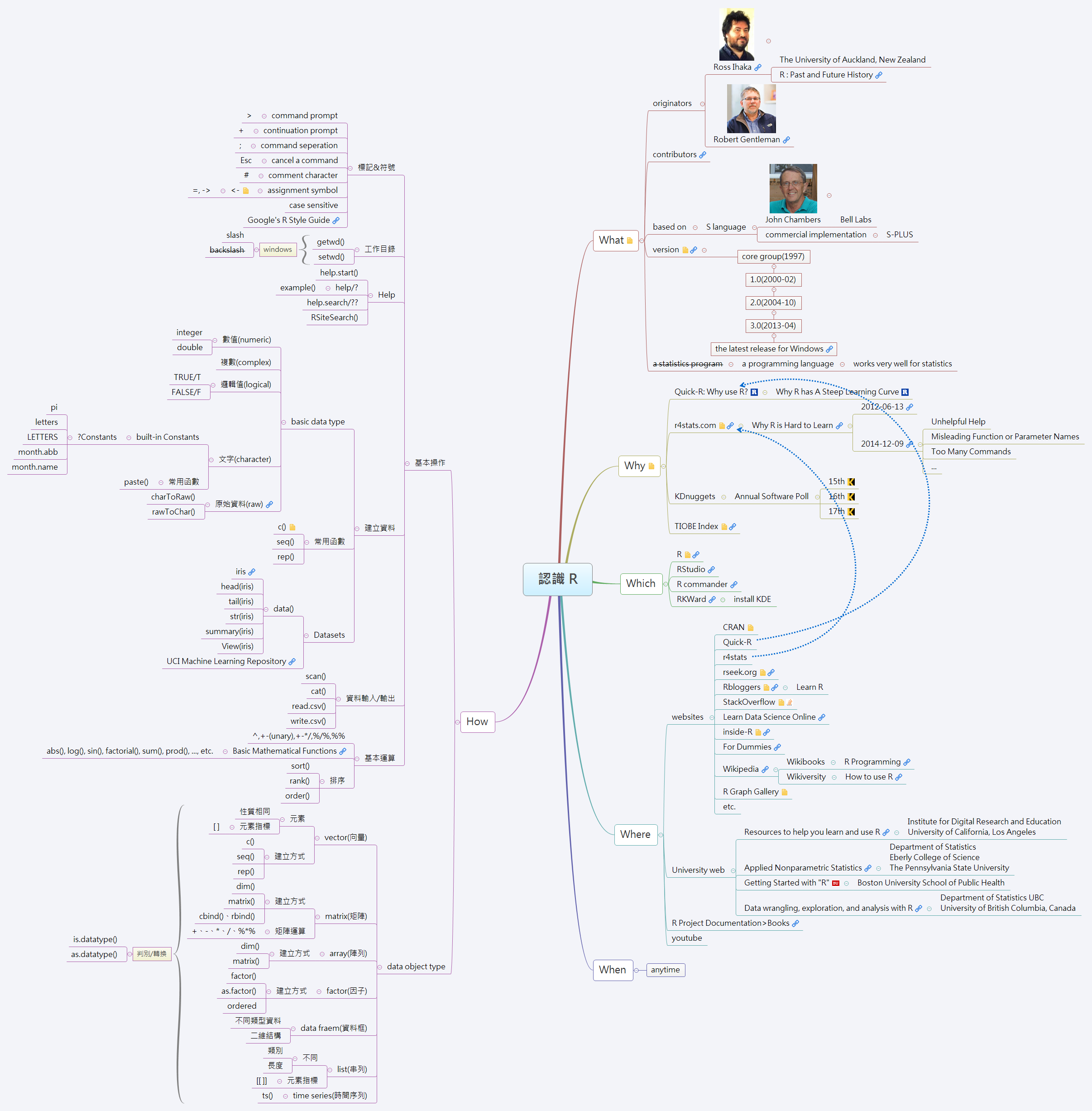
認識R is a comprehensive mind map template for learning the R programming language, covering its origin, why it's used, which tools to choose, where to find resources, when to learn, and how to perform basic operations. With 196 nodes, it details originators Ross Ihaka and Robert Gentleman, the S language foundation, and key resources like CRAN and Quick-R. The template includes specific nodes such as 'command prompt', 'assignment symbol', and 'data fraem(資料框)', making it an essential R cheat sheet for beginners. It is organized into six main branches—What, Why, Which, Where, When, How—providing a structured overview of R's ecosystem and practical skills.
利用規約Starting to learn R from scratch and needing a structured overview of the language's ecosystem and basic syntax.
Preparing a workshop or tutorial on R fundamentals and requiring a visual aid to cover history, tools, and resources.
Reviewing R basics before an exam or interview, focusing on data types and common functions.
在 Xmind 中開啟此模板,並透過 What、Why、Which 等六大分支快速掌握 R 語言的完整生態系。
點擊各個節點以展開詳細的語法說明與學習資源,並根據個人需求新增筆記或實作範例。
彈性調整心智圖內容以建立專屬學習筆記,完成後可匯出為圖片或 PDF 格式以便隨時複習。
The template covers R's origin, reasons to use R, tool options (R, RStudio, R commander), learning resources (CRAN, Quick-R, university websites), and practical how-to sections on basic operations, data types, and input/output.
Open the .xmind file in Xmind, then explore each branch: start with 'What' for background, 'Why' for motivation, 'Where' for resources, and 'How' for hands-on exercises on data types and functions.
Yes, the template is free to download and fully editable in Xmind. You can add your own notes, expand branches, or customize the content to fit your learning pace.
The template covers vector, matrix, array, factor, data frame, list, and time series, with creation methods and type conversion functions like is.datatype() and as.datatype().
Absolutely. The structured layout helps instructors present R's history, tools, and syntax step by step. Students can follow the 'How' branch for hands-on practice with commands and data types.
あなたのマインドマップ テンプレートを世界中のクリエイターと共有して、作品から収入を得ましょう。

