




Product designers and innovation leads
Kicking off a new product design project that requires understanding problem complexity and selecting an appropriate design approach.
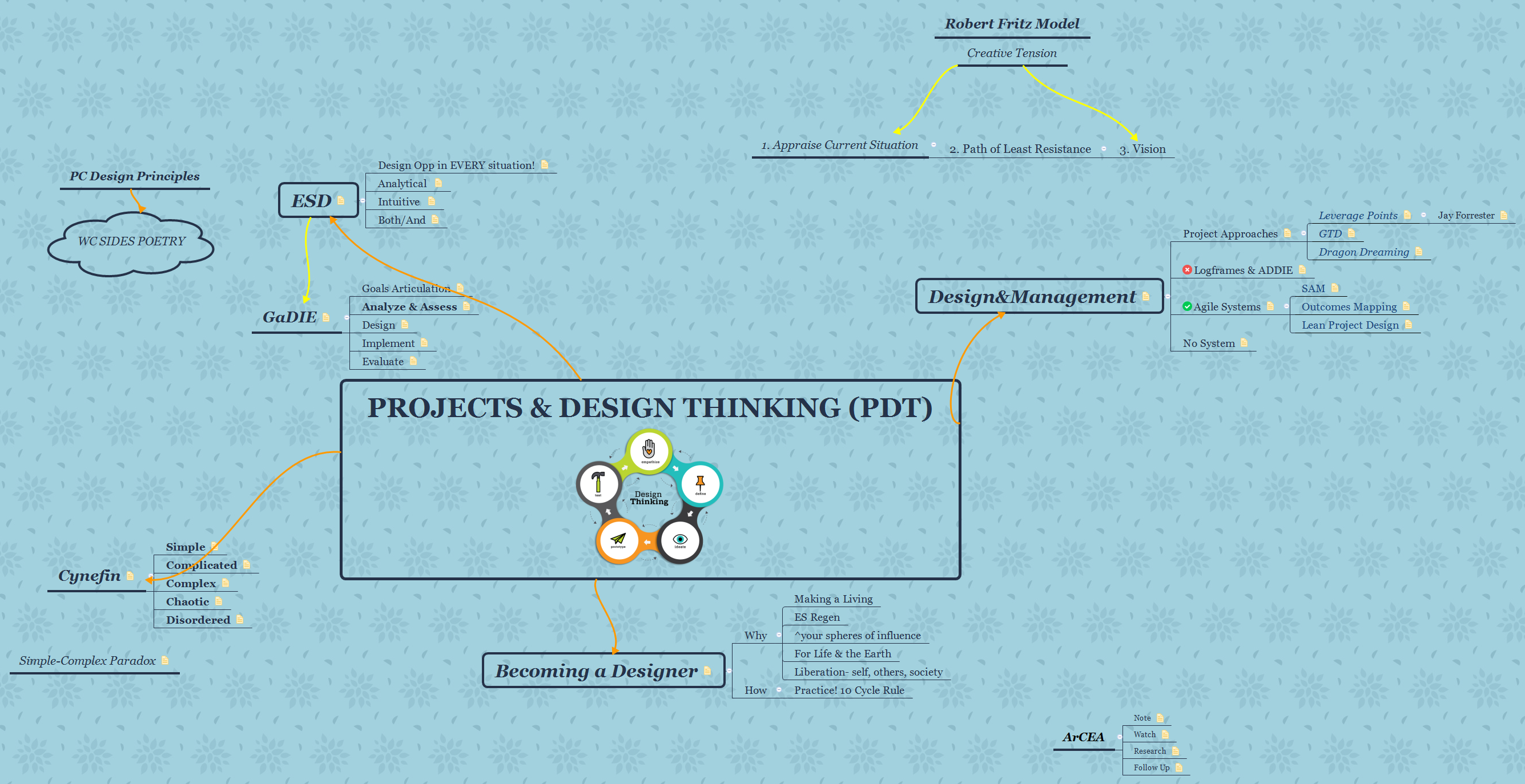
The Projects & Design Thinking (PDT) mind map template is a comprehensive 52-node framework used by designers, project managers, and systems thinkers to navigate complex problem-solving and creative design processes. It integrates multiple methodologies including the Cynefin framework (Simple, Complicated, Complex, Chaotic, Disordered), the GaDIE cycle (Goals Articulation, Analyze & Assess, Design, Implement, Evaluate), and the Robert Fritz Model of Creative Tension. The template also covers the Simple-Complex Paradox and provides practical steps like '1. Appraise Current Situation' and '2. Path of Least Resistance' to guide users from assessment to vision. This PDT cheat sheet is ideal for anyone seeking a structured yet flexible approach to design thinking and project management.
Termos e condiçõesKicking off a new product design project that requires understanding problem complexity and selecting an appropriate design approach.
Facilitating a workshop on systems thinking and design methods for cross-functional teams.
Reflecting on personal or organizational growth using the Creative Tension model to bridge current reality and vision.
Open the template in Xmind to explore the integrated Cynefin and GaDIE frameworks by expanding the pre-structured nodes.
Replace the placeholder text in sections like Appraise Current Situation with your specific project data and add custom subtopics.
Apply icons to highlight key creative tensions and export your completed design thinking map as a PDF or image for team collaboration.
The template includes 52 nodes covering frameworks like Cynefin, GaDIE, ArCEA, and the Robert Fritz Model, plus practical design and project management approaches such as Agile Systems and Logframes & ADDIE.
Start by classifying your problem using the Cynefin framework, then apply the GaDIE cycle (Goals, Analyze, Design, Implement, Evaluate) to structure your design process. Use the Creative Tension model to align vision with current reality.
Yes, it covers foundational concepts like the Simple-Complex Paradox and Becoming a Designer, with clear steps such as '1. Appraise Current Situation' to guide newcomers through the process.
Absolutely. You can edit, add, or remove nodes in Xmind to tailor the frameworks to your specific project or learning context.
It helps visualize Creative Tension between your current situation and desired vision, enabling you to identify the path of least resistance toward achieving your goals.
Compartilhe seus modelos de mapas mentais com criadores ao redor do mundo e comece a ganhar com seu trabalho.

