




Engineering, mathematics, or computer science students
Preparing for a university exam in optimization or operations research
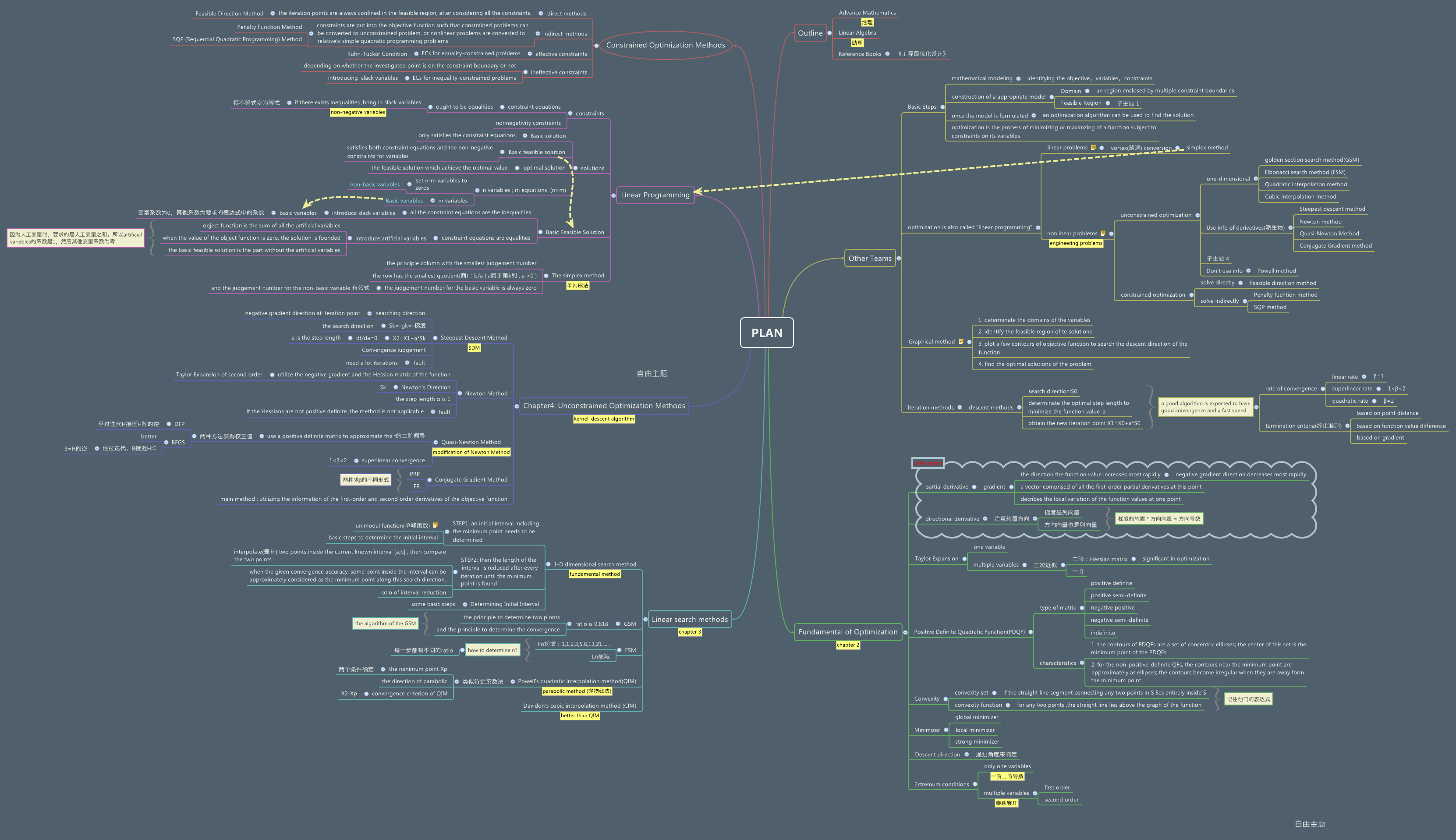
This optimization mind map template, titled 'PLAN', is designed for students and professionals in operations research, engineering, and applied mathematics. It covers 228 nodes across 8 major branches, including 'Fundamental of Optimization', 'Linear search methods', 'Chapter4: Unconstrained Optimization Methods', and 'Constrained Optimization Methods'. The template systematically organizes core concepts such as 'partial derivative', 'Taylor Expansion', 'Convexity', and 'The simplex method', providing a comprehensive cheat sheet for optimization theory and algorithms. It also includes an 'Outline' branch referencing prerequisite mathematics like 'Advance Mathematics' and 'Linear Algebra', making it a structured study aid for exam preparation or course review.
Terms and ConditionsPreparing for a university exam in optimization or operations research
Reviewing key optimization algorithms before a job interview in data science or AI
Structuring a study plan for self-learning optimization theory
Download the .xmind file and open it to navigate through the eight major branches covering optimization fundamentals and algorithms.
Personalize the template by adding your own examples, color-coding key formulas, and inserting notes to highlight important theoretical concepts.
Use the node structure to test your knowledge recall before exporting the final mind map as a PDF or image for offline study.
The template covers 228 nodes organized into 8 branches: Outline, Other Teams, Fundamental of Optimization, Linear search methods, Chapter4: Unconstrained Optimization Methods, Linear Programming, Constrained Optimization Methods, and two free topics. It includes key concepts like partial derivatives, Taylor expansion, convexity, and various optimization algorithms.
Use the 'Outline' branch to review prerequisite math, then study each optimization method branch sequentially. The mind map's hierarchical structure helps you memorize relationships between concepts like 'Steepest Descent Method' and 'Newton Method'.
Yes, you can open the .xmind file in Xmind desktop or web, then add, delete, or reorganize nodes. Customize the template by adding your own examples or annotations to the existing branches.
Direct methods handle constraints explicitly (e.g., penalty methods), while indirect methods transform the problem into an unconstrained one (e.g., Lagrange multipliers). The template covers both under 'Constrained Optimization Methods'.
Yes, the 'Linear Programming' branch covers 'constraints', 'solutions', 'Basic Feasible Solution', and 'The simplex method', providing a concise overview of LP fundamentals.
Share your mind map templates with creators around the world and start earning from your work.

