




Medical students and residents preparing for Step 2 CK or pediatric boards
Reviewing primary immunodeficiencies before a pediatrics board exam
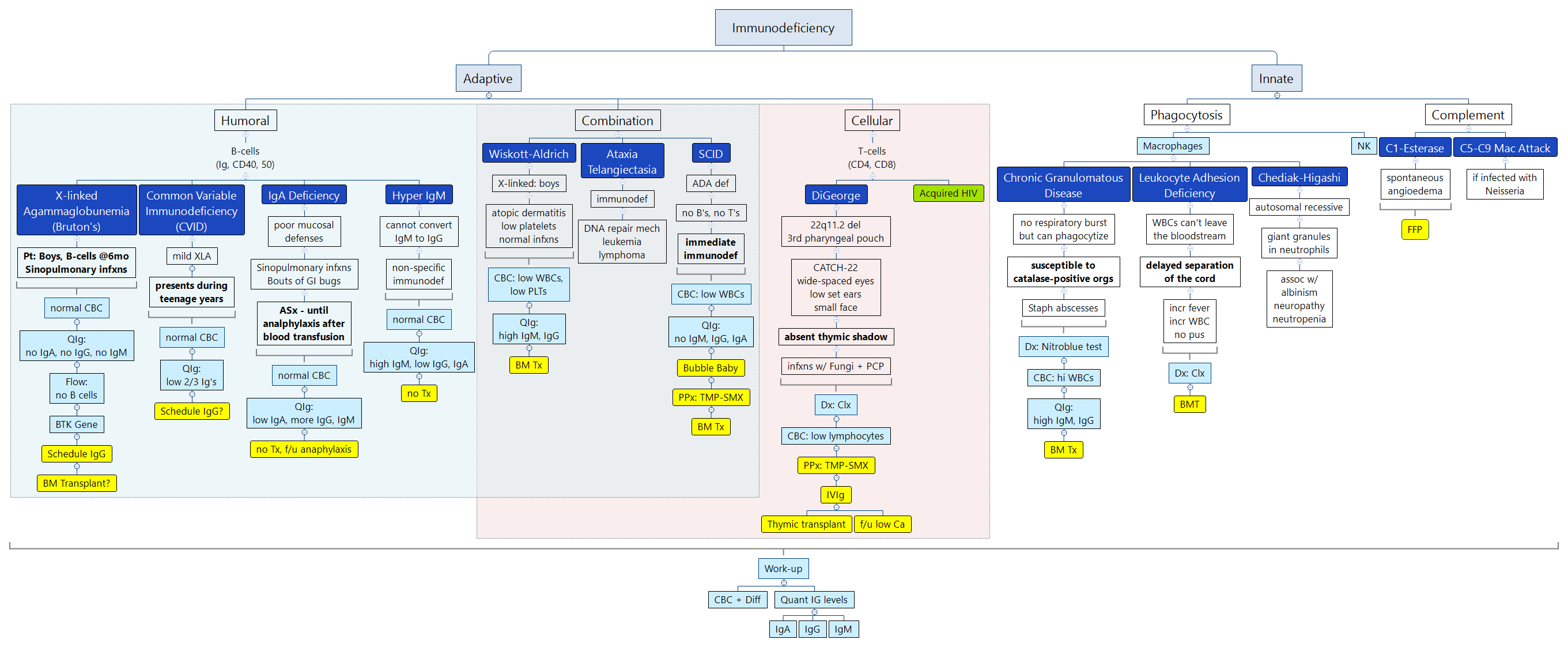
The Pediatric Immunodeficiency mind map template, based on OnlineMedEd for Step 2 CK prep, covers 98 nodes across three major branches: Adaptive, Innate, and Work-up. It systematically organizes primary immunodeficiencies by immune component, including Humoral (e.g., X-linked Agammaglobunemia, Common Variable Immunodeficiency), Cellular (e.g., DiGeorge, Acquired HIV), Combination (e.g., Wiskott-Aldrich, SCID), Phagocytosis (e.g., Chronic Granulomatous Disease, Chediak-Higashi), and Complement (e.g., C1-Esterase deficiency, C5-C9 Mac Attack). The Work-up section provides diagnostic steps such as CBC with Diff and Quantitative IG levels (IgA, IgG, IgM). This template serves as a concise cheat sheet for medical students and residents preparing for board exams or clinical rotations.
使用條款Reviewing primary immunodeficiencies before a pediatrics board exam
Creating a quick reference for diagnosing recurrent infections in clinic
Teaching medical students the classification of immune defects
Open the template in Xmind to navigate the three primary branches covering Adaptive, Innate, and Work-up classifications.
Select specific immunodeficiency nodes to add personal study notes, clinical icons, or additional sub-nodes for specific treatments.
Save your customized mind map as an image or PDF to use as a portable cheat sheet for Step 2 CK preparation.
The template covers 98 nodes organized into Adaptive, Innate, and Work-up branches. It includes specific immunodeficiencies like Bruton's agammaglobulinemia, CVID, DiGeorge, SCID, and complement deficiencies, plus diagnostic work-up steps.
Open the .xmind file in Xmind, then study each branch systematically. Use the Work-up section to review diagnostic approaches. Customize by adding your own notes or mnemonics to key nodes like Chronic Granulomatous Disease or Hyper IgM.
The template is available on Xmind's marketplace. Once downloaded, you can edit it freely in Xmind desktop or web—add, delete, or reorganize nodes to suit your study needs.
Focus on the Complement sub-branch under Innate. Note that C1-Esterase deficiency causes spontaneous angioedema treated with FFP, while C5-C9 defects increase Neisseria infections. Use color coding or icons to reinforce these associations.
Yes. The Work-up branch provides a framework (CBC, quantitative IGs). You can expand it with specific algorithms, add links to guidelines, or insert patient case examples for practical application.
把你的心智圖範本分享給全球創作者,從你的作品中獲得收益。

