




Music teachers and curriculum designers
Planning a music appreciation course curriculum
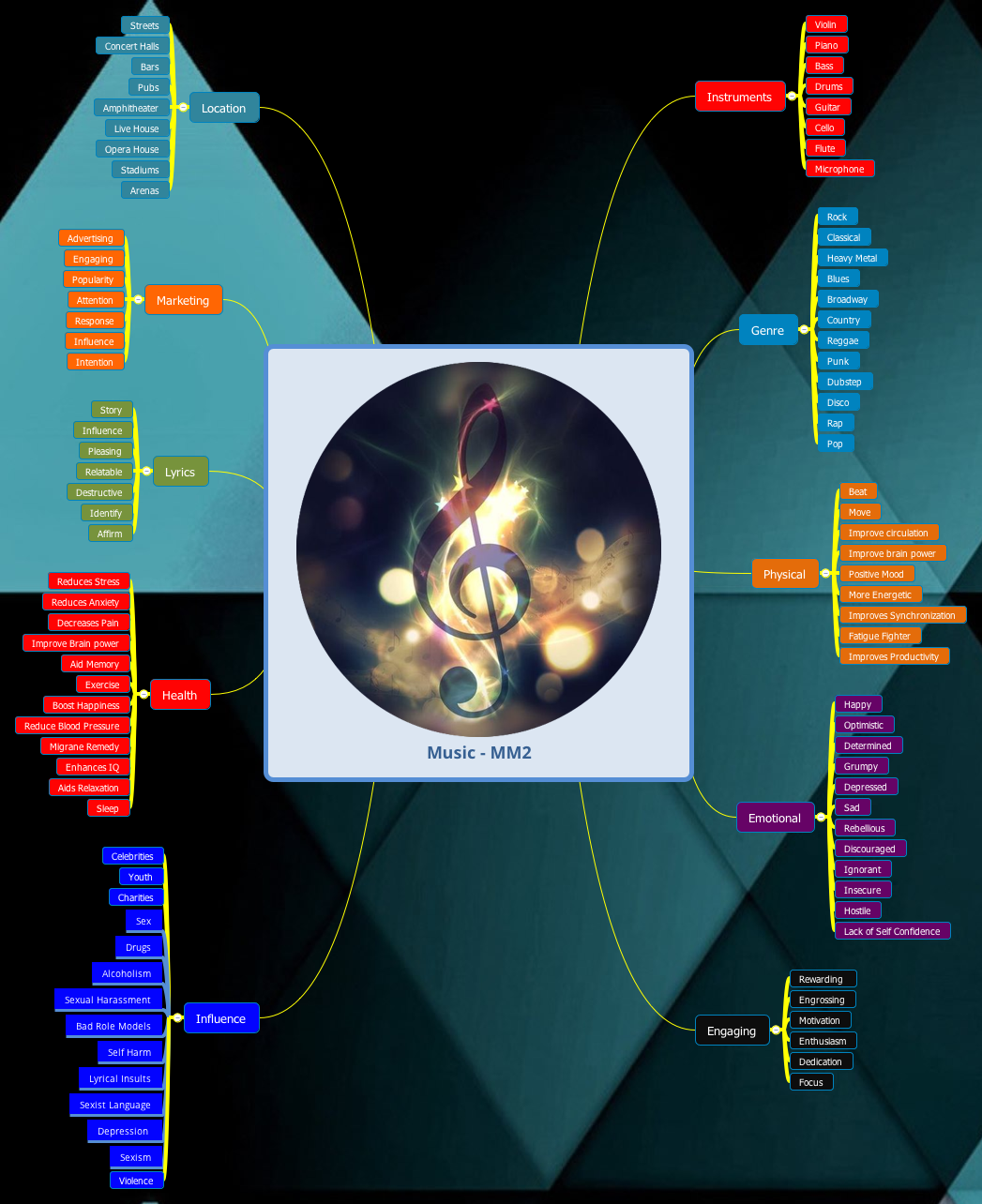
The Music - MM2 mind map template explores the multifaceted world of music across 107 nodes, covering instruments, genres, physical and emotional effects, social influence, health benefits, lyrical impact, marketing, and performance locations. This comprehensive cheat sheet includes specific nodes such as 'Violin', 'Piano', 'Rock', 'Classical', 'Reduces Stress', 'Improves Productivity', 'Celebrities', 'Violence', 'Advertising', and 'Concert Halls'. It serves as a structured reference for musicians, educators, and music enthusiasts to understand music's diverse dimensions. The template is organized into 10 major branches, each delving into a distinct aspect: Instruments lists common musical tools; Genre catalogs styles from 'Rock' to 'Pop'; Physical covers physiological responses like 'Beat' and 'Improve circulation'; Emotional maps feelings from 'Happy' to 'Lack of Self Confidence'; Engaging captures motivational states; Influence examines societal forces including 'Bad Role Models'; Health enumerates benefits like 'Aids Relaxation'; Lyrics explores narrative functions; Marketing addresses commercial angles; and Location lists venues from 'Streets' to 'Arenas'. This Xmind template is ideal for brainstorming, lesson planning, or personal exploration of music's impact.
Terms and ConditionsPlanning a music appreciation course curriculum
Analyzing the social impact of popular music on youth
Brainstorming marketing strategies for a music festival
Open the template in Xmind to navigate the ten major branches covering everything from musical instruments to health benefits.
Click specific nodes like Genre or Physical to add notes, reorganize branches, and customize colors to fit your musical research.
Save your completed music mind map as a high-quality image or PDF to share with fellow musicians and educators.
The template contains 107 nodes across 10 branches: Instruments, Genre, Physical, Emotional, Engaging, Influence, Health, Lyrics, Marketing, and Location. It covers specific instruments like 'Violin', genres like 'Classical', health benefits like 'Reduces Anxiety', and venues like 'Concert Halls'.
Teachers can use the 'Genre' branch to introduce music styles, the 'Emotional' branch to discuss how music affects mood, and the 'Influence' branch to explore social issues. It's a ready-made discussion framework for music education.
Yes, the Xmind template is fully editable. You can add, remove, or rearrange nodes. It can be exported as an image or PDF for printing, making it suitable for classroom handouts or personal study.
The 'Physical' branch lists effects like 'Beat', 'Move', 'Improve circulation', and 'Fatigue Fighter'. It helps users understand how music influences the body, useful for fitness instructors or health researchers.
Absolutely. You can expand the 'Influence' branch with additional nodes like 'Media' or 'Politics', or modify existing ones like 'Celebrities' and 'Self Harm' to fit a research paper or awareness campaign.
Share your mind map templates with creators around the world and start earning from your work.

