


'%3e%3cpath%20d='M26.7002%206.05468C26.7002%205.85186%2026.7636%205.68707%2026.8904%205.5603C27.0171%205.43354%2027.1788%205.37332%2027.3753%205.37966L27.9267%205.37966C28.1295%205.37966%2028.2911%205.43987%2028.4116%205.5603C28.532%205.68073%2028.5922%205.84869%2028.5922%206.06419L28.5827%2023.4206L27.8696%2025.8069C27.8506%2025.864%2027.8253%2025.9083%2027.7936%2025.94C27.7555%2025.9781%2027.7112%2025.9971%2027.6605%2025.9971C27.5844%2025.9971%2027.5242%2025.9749%2027.4798%2025.9305C27.4418%2025.8925%2027.4165%2025.8481%2027.4038%2025.7974L26.6907%2023.4301L26.7002%206.05468Z'%20fill='%23FF9334'/%3e%3cpath%20d='M18.8701%2012.6006C19.3331%2012.6006%2019.6787%2012.9599%2019.6787%2013.4092C19.6786%2013.8694%2019.3338%2014.2295%2018.8701%2014.2295H9.80762C9.33292%2014.2294%208.98744%2013.8702%208.9873%2013.4092C8.9873%2012.9591%209.33368%2012.6007%209.80762%2012.6006H18.8701ZM18.8701%208.44531C19.3313%208.44531%2019.6787%208.79114%2019.6787%209.24219C19.6785%209.70065%2019.3354%2010.0742%2018.8701%2010.0742H9.80762C9.33132%2010.0741%208.98752%209.70148%208.9873%209.24219C8.9873%208.79034%209.33542%208.44539%209.80762%208.44531H18.8701Z'%20fill='%23FF9334'/%3e%3cpath%20d='M14.0703%2016.7578C14.5315%2016.7578%2014.8789%2017.1036%2014.8789%2017.5547C14.8787%2018.0132%2014.5356%2018.3867%2014.0703%2018.3867H9.80762C9.33132%2018.3866%208.98752%2018.014%208.9873%2017.5547C8.9873%2017.1028%209.33542%2016.7579%209.80762%2016.7578H14.0703Z'%20fill='%23FF9334'/%3e%3crect%20x='5.8398'%20y='4.2402'%20width='17.12'%20height='21.92'%20rx='2.16'%20stroke='%23FF9334'%20stroke-width='2.08'/%3e%3c/g%3e%3cdefs%3e%3cclipPath%20id='clip0_11502_53292'%3e%3crect%20width='32'%20height='32'%20fill='white'/%3e%3c/clipPath%3e%3c/defs%3e%3c/svg%3e)

Database administrators and DevOps engineers
Tuning MongoDB performance for a new production deployment
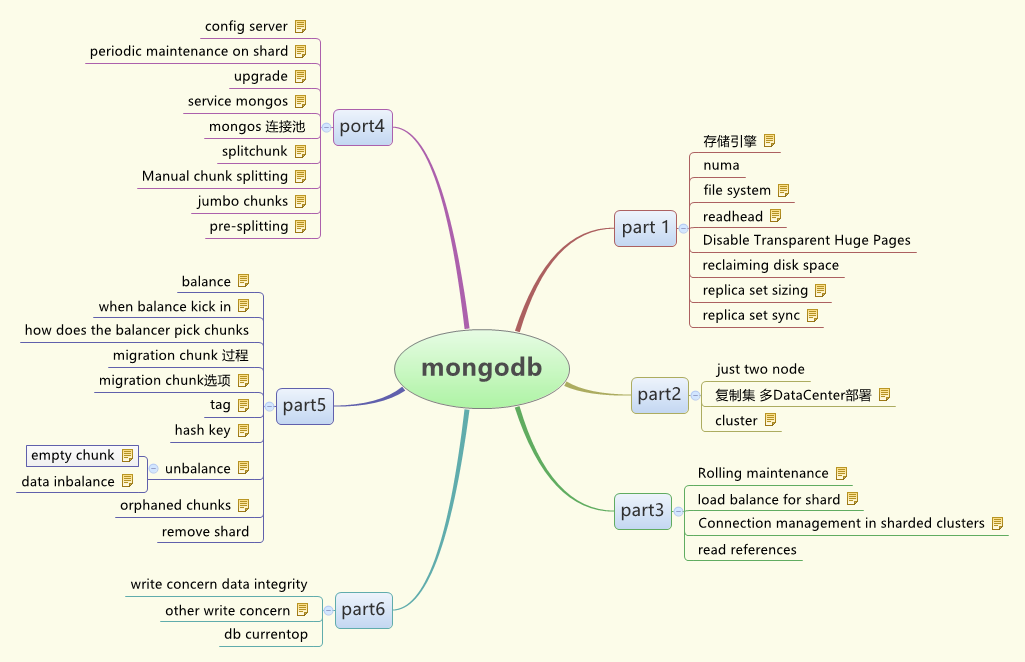
The MongoDB mind map template is a comprehensive reference for database administrators and DevOps engineers covering 46 nodes across 6 major categories: storage engine tuning, replica set management, sharded cluster operations, write concern configuration, balancer mechanics, and config server maintenance. Key topics include 'Disable Transparent Huge Pages', 'replica set sync', and 'migration chunk 过程'. This MongoDB cheat sheet organizes best practices for performance optimization, high availability, and scalability in production environments.
Terms and ConditionsTuning MongoDB performance for a new production deployment
Planning a sharded cluster migration or rebalancing
Reviewing replica set configuration for multi-data center resilience
Open the MongoDB template in Xmind to navigate through the six major categories covering storage tuning, replica sets, and sharded clusters.
Expand the 46 nodes to examine specific best practices for write concerns, balancer mechanics, and performance optimization settings like Transparent Huge Pages.
Add your own environment-specific parameters to the map before exporting it as a PDF or image to share with your DevOps team.
The template includes 46 nodes across 6 parts covering storage engines, replica sets, sharded clusters, write concerns, balancer operations, and config server maintenance.
Navigate to the 'part 1' branch and review the 'replica set sizing' and 'replica set sync' nodes. Use them as a checklist when planning replica set configurations.
Yes, you can open the .xmind file in Xmind and customize any node, add notes, or attach resources to fit your specific environment.
The 'balancer' section explains when the balancer kicks in, how it picks chunks, the chunk migration process, and how to handle unbalanced data using tags and hash keys.
Yes, the 'write concern data integrity' and 'other write concern' nodes provide a framework you can adapt to your application's consistency requirements.
Share your mind map templates with creators around the world and start earning from your work.

