




Business analysts and product owners
Kicking off a new software project to capture initial stakeholder needs and system context.
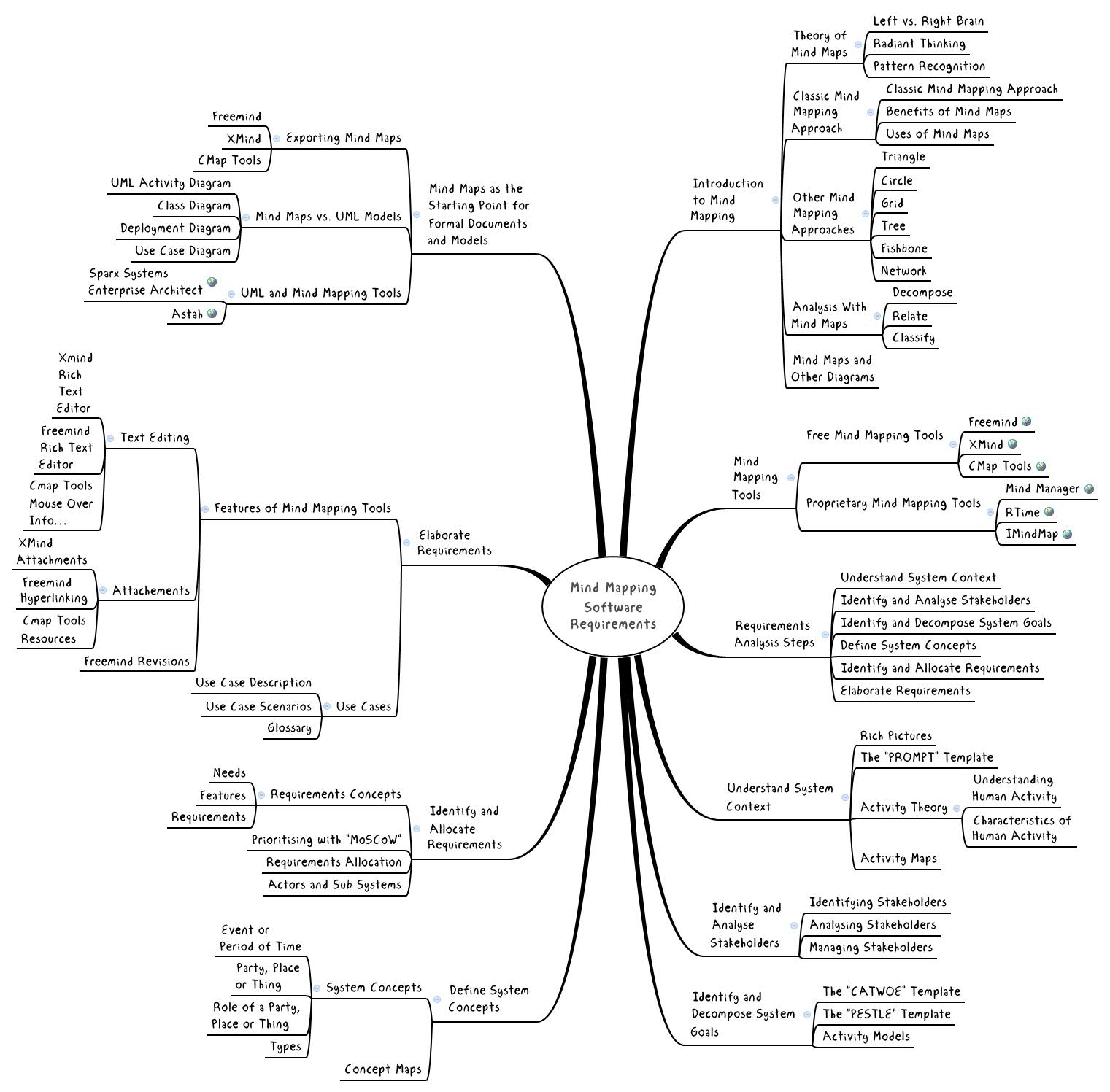
The Mind Mapping Software Requirements template is a comprehensive 96-node mind map designed for business analysts, requirements engineers, and software teams to capture, analyze, and document system requirements using mind mapping techniques. It covers the full requirements lifecycle, from understanding system context with 'Rich Pictures' and 'Activity Theory' to elaborating requirements with 'Use Cases' and 'MoSCoW' prioritization. The template also compares mind mapping tools like XMind and Freemind, and shows how to export maps to formal documents and UML models. This mind map template serves as both a learning resource and a practical cheat sheet for applying mind maps in traditional and Agile environments.
利用規約Kicking off a new software project to capture initial stakeholder needs and system context.
Conducting a requirements workshop to decompose high-level goals into actionable features.
Preparing to transition mind maps into formal UML diagrams or requirements documents.
Open the .xmind file to explore the 96-node structure covering requirements analysis steps and system context models.
Edit the nodes to include your specific stakeholder lists and use the MoSCoW branch to categorize your project priorities.
Convert your completed mind map into a PDF, image, or UML model to share your requirements with the development team.
The template includes 96 nodes covering mind mapping theory, tools (XMind, Freemind), requirements analysis steps, stakeholder analysis, goal decomposition with CATWOE, concept definition, requirements allocation with MoSCoW, and export to UML models.
Start by exploring the 'Understand System Context' branch to create Rich Pictures and Activity Maps. Then follow the steps: identify stakeholders, decompose goals using CATWOE, define concepts, and allocate requirements with MoSCoW prioritization.
Yes, the .xmind file is fully editable in Xmind desktop or web. You can customize nodes, add attachments, and export to PDF or image formats for printing.
Absolutely. The template covers both traditional and Agile approaches, with techniques like MoSCoW for prioritization and use case scenarios that fit iterative development.
The template compares free tools (Freemind, XMind, CMap Tools) and proprietary ones (Mind Manager, RTime, iMindMap), highlighting features like text editing, attachments, and revisions.
あなたのマインドマップ テンプレートを世界中のクリエイターと共有して、作品から収入を得ましょう。

