




Backend developers and API architects
Designing a new REST API from scratch for a microservices project
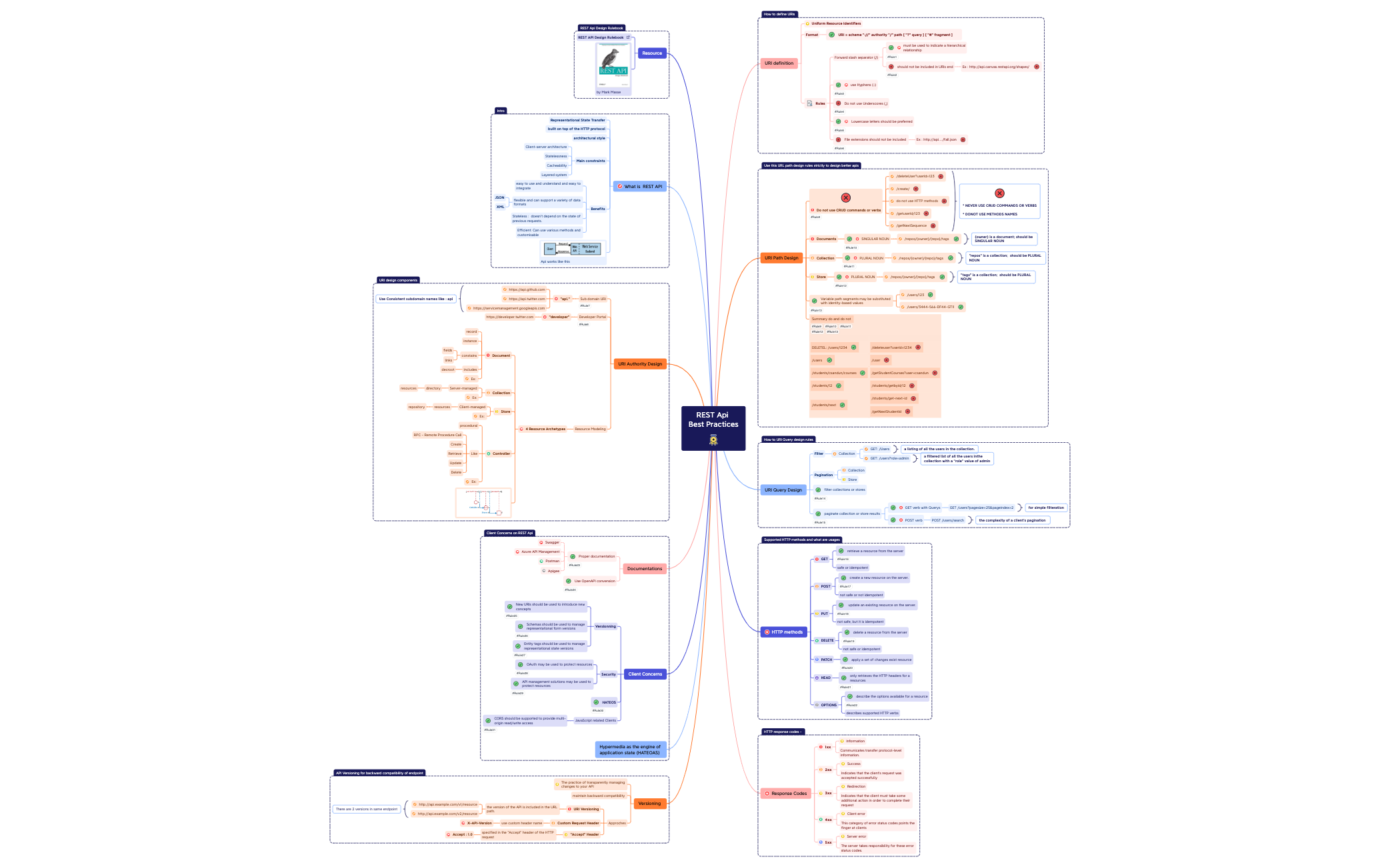
The REST API Best Practices mind map template provides a comprehensive 199-node breakdown of designing and implementing RESTful APIs, covering URI definition, HTTP methods, response codes, versioning, HATEOAS, and client concerns. Based on Mark Masse's 'REST API Design Rulebook', this template serves as a cheat sheet for developers and architects. Key nodes include 'URI = scheme "://" authority "/" path [ "?" query ] [ "#" fragment ]' and '4 Resource Archetypes: Document, Collection, Store, Controller'. It offers actionable rules like using forward slashes for hierarchy, avoiding underscores, and never including CRUD commands in URIs. This REST API best practices template is ideal for designing scalable, maintainable APIs.
Terms and ConditionsDesigning a new REST API from scratch for a microservices project
Reviewing an existing API for compliance with REST best practices
Preparing for an API design interview or certification exam
Launch the template in Xmind to navigate the 199-node breakdown of RESTful API design rules and resource archetypes.
Replace the example URIs with your own endpoints and adjust the subtopics to fit your project's specific architectural needs.
Save your finalized API design as a PDF or PNG file to share these best practices with your development team.
It covers URI definition, path and query design, HTTP methods, response codes, versioning, HATEOAS, client concerns, documentation, and resource modeling with 199 nodes.
Open the .xmind file in Xmind, then follow the branches: start with URI definition rules, choose appropriate HTTP methods, plan response codes, and apply versioning strategies.
Yes, the template is fully editable in Xmind desktop or web. You can customize nodes, add your own examples, and export as PDF or image for printing.
The template lists client-server architecture, statelessness, cacheability, and layered system as the main constraints of REST.
Absolutely. Replace placeholder URIs like '/users/123' with your own endpoints. The template provides structural guidance you can adapt.
It suggests Swagger, Azure API Management, Postman, and Apigee, and recommends using the OpenAPI convention.
Share your mind map templates with creators around the world and start earning from your work.

