


'%3e%3cpath%20d='M26.7002%206.05468C26.7002%205.85186%2026.7636%205.68707%2026.8904%205.5603C27.0171%205.43354%2027.1788%205.37332%2027.3753%205.37966L27.9267%205.37966C28.1295%205.37966%2028.2911%205.43987%2028.4116%205.5603C28.532%205.68073%2028.5922%205.84869%2028.5922%206.06419L28.5827%2023.4206L27.8696%2025.8069C27.8506%2025.864%2027.8253%2025.9083%2027.7936%2025.94C27.7555%2025.9781%2027.7112%2025.9971%2027.6605%2025.9971C27.5844%2025.9971%2027.5242%2025.9749%2027.4798%2025.9305C27.4418%2025.8925%2027.4165%2025.8481%2027.4038%2025.7974L26.6907%2023.4301L26.7002%206.05468Z'%20fill='%23FF9334'/%3e%3cpath%20d='M18.8701%2012.6006C19.3331%2012.6006%2019.6787%2012.9599%2019.6787%2013.4092C19.6786%2013.8694%2019.3338%2014.2295%2018.8701%2014.2295H9.80762C9.33292%2014.2294%208.98744%2013.8702%208.9873%2013.4092C8.9873%2012.9591%209.33368%2012.6007%209.80762%2012.6006H18.8701ZM18.8701%208.44531C19.3313%208.44531%2019.6787%208.79114%2019.6787%209.24219C19.6785%209.70065%2019.3354%2010.0742%2018.8701%2010.0742H9.80762C9.33132%2010.0741%208.98752%209.70148%208.9873%209.24219C8.9873%208.79034%209.33542%208.44539%209.80762%208.44531H18.8701Z'%20fill='%23FF9334'/%3e%3cpath%20d='M14.0703%2016.7578C14.5315%2016.7578%2014.8789%2017.1036%2014.8789%2017.5547C14.8787%2018.0132%2014.5356%2018.3867%2014.0703%2018.3867H9.80762C9.33132%2018.3866%208.98752%2018.014%208.9873%2017.5547C8.9873%2017.1028%209.33542%2016.7579%209.80762%2016.7578H14.0703Z'%20fill='%23FF9334'/%3e%3crect%20x='5.8398'%20y='4.2402'%20width='17.12'%20height='21.92'%20rx='2.16'%20stroke='%23FF9334'%20stroke-width='2.08'/%3e%3c/g%3e%3cdefs%3e%3cclipPath%20id='clip0_11502_53292'%3e%3crect%20width='32'%20height='32'%20fill='white'/%3e%3c/clipPath%3e%3c/defs%3e%3c/svg%3e)

Undergraduate linguistics students
Preparing for an introductory linguistics exam that requires memorizing key terms and definitions.
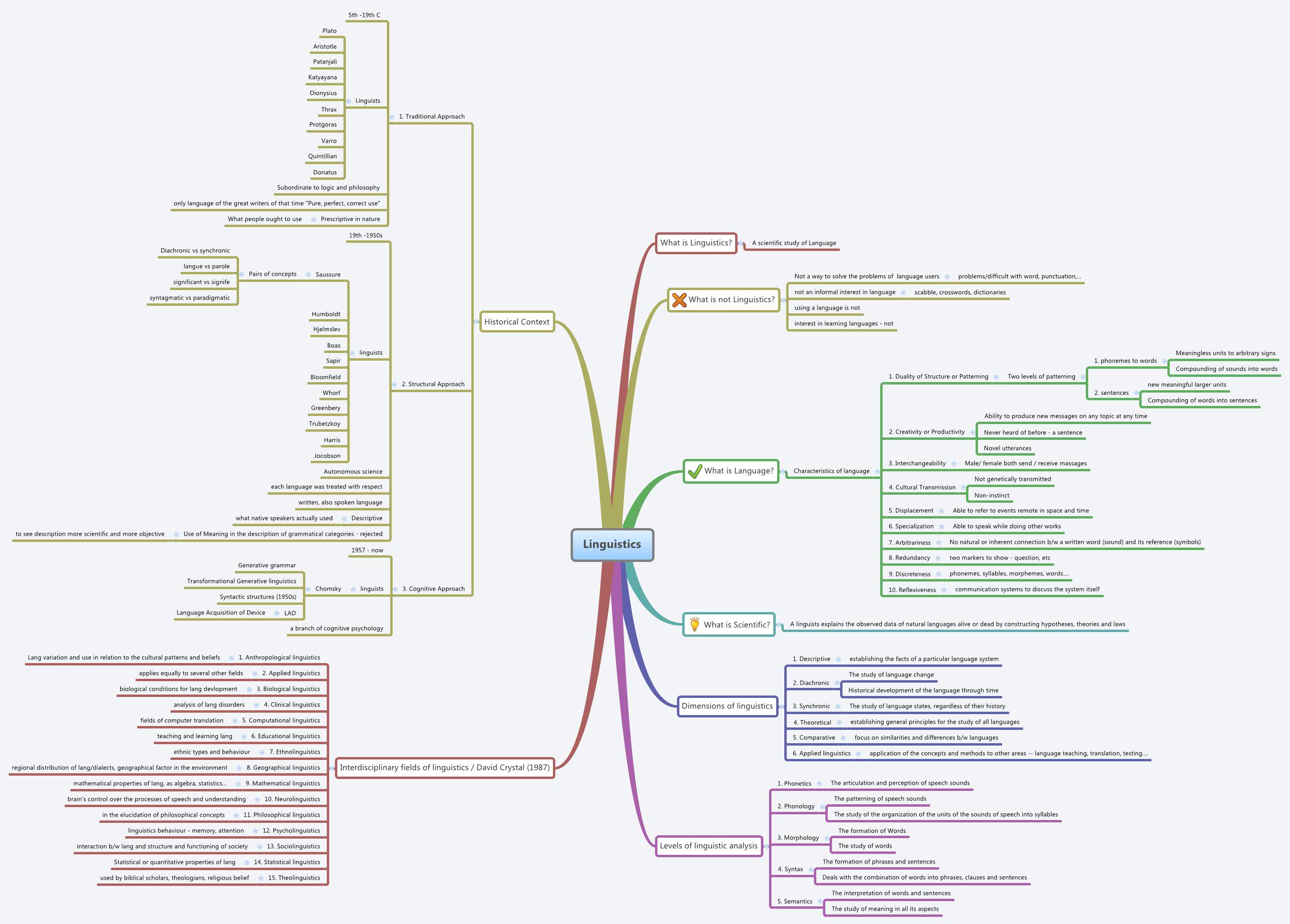
The Linguistics mind map template offers a comprehensive 157-node overview of the scientific study of language, covering core definitions, key characteristics, analytical levels, and interdisciplinary connections. It opens by distinguishing linguistics from informal language interest or problem-solving, then explores ten defining characteristics of language such as 'Duality of Structure or Patterning' and 'Arbitrariness'. The template systematically presents six dimensions of linguistics (Descriptive, Diachronic, Synchronic, Theoretical, Comparative, Applied), five levels of linguistic analysis from Phonetics to Semantics, and fifteen interdisciplinary fields including 'Computational linguistics' and 'Neurolinguistics'. A historical context section traces the evolution from Traditional (5th–19th C) through Structural (19th–1950s) to Cognitive (1957–now) approaches, naming key linguists like Saussure and Chomsky. This Linguistics mind map serves as both a study reference and a teaching aid, making it a valuable Linguistics template for students and educators. Its structured layout—organized by major branches—allows quick navigation through complex topics, functioning as a Linguistics cheat sheet for exam prep or curriculum design.
Điều khoản sử dụngPreparing for an introductory linguistics exam that requires memorizing key terms and definitions.
Designing a syllabus for a first-year linguistics course and needing a structured overview of topics.
Writing a research paper on language universals and needing a quick reference to interdisciplinary fields like 'Psycholinguistics' and 'Neurolinguistics'.
Open the .xmind file in your preferred Xmind app and expand the main branches to explore the foundational levels of linguistic analysis.
Personalize the template by adding your own research notes, specific language examples, or color-coding the interdisciplinary fields for better clarity.
Save your progress and export the completed linguistics map as a PDF, image, or outline to share with your study group or colleagues.
The template covers 157 nodes across branches: What is Linguistics, What is not Linguistics, What is Language (10 characteristics), What is Scientific, Dimensions of linguistics, Levels of linguistic analysis, Interdisciplinary fields (15 areas), and Historical Context (three approaches with key linguists).
Open the .xmind file in Xmind, then explore each branch to review core concepts. You can add notes, color-code topics, or collapse branches to quiz yourself on terms like 'Duality of Structure' or 'Synchronic linguistics'.
Yes, the template is fully editable in Xmind (desktop, web, or mobile). You can modify text, add subtopics, or export as PDF or image for printing as a study reference.
The template details Phonetics (speech sounds), Phonology (sound patterning), Morphology (word formation), Syntax (phrase/sentence formation), and Semantics (meaning interpretation).
Yes, the 'Historical Context' branch covers Traditional (Plato, Aristotle, etc.), Structural (Saussure, Sapir, Bloomfield), and Cognitive (Chomsky) approaches, with prescriptive vs. descriptive distinctions.
Chia sẻ mẫu sơ đồ tư duy của bạn với người sáng tạo trên khắp thế giới và bắt đầu kiếm tiền từ tác phẩm của mình.

