


'%3e%3cpath%20d='M15.9996%208.0002C17.3251%208.0002%2018.3996%206.92568%2018.3996%205.6002C18.3996%204.27471%2017.3251%203.2002%2015.9996%203.2002C14.6741%203.2002%2013.5996%204.27471%2013.5996%205.6002C13.5996%206.92568%2014.6741%208.0002%2015.9996%208.0002Z'%20stroke='%23FF9334'%20stroke-width='1.92'/%3e%3cpath%20d='M16%208V26.3999'%20stroke='%23FF9334'%20stroke-width='1.92'%20stroke-linecap='round'/%3e%3cpath%20d='M4.7998%2011.2002H27.1998'%20stroke='%23FF9334'%20stroke-width='1.92'%20stroke-linecap='round'/%3e%3cpath%20d='M6.3998%2011.2002L4.7998%2017.6002H11.1998L9.5998%2011.2002L6.3998%2011.2002Z'%20stroke='%23FF9334'%20stroke-width='1.92'%20stroke-linejoin='round'/%3e%3cpath%20d='M22.3998%2011.2002L20.7998%2017.6002H27.1998L25.5998%2011.2002L22.3998%2011.2002Z'%20stroke='%23FF9334'%20stroke-width='1.92'%20stroke-linejoin='round'/%3e%3cpath%20d='M11.2002%2027.2002H20.8002'%20stroke='%23FF9334'%20stroke-width='2.4'%20stroke-linecap='round'/%3e%3c/g%3e%3cdefs%3e%3cclipPath%20id='clip0_11502_53340'%3e%3crect%20width='32'%20height='32'%20fill='white'/%3e%3c/clipPath%3e%3c/defs%3e%3c/svg%3e)

Law students and legal researchers
Preparing a legal case study for a law school assignment on intellectual property
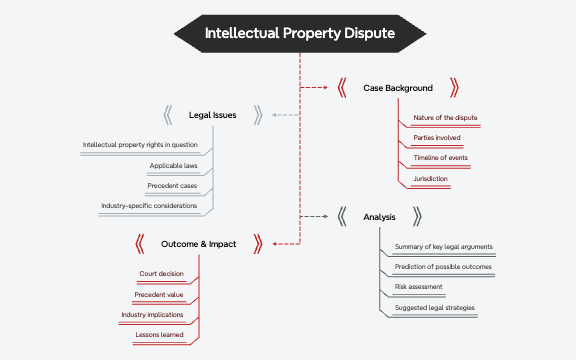
The Intellectual Property Dispute mind map template provides a structured framework for analyzing IP litigation, covering 4 core branches and 16 sub-nodes. It guides legal professionals through Case Background (including 'Nature of the dispute' and 'Jurisdiction'), Legal Issues (such as 'Intellectual property rights in question' and 'Precedent cases'), Analysis (with 'Risk assessment' and 'Suggested legal strategies'), and Outcome & Impact (featuring 'Court decision' and 'Industry implications'). This template is ideal for law students, attorneys, and corporate counsel preparing case studies or litigation strategies.
Conditions d'utilisationPreparing a legal case study for a law school assignment on intellectual property
Analyzing a real or hypothetical IP dispute during litigation strategy meetings
Conducting a post-case review to document lessons learned and industry impact
Open the template in Xmind to familiarize yourself with the four main branches covering Case Background, Legal Issues, Analysis, and Outcome.
Replace placeholder text in the 16 sub-nodes with your specific litigation data and add new child nodes to detail relevant precedent cases or strategies.
Save your completed intellectual property analysis and export the map as a PDF or image to share with your legal team or clients.
The template includes 4 main branches: Case Background, Legal Issues, Analysis, and Outcome & Impact, with 16 detailed sub-nodes covering parties, jurisdiction, applicable laws, risk assessment, and court decisions.
Start by filling in Case Background (nature of dispute, parties, timeline, jurisdiction). Then list relevant Legal Issues (IP rights, laws, precedents). Use the Analysis branch to evaluate arguments and risks, and finally document the Outcome & Impact.
Yes, the .xmind file is fully editable in Xmind desktop or web. You can add, remove, or rearrange nodes, and export to PDF or image for printing.
Absolutely. The 'Risk assessment' sub-node is a placeholder; you can expand it with your own criteria, probabilities, or mitigation strategies directly in Xmind.
Use it to outline a mock IP dispute: fill in a hypothetical scenario under Case Background, identify legal issues, practice argument analysis, and predict outcomes. The structured format helps memorize key elements.
Partagez vos modèles de cartes mentales avec des créateurs du monde entier et commencez à gagner avec votre travail.

