


'%3e%3cpath%20d='M26.7002%206.05468C26.7002%205.85186%2026.7636%205.68707%2026.8904%205.5603C27.0171%205.43354%2027.1788%205.37332%2027.3753%205.37966L27.9267%205.37966C28.1295%205.37966%2028.2911%205.43987%2028.4116%205.5603C28.532%205.68073%2028.5922%205.84869%2028.5922%206.06419L28.5827%2023.4206L27.8696%2025.8069C27.8506%2025.864%2027.8253%2025.9083%2027.7936%2025.94C27.7555%2025.9781%2027.7112%2025.9971%2027.6605%2025.9971C27.5844%2025.9971%2027.5242%2025.9749%2027.4798%2025.9305C27.4418%2025.8925%2027.4165%2025.8481%2027.4038%2025.7974L26.6907%2023.4301L26.7002%206.05468Z'%20fill='%23FF9334'/%3e%3cpath%20d='M18.8701%2012.6006C19.3331%2012.6006%2019.6787%2012.9599%2019.6787%2013.4092C19.6786%2013.8694%2019.3338%2014.2295%2018.8701%2014.2295H9.80762C9.33292%2014.2294%208.98744%2013.8702%208.9873%2013.4092C8.9873%2012.9591%209.33368%2012.6007%209.80762%2012.6006H18.8701ZM18.8701%208.44531C19.3313%208.44531%2019.6787%208.79114%2019.6787%209.24219C19.6785%209.70065%2019.3354%2010.0742%2018.8701%2010.0742H9.80762C9.33132%2010.0741%208.98752%209.70148%208.9873%209.24219C8.9873%208.79034%209.33542%208.44539%209.80762%208.44531H18.8701Z'%20fill='%23FF9334'/%3e%3cpath%20d='M14.0703%2016.7578C14.5315%2016.7578%2014.8789%2017.1036%2014.8789%2017.5547C14.8787%2018.0132%2014.5356%2018.3867%2014.0703%2018.3867H9.80762C9.33132%2018.3866%208.98752%2018.014%208.9873%2017.5547C8.9873%2017.1028%209.33542%2016.7579%209.80762%2016.7578H14.0703Z'%20fill='%23FF9334'/%3e%3crect%20x='5.8398'%20y='4.2402'%20width='17.12'%20height='21.92'%20rx='2.16'%20stroke='%23FF9334'%20stroke-width='2.08'/%3e%3c/g%3e%3cdefs%3e%3cclipPath%20id='clip0_11502_53292'%3e%3crect%20width='32'%20height='32'%20fill='white'/%3e%3c/clipPath%3e%3c/defs%3e%3c/svg%3e)

Teachers and curriculum designers
Designing a differentiated lesson plan that caters to diverse learning preferences in a classroom.
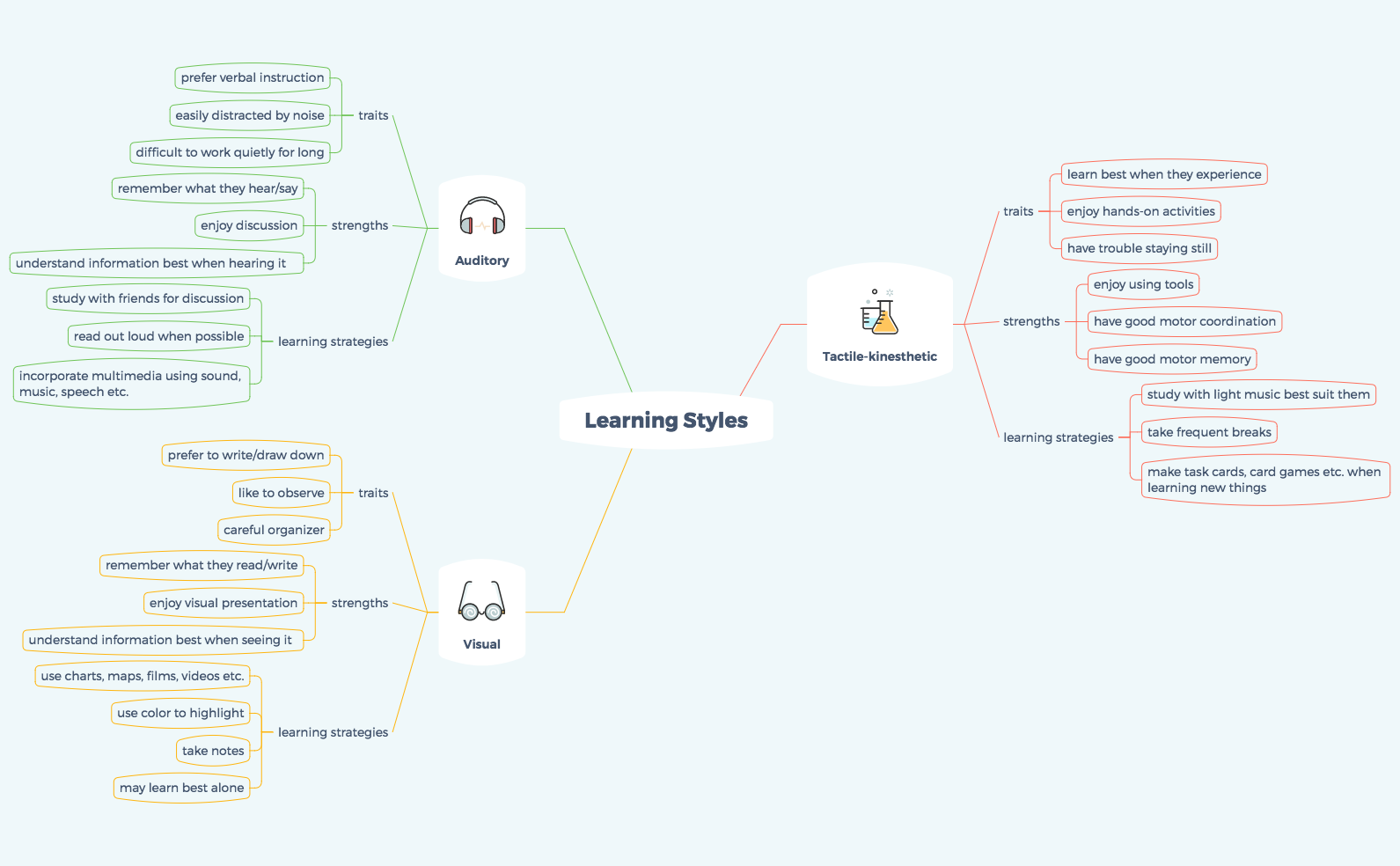
The Learning Styles mind map template helps educators, students, and trainers identify and leverage three primary learning modalities: Tactile-kinesthetic, Visual, and Auditory. With 41 nodes organized into traits, strengths, and learning strategies for each style, this template provides a structured overview of how different learners absorb and process information. Key nodes include 'learn best when they experience' for tactile-kinesthetic learners, 'use charts, maps, films, videos etc.' for visual learners, and 'study with friends for discussion' for auditory learners. This Xmind template serves as a practical cheat sheet for tailoring instruction and study techniques to individual preferences.
Terms and ConditionsDesigning a differentiated lesson plan that caters to diverse learning preferences in a classroom.
Conducting a workshop on study skills where participants identify their dominant learning style and adopt tailored techniques.
Creating personalized training materials for corporate employees to enhance knowledge retention.
Launch the .xmind file to review the three primary branches covering Tactile-kinesthetic, Visual, and Auditory learning modalities.
Expand the 41 nodes to explore specific traits and strategies, then add your own notes or icons to personalize the template.
Save your customized mind map as an image or PDF to share these instructional strategies with students or colleagues.
The template covers three main learning styles: Tactile-kinesthetic, Visual, and Auditory. For each style, it details traits, strengths, and learning strategies, totaling 41 nodes.
Use the template to assess your students' preferred learning styles and adapt your lessons accordingly. For example, incorporate hands-on activities for tactile-kinesthetic learners, visual aids for visual learners, and group discussions for auditory learners.
Yes, the template is fully editable. You can add, remove, or modify nodes to suit your specific context, such as adding new strategies or customizing the layout.
Absolutely. Identify your own learning style by reviewing the traits and strengths, then apply the recommended strategies like 'take frequent breaks' or 'study with light music' to improve your study efficiency.
Share your mind map templates with creators around the world and start earning from your work.

