




Product development teams and innovation managers
When a team struggles to balance delivering current features (exploitation) with exploring new ideas (exploration).
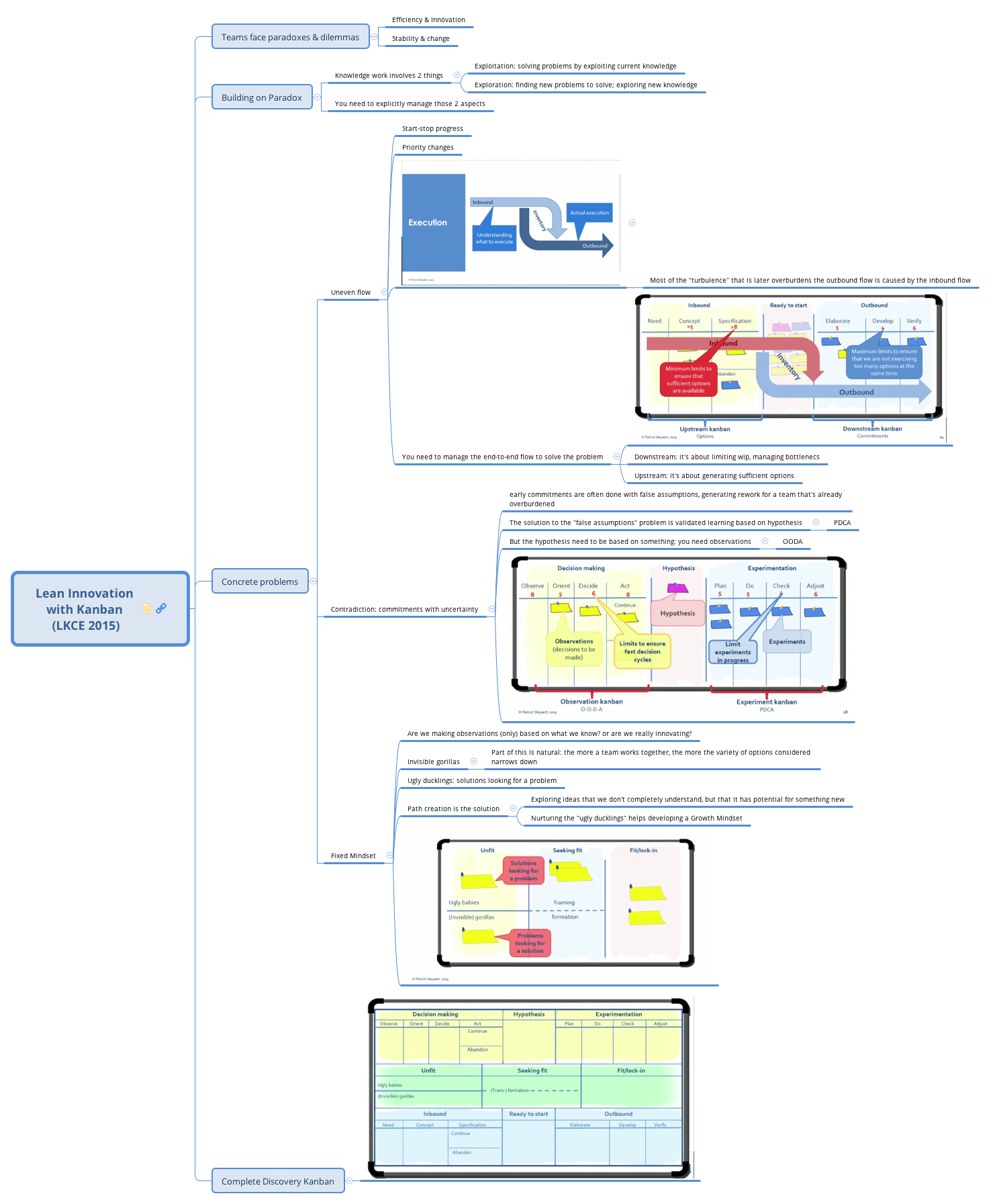
The Lean Innovation with Kanban (LKCE 2015) mind map template, presented at the Lean Kanban Central Europe conference, explores how teams can balance efficiency and innovation using Kanban principles. With 37 nodes across a single sheet, it covers paradoxes like 'Efficiency & Innovation' and 'Stability & change', concrete problems such as 'Uneven flow' and 'Contradiction: commitments with uncertainty', and introduces the 'Complete Discovery Kanban' framework. Key concepts include 'Exploitation' vs 'Exploration', 'PDCA' and 'OODA' loops, and 'Path creation' for nurturing 'ugly ducklings'. This Lean Innovation with Kanban template serves as a cheat sheet for applying discovery kanban in knowledge work.
使用條款When a team struggles to balance delivering current features (exploitation) with exploring new ideas (exploration).
During a retrospective or process improvement session to identify and address uneven flow and bottlenecks.
When launching a discovery initiative to validate hypotheses and reduce uncertainty before committing to a full project.
Open the template in Xmind to explore the pre-defined branches covering efficiency, innovation, and common team dilemmas.
Replace the example problems with your team's specific issues and customize the Complete Discovery Kanban section to match your unique workflow.
Apply the PDCA and OODA loops to your strategy before exporting the map to collaborate with your team on action planning.
It's a template based on the LKCE 2015 talk, covering how teams can use Kanban to balance efficiency and innovation. It includes paradoxes, concrete problems like uneven flow, and the Complete Discovery Kanban framework.
It suggests using validated learning based on hypotheses (PDCA) and observations (OODA) to avoid false assumptions and reduce rework, helping teams commit with more confidence.
Path creation is the solution to fixed mindset, encouraging teams to explore ideas they don't fully understand ('ugly ducklings') to nurture a growth mindset and foster innovation.
Yes, you can edit the .xmind file in Xmind desktop or web, adding your own team's paradoxes, problems, and discovery kanban steps to tailor it to your context.
Yes, it's designed for knowledge work teams facing efficiency-innovation tensions, making it ideal for agile teams, product development, and innovation labs.
把你的心智圖範本分享給全球創作者,從你的作品中獲得收益。

