




University administrators and department heads
Faculty meeting debating a new camera policy for online courses
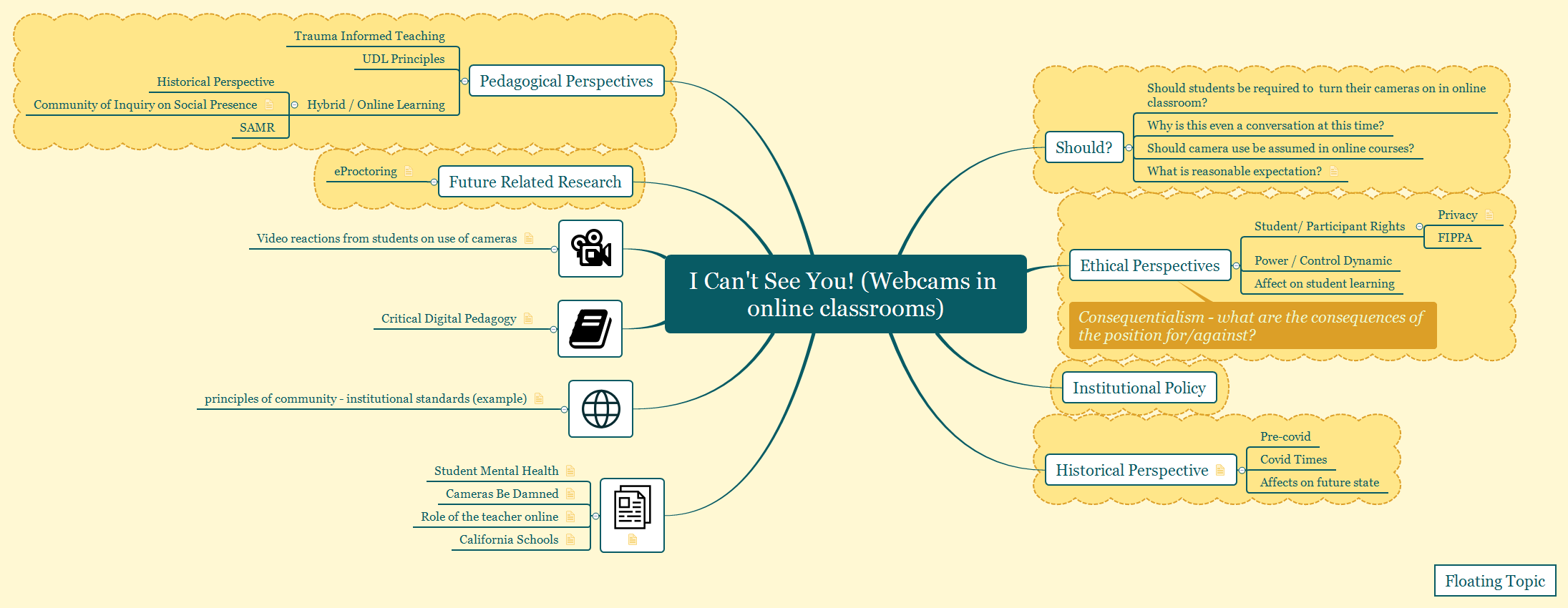
The 'I Can't See You! (Webcams in online classrooms)' mind map template explores the complex debate around requiring webcams in online education. It covers 39 nodes across 8 branches, including ethical, pedagogical, and institutional perspectives. Key nodes like 'Trauma Informed Teaching', 'UDL Principles', and 'Community of Inquiry on Social Presence' provide frameworks for understanding the issue. This template serves as a discussion guide for educators, administrators, and students navigating camera policies in virtual classrooms.
使用条款Faculty meeting debating a new camera policy for online courses
Designing an online course syllabus that addresses camera expectations
Student advocacy group preparing arguments for privacy rights in virtual classrooms
Launch the .xmind file to review the eight branches covering ethical and pedagogical perspectives on webcam usage.
Add your own notes to key nodes like UDL Principles while customizing colors and icons to highlight your specific priorities.
Save your finalized discussion guide as a PDF or image to facilitate policy conversations with educators and students.
It's a discussion framework for exploring the debate over requiring webcams in online classrooms, covering ethical, pedagogical, and institutional angles.
It covers student privacy rights (FIPPA), power/control dynamics, effects on learning, and consequentialist arguments for and against camera requirements.
It includes trauma-informed teaching, Universal Design for Learning (UDL) principles, and the Community of Inquiry model focusing on social presence.
Yes, the 'Institutional Policy' branch provides a starting point for drafting guidelines, while other branches offer supporting arguments and research.
Absolutely. You can add, remove, or edit nodes, attach notes and links, and reorganize branches to fit your specific context.
把你的思维导图模板分享给全球创作者,从你的作品中获得收益。

