


'%3e%3cpath%20d='M26.7002%206.05468C26.7002%205.85186%2026.7636%205.68707%2026.8904%205.5603C27.0171%205.43354%2027.1788%205.37332%2027.3753%205.37966L27.9267%205.37966C28.1295%205.37966%2028.2911%205.43987%2028.4116%205.5603C28.532%205.68073%2028.5922%205.84869%2028.5922%206.06419L28.5827%2023.4206L27.8696%2025.8069C27.8506%2025.864%2027.8253%2025.9083%2027.7936%2025.94C27.7555%2025.9781%2027.7112%2025.9971%2027.6605%2025.9971C27.5844%2025.9971%2027.5242%2025.9749%2027.4798%2025.9305C27.4418%2025.8925%2027.4165%2025.8481%2027.4038%2025.7974L26.6907%2023.4301L26.7002%206.05468Z'%20fill='%23FF9334'/%3e%3cpath%20d='M18.8701%2012.6006C19.3331%2012.6006%2019.6787%2012.9599%2019.6787%2013.4092C19.6786%2013.8694%2019.3338%2014.2295%2018.8701%2014.2295H9.80762C9.33292%2014.2294%208.98744%2013.8702%208.9873%2013.4092C8.9873%2012.9591%209.33368%2012.6007%209.80762%2012.6006H18.8701ZM18.8701%208.44531C19.3313%208.44531%2019.6787%208.79114%2019.6787%209.24219C19.6785%209.70065%2019.3354%2010.0742%2018.8701%2010.0742H9.80762C9.33132%2010.0741%208.98752%209.70148%208.9873%209.24219C8.9873%208.79034%209.33542%208.44539%209.80762%208.44531H18.8701Z'%20fill='%23FF9334'/%3e%3cpath%20d='M14.0703%2016.7578C14.5315%2016.7578%2014.8789%2017.1036%2014.8789%2017.5547C14.8787%2018.0132%2014.5356%2018.3867%2014.0703%2018.3867H9.80762C9.33132%2018.3866%208.98752%2018.014%208.9873%2017.5547C8.9873%2017.1028%209.33542%2016.7579%209.80762%2016.7578H14.0703Z'%20fill='%23FF9334'/%3e%3crect%20x='5.8398'%20y='4.2402'%20width='17.12'%20height='21.92'%20rx='2.16'%20stroke='%23FF9334'%20stroke-width='2.08'/%3e%3c/g%3e%3cdefs%3e%3cclipPath%20id='clip0_11502_53292'%3e%3crect%20width='32'%20height='32'%20fill='white'/%3e%3c/clipPath%3e%3c/defs%3e%3c/svg%3e)

Training managers and HR professionals
Designing a customer service training curriculum for new hires
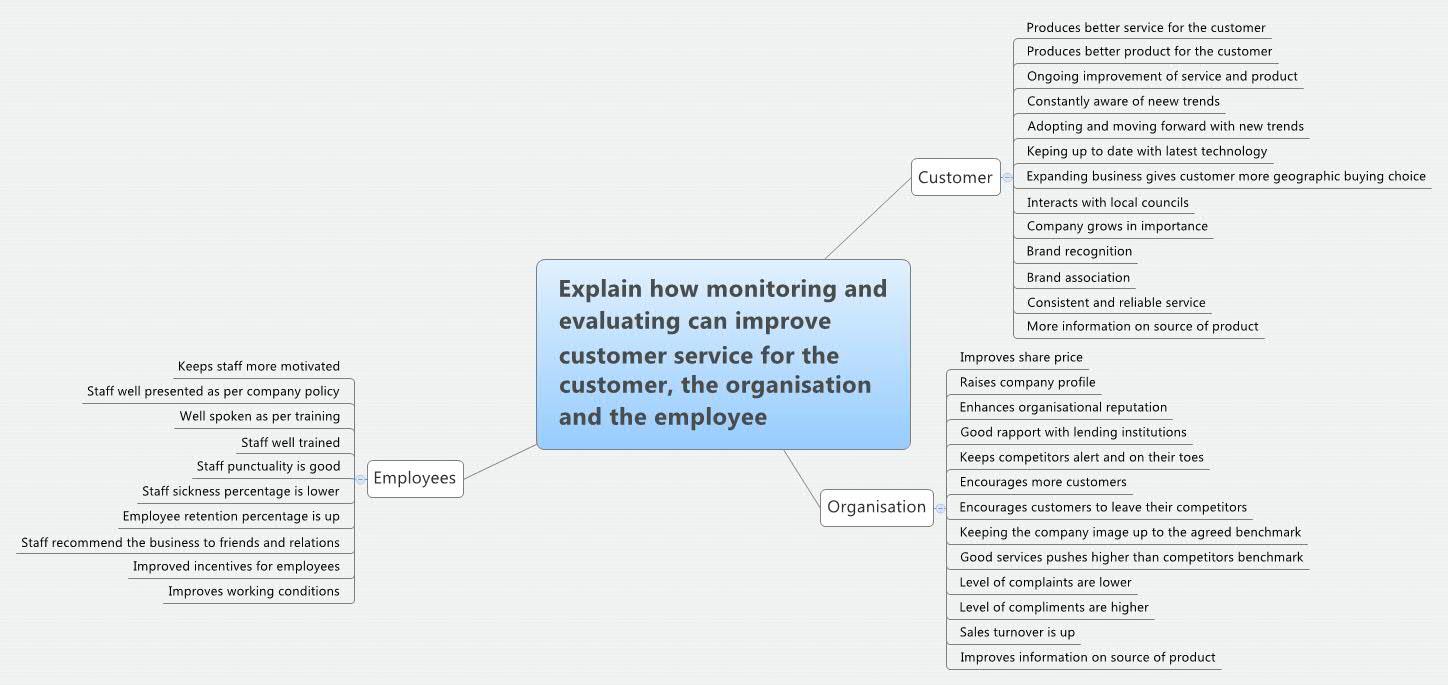
This mind map template, designed for customer relations classes, explores how monitoring and evaluating customer service can benefit three key stakeholders: the customer, the organisation, and the employee. With 40 nodes across three main branches, it covers concrete outcomes such as 'Brand recognition', 'Sales turnover is up', and 'Employee retention percentage is up'. The template provides a structured framework for analyzing the ripple effects of service evaluation, making it a practical tool for business students, trainers, and managers. By linking specific metrics like 'Level of complaints are lower' and 'Staff well trained' to broader strategic goals, it offers a comprehensive cheat sheet for understanding the value of continuous improvement in customer service.
利用規約Designing a customer service training curriculum for new hires
Preparing a business case to justify investment in service monitoring tools
Conducting a team workshop on the benefits of performance evaluation
Download the .xmind file and open it in Xmind (desktop or web).
Review the three main branches: Customer, Organisation, and Employees.
Replace generic nodes with your own data, such as specific metrics or company examples.
Add new nodes to capture additional benefits or context relevant to your situation.
Export the mind map as an image or PDF for presentations or reports.
The template covers 40 nodes organized into three main branches: Customer, Organisation, and Employees. It lists specific outcomes like 'Brand recognition', 'Sales turnover is up', and 'Staff well trained', making it a complete cheat sheet for analyzing the impact of service evaluation.
Open the .xmind file in Xmind, then explore each branch to discuss how monitoring improves service. Use the 'Customer' branch to talk about consistency, the 'Organisation' branch for business benefits, and the 'Employees' branch for staff motivation. Customize nodes with your own examples.
Yes, the template is free to download and fully editable in Xmind. You can add, remove, or modify nodes to fit your specific context, such as adding industry-specific metrics or company policies.
Use the template as a visual aid during meetings. Start with the root question, then expand each branch to show how monitoring benefits customers, the organisation, and employees. Highlight key nodes like 'Level of complaints are lower' to support your points.
Absolutely. The template's structure maps directly to report sections: customer impact, organisational outcomes, and employee effects. Use nodes like 'Sales turnover is up' and 'Employee retention percentage is up' as evidence in your analysis.
あなたのマインドマップ テンプレートを世界中のクリエイターと共有して、作品から収入を得ましょう。

