


'%3e%3cpath%20d='M26.7002%206.05468C26.7002%205.85186%2026.7636%205.68707%2026.8904%205.5603C27.0171%205.43354%2027.1788%205.37332%2027.3753%205.37966L27.9267%205.37966C28.1295%205.37966%2028.2911%205.43987%2028.4116%205.5603C28.532%205.68073%2028.5922%205.84869%2028.5922%206.06419L28.5827%2023.4206L27.8696%2025.8069C27.8506%2025.864%2027.8253%2025.9083%2027.7936%2025.94C27.7555%2025.9781%2027.7112%2025.9971%2027.6605%2025.9971C27.5844%2025.9971%2027.5242%2025.9749%2027.4798%2025.9305C27.4418%2025.8925%2027.4165%2025.8481%2027.4038%2025.7974L26.6907%2023.4301L26.7002%206.05468Z'%20fill='%23FF9334'/%3e%3cpath%20d='M18.8701%2012.6006C19.3331%2012.6006%2019.6787%2012.9599%2019.6787%2013.4092C19.6786%2013.8694%2019.3338%2014.2295%2018.8701%2014.2295H9.80762C9.33292%2014.2294%208.98744%2013.8702%208.9873%2013.4092C8.9873%2012.9591%209.33368%2012.6007%209.80762%2012.6006H18.8701ZM18.8701%208.44531C19.3313%208.44531%2019.6787%208.79114%2019.6787%209.24219C19.6785%209.70065%2019.3354%2010.0742%2018.8701%2010.0742H9.80762C9.33132%2010.0741%208.98752%209.70148%208.9873%209.24219C8.9873%208.79034%209.33542%208.44539%209.80762%208.44531H18.8701Z'%20fill='%23FF9334'/%3e%3cpath%20d='M14.0703%2016.7578C14.5315%2016.7578%2014.8789%2017.1036%2014.8789%2017.5547C14.8787%2018.0132%2014.5356%2018.3867%2014.0703%2018.3867H9.80762C9.33132%2018.3866%208.98752%2018.014%208.9873%2017.5547C8.9873%2017.1028%209.33542%2016.7579%209.80762%2016.7578H14.0703Z'%20fill='%23FF9334'/%3e%3crect%20x='5.8398'%20y='4.2402'%20width='17.12'%20height='21.92'%20rx='2.16'%20stroke='%23FF9334'%20stroke-width='2.08'/%3e%3c/g%3e%3cdefs%3e%3cclipPath%20id='clip0_11502_53292'%3e%3crect%20width='32'%20height='32'%20fill='white'/%3e%3c/clipPath%3e%3c/defs%3e%3c/svg%3e)

Undergraduate sociology students
Preparing for a sociology exam on social stratification theories
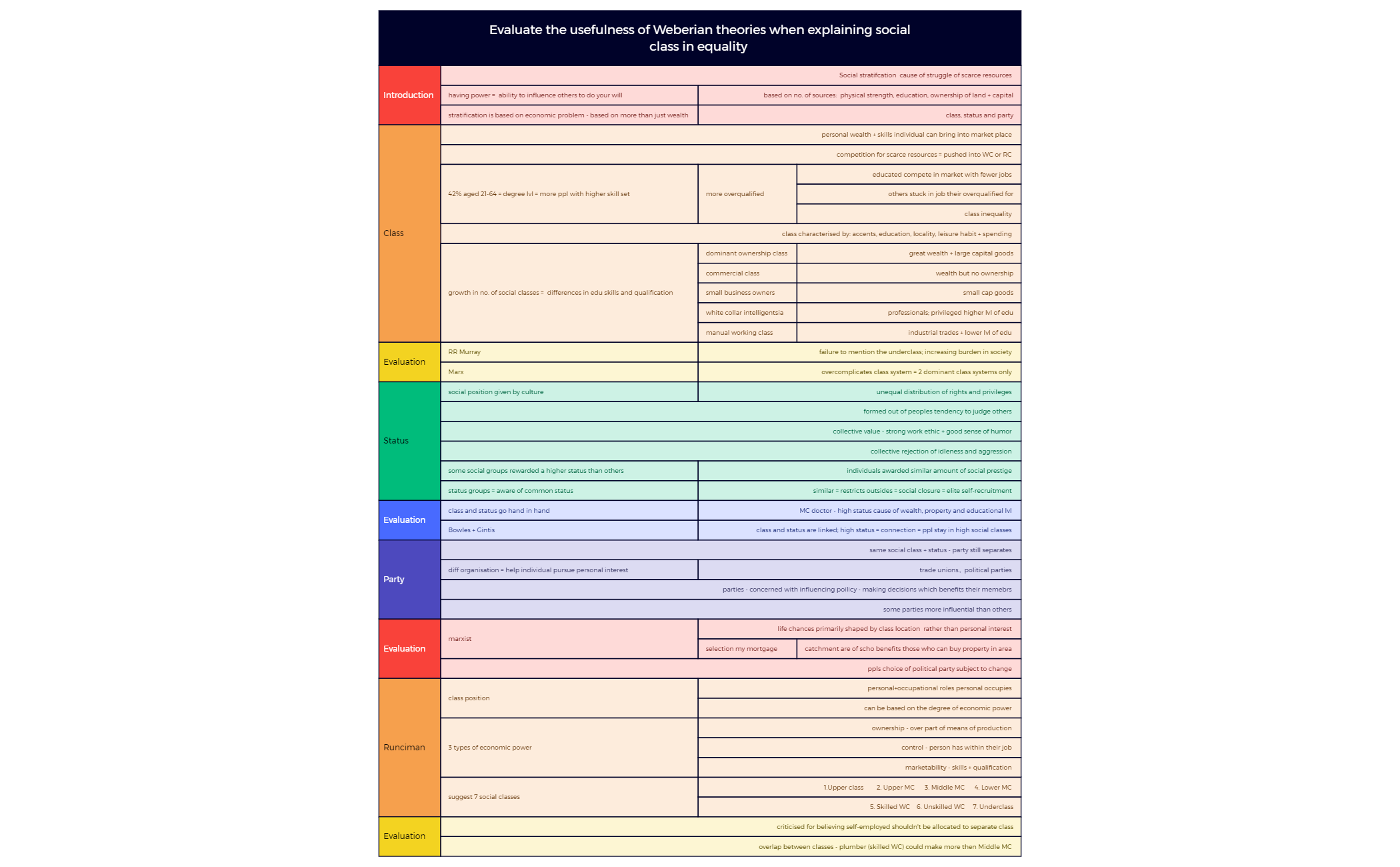
This mind map evaluates the usefulness of Weberian theories for explaining social class and inequality, covering 73 nodes across key concepts: Class, Status, Party, and Runciman's 7-class model. It examines how Weber's multidimensional approach—beyond Marx's binary—accounts for class based on market position, status groups with social closure, and party as political influence. Specific nodes like 'dominant ownership class' and 'social closure = elite self-recruitment' illustrate the framework. The template also includes evaluations from theorists such as R.R. Murray, who criticizes the failure to mention the underclass, and Bowles & Gintis, who link class and status. Organized as a central root with six major branches, this Weberian theories mind map serves as a comprehensive study aid for sociology students.
Terms and ConditionsPreparing for a sociology exam on social stratification theories
Writing an essay comparing Weberian and Marxist views on class inequality
Reviewing key theorists and evaluations for a class presentation on Weber
Open the template in Xmind to review the central branches covering Class, Status, Party, and Runciman's model.
Click on specific nodes to read detailed notes on social closure or add your own examples and personalized styling.
Save your finalized evaluation as a PDF or image to use for academic revision or sharing with peers.
The template covers key Weberian concepts: Class, Status, Party, and Runciman's 7-class model, with evaluations from theorists like Marx, R.R. Murray, and Bowles & Gintis. It has 73 nodes organized into an introduction and six main branches.
Open the .xmind file in Xmind, then explore each branch—Class, Status, Party, Runciman—and their evaluations. Customize by adding your own examples or critiques to deepen understanding of Weberian theory's applicability.
Yes, the Xmind template is fully editable. You can modify nodes, add notes, and export as PDF or image for printing. It's designed for flexible study and revision.
Runciman's model classifies society into seven classes based on economic power: ownership, control, and marketability. It helps analyze class inequality beyond traditional two-class models.
Absolutely. Each evaluation branch (e.g., 'Evaluation' under Class, Status, Party) can be expanded with your own arguments, counterpoints, or contemporary examples to tailor the template to your course.
Share your mind map templates with creators around the world and start earning from your work.

