


'%3e%3cpath%20d='M26.7002%206.05468C26.7002%205.85186%2026.7636%205.68707%2026.8904%205.5603C27.0171%205.43354%2027.1788%205.37332%2027.3753%205.37966L27.9267%205.37966C28.1295%205.37966%2028.2911%205.43987%2028.4116%205.5603C28.532%205.68073%2028.5922%205.84869%2028.5922%206.06419L28.5827%2023.4206L27.8696%2025.8069C27.8506%2025.864%2027.8253%2025.9083%2027.7936%2025.94C27.7555%2025.9781%2027.7112%2025.9971%2027.6605%2025.9971C27.5844%2025.9971%2027.5242%2025.9749%2027.4798%2025.9305C27.4418%2025.8925%2027.4165%2025.8481%2027.4038%2025.7974L26.6907%2023.4301L26.7002%206.05468Z'%20fill='%23FF9334'/%3e%3cpath%20d='M18.8701%2012.6006C19.3331%2012.6006%2019.6787%2012.9599%2019.6787%2013.4092C19.6786%2013.8694%2019.3338%2014.2295%2018.8701%2014.2295H9.80762C9.33292%2014.2294%208.98744%2013.8702%208.9873%2013.4092C8.9873%2012.9591%209.33368%2012.6007%209.80762%2012.6006H18.8701ZM18.8701%208.44531C19.3313%208.44531%2019.6787%208.79114%2019.6787%209.24219C19.6785%209.70065%2019.3354%2010.0742%2018.8701%2010.0742H9.80762C9.33132%2010.0741%208.98752%209.70148%208.9873%209.24219C8.9873%208.79034%209.33542%208.44539%209.80762%208.44531H18.8701Z'%20fill='%23FF9334'/%3e%3cpath%20d='M14.0703%2016.7578C14.5315%2016.7578%2014.8789%2017.1036%2014.8789%2017.5547C14.8787%2018.0132%2014.5356%2018.3867%2014.0703%2018.3867H9.80762C9.33132%2018.3866%208.98752%2018.014%208.9873%2017.5547C8.9873%2017.1028%209.33542%2016.7579%209.80762%2016.7578H14.0703Z'%20fill='%23FF9334'/%3e%3crect%20x='5.8398'%20y='4.2402'%20width='17.12'%20height='21.92'%20rx='2.16'%20stroke='%23FF9334'%20stroke-width='2.08'/%3e%3c/g%3e%3cdefs%3e%3cclipPath%20id='clip0_11502_53292'%3e%3crect%20width='32'%20height='32'%20fill='white'/%3e%3c/clipPath%3e%3c/defs%3e%3c/svg%3e)

Language teachers and curriculum designers
Planning a language lesson that incorporates diverse learning strategies
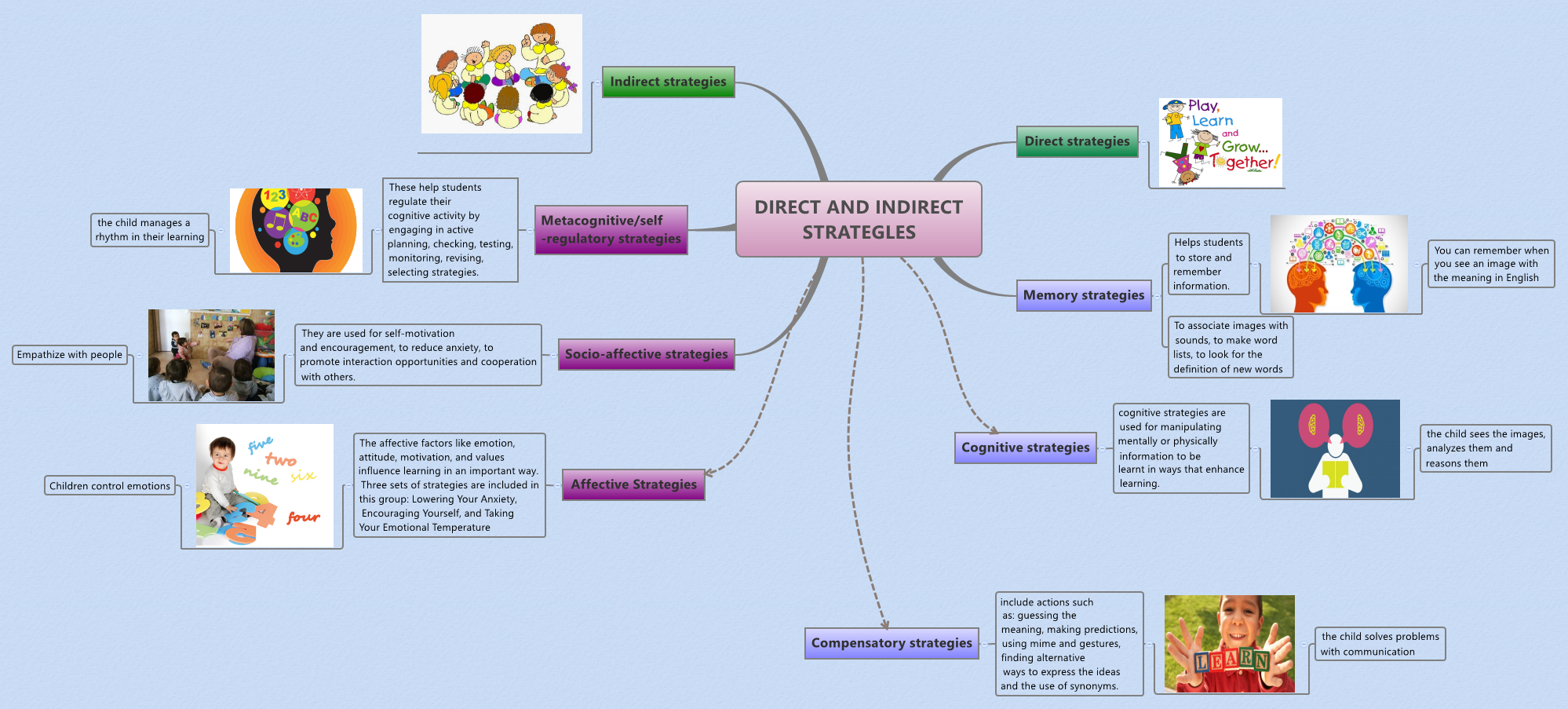
The DIRECT AND INDIRECT STRATEGIES mind map template organizes 30 nodes across 8 top-level branches covering language learning strategies. It categorizes strategies into direct (Memory, Cognitive, Compensatory) and indirect (Metacognitive/self-regulatory, Affective, Socio-affective) groups. Key nodes include 'Memory strategies' (helps students to store and remember information), 'Compensatory strategies' (guessing the meaning, using mime and gestures), and 'Affective Strategies' (Lowering Your Anxiety, Encouraging You). This template serves as a cheat sheet for educators, learners, and curriculum designers to visualize and apply Oxford's taxonomy of language learning strategies. It is structured as a radial mind map with color-coded branches for easy reference.
Conditions d'utilisationPlanning a language lesson that incorporates diverse learning strategies
Self-studying a new language and needing to identify effective techniques
Conducting a workshop on metacognitive and affective skills for students
Launch the template in Xmind to explore the radial layout of direct and indirect language learning strategies.
Navigate through the eight top-level branches and double-click any node to replace the default examples with your own learning techniques.
Use Xmind's icons and color-coding tools to highlight specific memory or affective strategies you intend to prioritize in your curriculum.
The template includes 30 nodes across 8 branches: Direct strategies, Memory strategies, Cognitive strategies, Compensatory strategies, Indirect strategies, Metacognitive/self-regulatory strategies, Affective Strategies, and Socio-affective strategies.
Use the template to identify and organize learning strategies: apply Memory strategies for vocabulary, Cognitive strategies for processing, and Affective Strategies for managing anxiety. Customize nodes with your own techniques.
Yes, the Xmind template is fully editable. You can add, remove, or modify nodes, and export it as PDF or image for printing.
Direct strategies (Memory, Cognitive, Compensatory) directly involve the target language, while indirect strategies (Metacognitive, Affective, Socio-affective) support learning through planning, motivation, and interaction.
Absolutely. Teachers can present the map to students as a reference, then expand each branch with examples or activities tailored to their class.
Partagez vos modèles de cartes mentales avec des créateurs du monde entier et commencez à gagner avec votre travail.

