




Curriculum developers and TESOL program coordinators
Designing a new English curriculum that integrates multiple learning theories
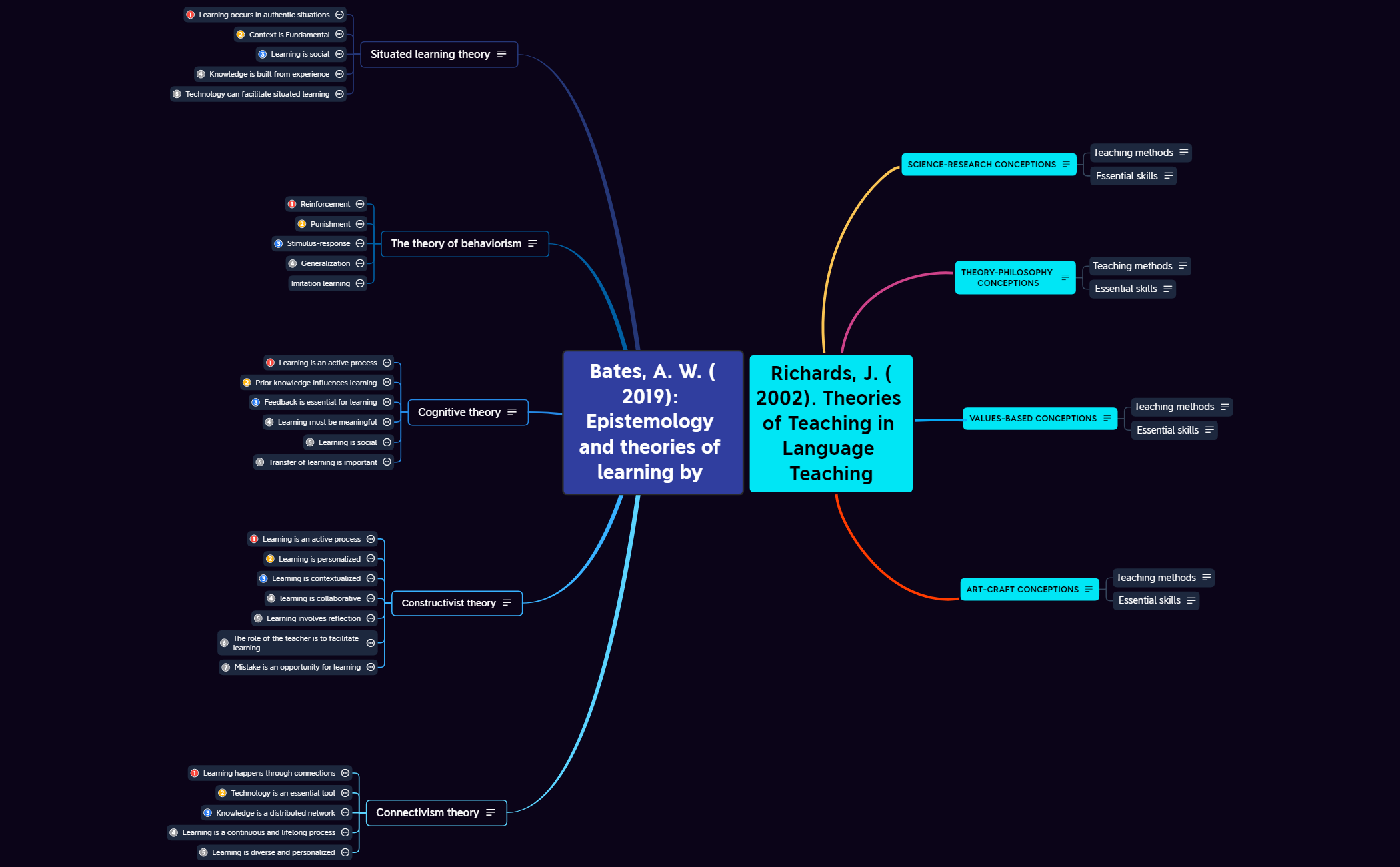
The Didactics of English mind map template, based on Bates (2019) and Richards (2002), covers 5 major learning theories and 4 teaching conceptions across 47 nodes. It explores Connectivism theory, Constructivist theory, Cognitive theory, The theory of behaviorism, and Situated learning theory, each with key principles like 'Learning happens through connections' and 'Mistake is an opportunity for learning'. The template also breaks down Richards' SCIENCE-RESEARCH CONCEPTIONS, THEORY-PHILOSOPHY CONCEPTIONS, ART-CRAFT CONCEPTIONS, and VALUES-BASED CONCEPTIONS into teaching methods and essential skills. This Didactics of English mind map is a comprehensive cheat sheet for educators and TESOL students seeking to align teaching strategies with theoretical frameworks.
利用規約Designing a new English curriculum that integrates multiple learning theories
Preparing for a teacher training session on language teaching methodologies
Writing a research paper or thesis on English didactics and comparing theoretical frameworks
Open the template in Xmind to navigate the five major learning theories and their core principles like Connectivism and Behaviorism.
Expand the Richards' conceptions section to compare the science, philosophy, art, and values-based approaches to English instruction.
Add your own pedagogical notes to the nodes before exporting the final mind map as a PDF or image for your teaching practice.
The template includes 47 nodes covering five learning theories (Connectivism, Constructivist, Cognitive, Behaviorism, Situated Learning) and four teaching conceptions by Richards, each with teaching methods and essential skills.
Open the .xmind file in Xmind, then explore each theory branch to identify principles that align with your lesson goals. For example, use 'Learning is contextualized' from Constructivist theory to design real-world tasks.
Yes, the template is fully editable in Xmind. You can add, remove, or reorganize nodes, and customize colors or icons to suit your teaching context.
This branch, based on Richards (2002), outlines teaching methods and essential skills from a scientific-research perspective, helping educators ground their practice in empirical findings.
Absolutely. The template provides a structured overview of key theories and conceptions, making it ideal for facilitating discussions on teaching approaches and comparing different methodologies.
あなたのマインドマップ テンプレートを世界中のクリエイターと共有して、作品から収入を得ましょう。

