




CISOs and security architects
Building a comprehensive cybersecurity program from scratch for a new organization.
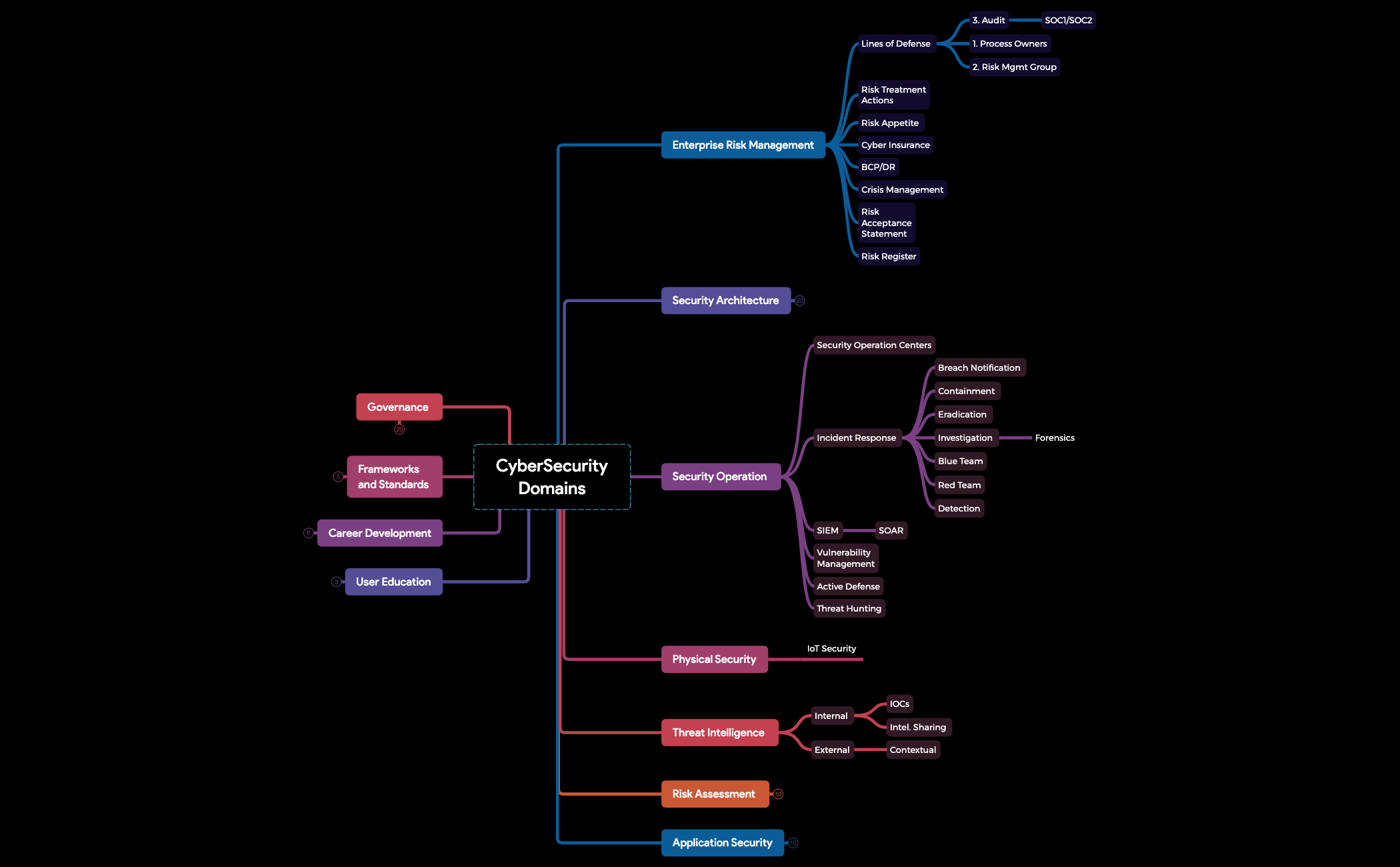
The CyberSecurity Domains mind map template provides a structured overview of 11 core cybersecurity domains, covering over 120 nodes including Enterprise Risk Management, Security Architecture, and Security Operation. Designed for security professionals, CISOs, and IT managers, this template serves as a comprehensive cheat sheet for governance, risk assessment, and incident response. Key nodes such as 'Lines of Defense' (with 1. Process Owners, 2. Risk Mgmt Group, 3. Audit) and 'Incident Response' (including Containment, Eradication, and Forensics) are detailed. The map also explores 'Frameworks and Standards' like NIST Cybersecurity Framework and ISO 27001, making it an essential reference for building and auditing security programs.
Conditions d'utilisationBuilding a comprehensive cybersecurity program from scratch for a new organization.
Preparing for a compliance audit against standards like ISO 27001 or PCI DSS.
Conducting a gap analysis of existing security controls across domains.
Open the .xmind file to review the structured overview of the eleven core cybersecurity domains and their hierarchical nodes.
Personalize the existing branches by renaming nodes or adding specific sub-nodes for your organization's policies, tools, and procedures.
Complete your security program reference and export the final mind map as a PDF or image file to share with your team.
The template covers 11 domains: Enterprise Risk Management, Security Architecture, Security Operation, Physical Security, Threat Intelligence, Risk Assessment, Application Security, User Education, Career Development, Frameworks and Standards, and Governance. It includes over 120 nodes detailing processes, tools, and standards.
Navigate to the Risk Assessment branch to find nodes like 3rd Party Risk, Penetration test (Infrastructure, Application, Social Engineering), Vulnerability scan, and Assets Inventory. Customize these nodes with your organization's specific risks and controls.
Yes, the .xmind file is fully editable. You can add, remove, or reorganize nodes, attach notes and resources, and export to PDF, PNG, or other formats. It's designed for customization to fit your security framework.
The template includes NIST Cybersecurity Framework, ISO 27001/27017/27018, OWASP Top 10 (WebApp & API), CIS Top 20 Controls, and MITRE ATT&CK Framework. Each is a node under Frameworks and Standards.
Absolutely. The User Education branch covers Training (new skills), Awareness (reinforcement), and Cyber security table-top exercise. Use these nodes to plan and track your security awareness program.
Partagez vos modèles de cartes mentales avec des créateurs du monde entier et commencez à gagner avec votre travail.

