


'%3e%3cpath%20d='M15.9996%208.0002C17.3251%208.0002%2018.3996%206.92568%2018.3996%205.6002C18.3996%204.27471%2017.3251%203.2002%2015.9996%203.2002C14.6741%203.2002%2013.5996%204.27471%2013.5996%205.6002C13.5996%206.92568%2014.6741%208.0002%2015.9996%208.0002Z'%20stroke='%23FF9334'%20stroke-width='1.92'/%3e%3cpath%20d='M16%208V26.3999'%20stroke='%23FF9334'%20stroke-width='1.92'%20stroke-linecap='round'/%3e%3cpath%20d='M4.7998%2011.2002H27.1998'%20stroke='%23FF9334'%20stroke-width='1.92'%20stroke-linecap='round'/%3e%3cpath%20d='M6.3998%2011.2002L4.7998%2017.6002H11.1998L9.5998%2011.2002L6.3998%2011.2002Z'%20stroke='%23FF9334'%20stroke-width='1.92'%20stroke-linejoin='round'/%3e%3cpath%20d='M22.3998%2011.2002L20.7998%2017.6002H27.1998L25.5998%2011.2002L22.3998%2011.2002Z'%20stroke='%23FF9334'%20stroke-width='1.92'%20stroke-linejoin='round'/%3e%3cpath%20d='M11.2002%2027.2002H20.8002'%20stroke='%23FF9334'%20stroke-width='2.4'%20stroke-linecap='round'/%3e%3c/g%3e%3cdefs%3e%3cclipPath%20id='clip0_11502_53340'%3e%3crect%20width='32'%20height='32'%20fill='white'/%3e%3c/clipPath%3e%3c/defs%3e%3c/svg%3e)

Law students studying equity and trusts.
Preparing for a trust law exam covering trustee powers and beneficiary rights.
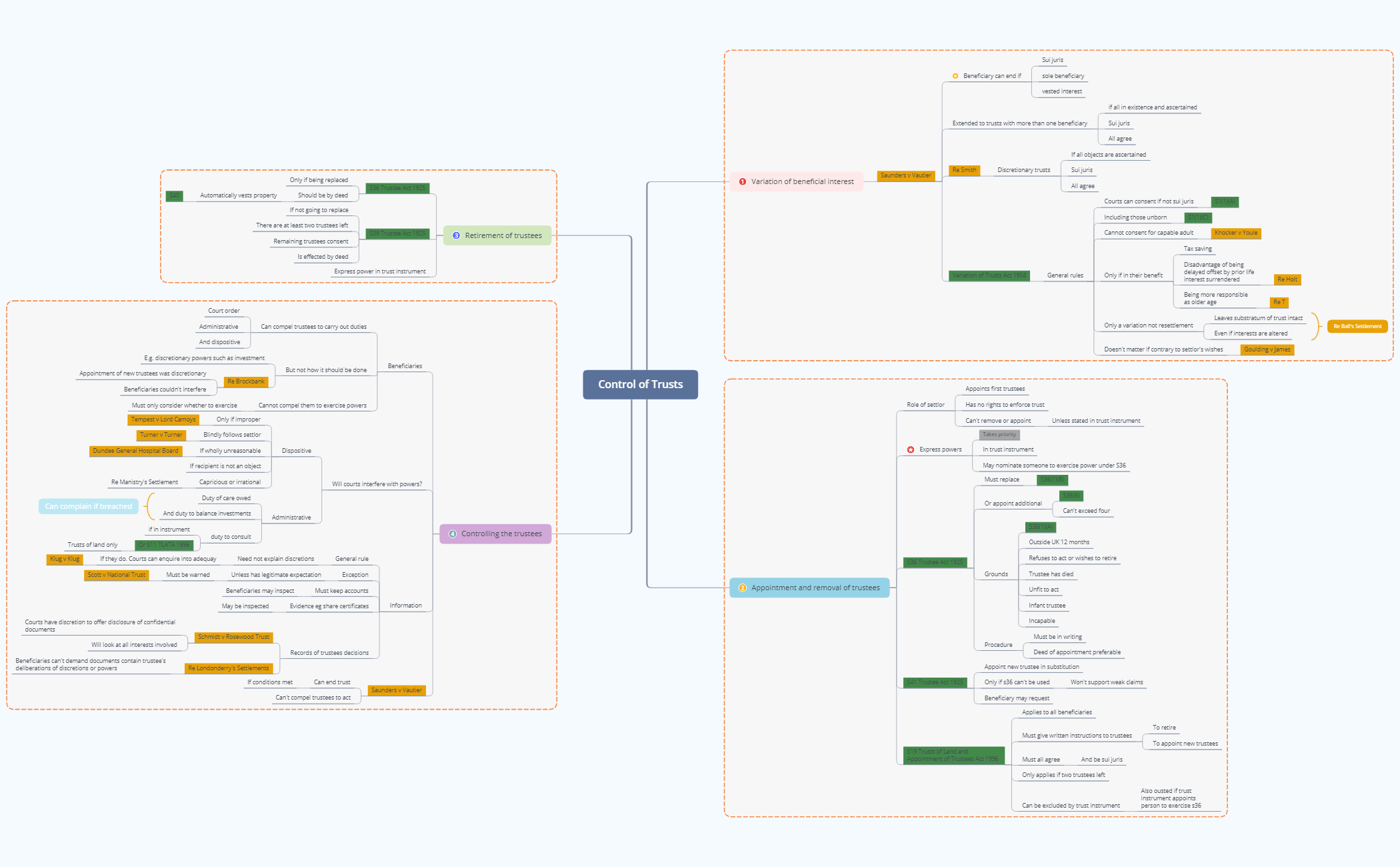
The Control of Trusts mind map template covers 145 nodes across four major branches: Variation of beneficial interest, Appointment and removal of trustees, Controlling the trustees, and Retirement of trustees. It is designed for law students, legal professionals, and trust practitioners to understand the legal mechanisms governing trust administration. Key concepts include the rule in Saunders v Vautier, which allows beneficiaries to end a trust if they are sui juris, sole beneficiaries, and have a vested interest, and the statutory powers under S36 Trustee Act 1925 for appointing and removing trustees. The template also explores how beneficiaries can compel trustees to carry out duties through court orders, though not how discretions should be exercised, as illustrated in Re Brockbank. This cheat sheet provides a structured overview of the legal framework for controlling trusts, making it an essential study aid for trust law exams.
NutzungsbedingungenPreparing for a trust law exam covering trustee powers and beneficiary rights.
Advising a client on how to remove a trustee who is unfit or unwilling to act.
Drafting a trust instrument that includes express powers for appointing and removing trustees.
Open the template in Xmind to navigate the four primary branches covering beneficial interest, trustee appointment, control, and retirement.
Examine the detailed legal notes on statutes and cases while adding your own jurisdiction-specific rules or case study observations to the nodes.
Save your finalized trust administration map as a PDF or image file for use in legal presentations or academic study sessions.
The rule allows beneficiaries who are sui juris, the sole beneficiary, and have a vested interest to end the trust and distribute the property as they wish. It can also apply to trusts with multiple beneficiaries if all are in existence, ascertained, sui juris, and agree.
A trustee can be removed if they are outside the UK for 12 months, refuse to act, wish to retire, have died, are unfit, an infant, or incapable. The appointment must be in writing, and a deed of appointment is preferable.
No, beneficiaries cannot compel trustees to exercise discretionary powers such as investment choices. Trustees must only consider whether to exercise them, as established in Re Brockbank.
Trustees must keep accounts that beneficiaries may inspect, and evidence like share certificates can be inspected. However, they generally need not explain discretions unless there is a legitimate expectation, per Schmidt v Rosewood Trust.
Under S39 Trustee Act 1925, a trustee can retire if not being replaced, provided at least two trustees remain, the remaining trustees consent, and the retirement is effected by deed.
The Act allows the court to approve variations of trust arrangements on behalf of beneficiaries who cannot consent, such as minors or unborn beneficiaries, to benefit the trust as a whole.
Teilen Sie Ihre Mindmap-Vorlagen mit Erstellern weltweit und verdienen Sie mit Ihrer Arbeit.

