


'%3e%3cpath%20d='M26.7002%206.05468C26.7002%205.85186%2026.7636%205.68707%2026.8904%205.5603C27.0171%205.43354%2027.1788%205.37332%2027.3753%205.37966L27.9267%205.37966C28.1295%205.37966%2028.2911%205.43987%2028.4116%205.5603C28.532%205.68073%2028.5922%205.84869%2028.5922%206.06419L28.5827%2023.4206L27.8696%2025.8069C27.8506%2025.864%2027.8253%2025.9083%2027.7936%2025.94C27.7555%2025.9781%2027.7112%2025.9971%2027.6605%2025.9971C27.5844%2025.9971%2027.5242%2025.9749%2027.4798%2025.9305C27.4418%2025.8925%2027.4165%2025.8481%2027.4038%2025.7974L26.6907%2023.4301L26.7002%206.05468Z'%20fill='%23FF9334'/%3e%3cpath%20d='M18.8701%2012.6006C19.3331%2012.6006%2019.6787%2012.9599%2019.6787%2013.4092C19.6786%2013.8694%2019.3338%2014.2295%2018.8701%2014.2295H9.80762C9.33292%2014.2294%208.98744%2013.8702%208.9873%2013.4092C8.9873%2012.9591%209.33368%2012.6007%209.80762%2012.6006H18.8701ZM18.8701%208.44531C19.3313%208.44531%2019.6787%208.79114%2019.6787%209.24219C19.6785%209.70065%2019.3354%2010.0742%2018.8701%2010.0742H9.80762C9.33132%2010.0741%208.98752%209.70148%208.9873%209.24219C8.9873%208.79034%209.33542%208.44539%209.80762%208.44531H18.8701Z'%20fill='%23FF9334'/%3e%3cpath%20d='M14.0703%2016.7578C14.5315%2016.7578%2014.8789%2017.1036%2014.8789%2017.5547C14.8787%2018.0132%2014.5356%2018.3867%2014.0703%2018.3867H9.80762C9.33132%2018.3866%208.98752%2018.014%208.9873%2017.5547C8.9873%2017.1028%209.33542%2016.7579%209.80762%2016.7578H14.0703Z'%20fill='%23FF9334'/%3e%3crect%20x='5.8398'%20y='4.2402'%20width='17.12'%20height='21.92'%20rx='2.16'%20stroke='%23FF9334'%20stroke-width='2.08'/%3e%3c/g%3e%3cdefs%3e%3cclipPath%20id='clip0_11502_53292'%3e%3crect%20width='32'%20height='32'%20fill='white'/%3e%3c/clipPath%3e%3c/defs%3e%3c/svg%3e)

ESL students and language learners
Preparing for an English grammar exam that tests conditional structures and tense usage.
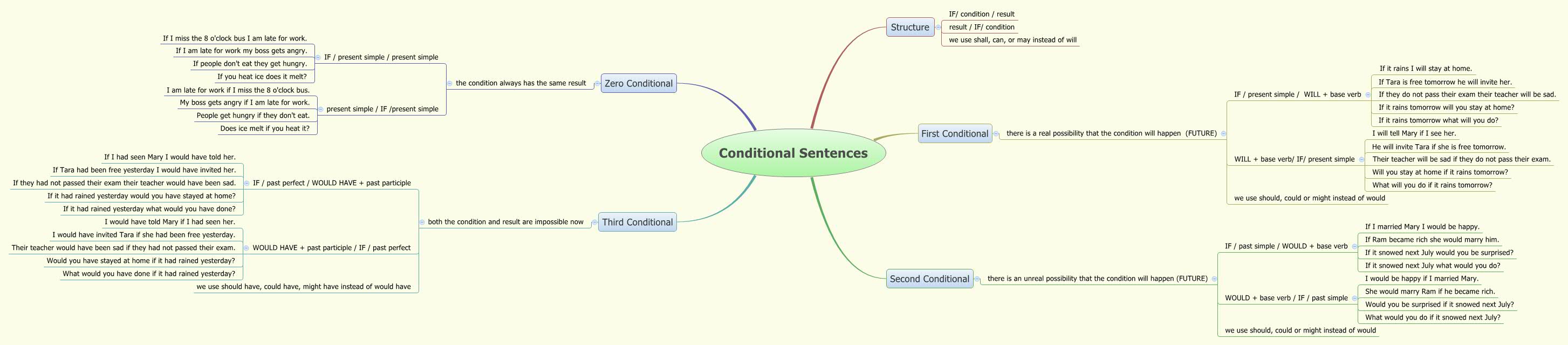
The Conditional Sentences mind map template from Xmind covers the four main types of English conditionals—Zero, First, Second, and Third—with 60 nodes detailing structure, usage, and example sentences. It includes specific node names like 'IF/ condition / result' and 'we use shall, can, or may instead of will' to clarify grammatical patterns. This cheat sheet is ideal for ESL learners, teachers, and grammar enthusiasts seeking a structured overview of conditional clauses. Organized by conditional type, each branch explains the tense combinations (e.g., 'IF / present simple / WILL + base verb') and provides real-world examples such as 'If it rains I will stay at home.' The template also covers inverted structures like 'result / IF/ condition' and alternative modal verbs, making it a comprehensive reference for mastering English conditionals.
NutzungsbedingungenPreparing for an English grammar exam that tests conditional structures and tense usage.
Teaching a lesson on conditionals and needing a clear visual reference for classroom presentation.
Reviewing grammar rules before writing or speaking to ensure correct use of conditionals in real-life communication.
Open the template in Xmind to navigate through the four main conditional types and their specific grammatical structures.
Edit the existing example sentences to suit your needs and use the branch folding feature to focus on one conditional type at a time.
Save your personalized grammar cheat sheet as an image or PDF for easy printing and sharing with other learners.
The template covers all four main types: Zero Conditional (general truths), First Conditional (real future), Second Conditional (unreal future), and Third Conditional (impossible past). Each type includes structure rules, example sentences, and alternative modals.
Each conditional type is split into two sub-branches: one starting with 'IF' and one starting with the result clause. For example, First Conditional has 'IF / present simple / WILL + base verb' and 'WILL + base verb / IF / present simple'.
Yes, the template provides numerous example sentences for each structure, such as 'If it rains tomorrow will you stay at home?' and 'Would you be surprised if it snowed next July?' You can replace the examples with your own ideas.
Yes, each conditional type notes alternative modals: First Conditional uses 'should, could, or might' instead of 'will'; Second Conditional uses them instead of 'would'; Third Conditional uses 'should have, could have, might have' instead of 'would have'.
Yes, the .xmind file is fully editable in Xmind desktop or web. You can customize the text, add new branches, or print the mind map as a study aid.
Teilen Sie Ihre Mindmap-Vorlagen mit Erstellern weltweit und verdienen Sie mit Ihrer Arbeit.

