




Medical or PT students
Reviewing somatosensory pathways before a neuroanatomy exam
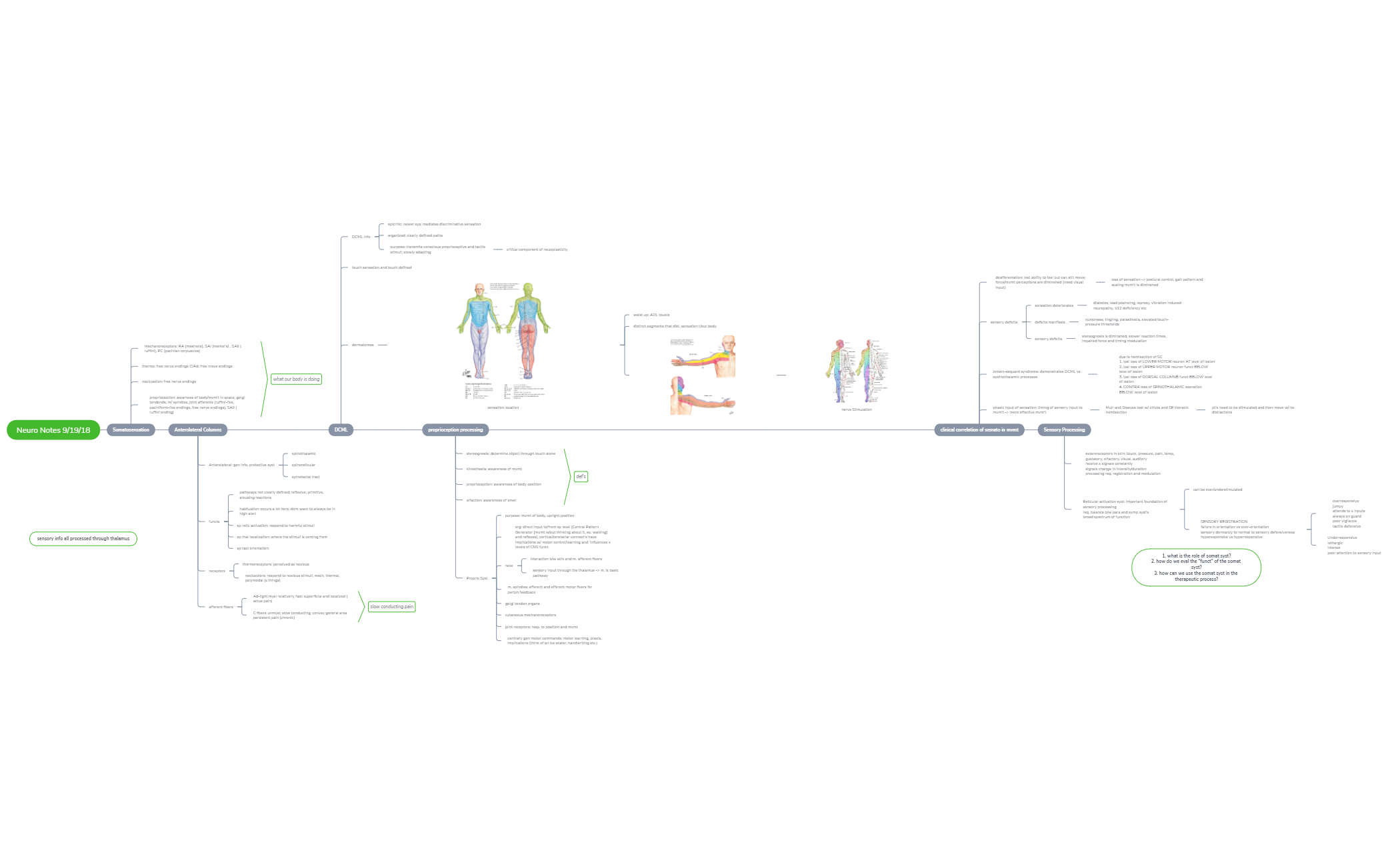
This neuroscience mind map, titled 'Ch 6 and 7 NS', covers the somatosensory system with 79 nodes across one sheet. It details somatosensation, anterolateral columns, DCML, proprioception processing, and sensory processing. Key concepts include mechanoreceptors (RA, SAI, SAII, PC), nociception, and the brown-sequard syndrome. The template serves as a study aid for understanding sensory pathways and their clinical correlations.
Terms and ConditionsReviewing somatosensory pathways before a neuroanatomy exam
Preparing a lecture on sensory processing and clinical correlations
Studying the effects of spinal cord lesions like brown-sequard syndrome
Open the .xmind file and expand the primary branches like Somatosensation or DCML to visualize the full neuroscience hierarchy.
Edit node text to include personal study notes on mechanoreceptors while using the Outline view for rapid navigation across the 79 nodes.
Save your customized sensory pathway map as an image or PDF to facilitate easy sharing and offline clinical correlation review.
The template covers somatosensation, anterolateral columns, DCML, proprioception processing, clinical correlations, and sensory processing, with 79 nodes detailing mechanoreceptors, nociceptors, and pathways.
Open the .xmind file in Xmind, then expand branches like 'Anterolateral Columns' or 'DCML' to review pathways. Customize colors or add notes to reinforce key concepts like brown-sequard syndrome.
Yes, the Xmind template is fully editable. You can modify nodes, add images, or export as PDF or image for printing.
It demonstrates the difference between DCML and spinothalamic tracts by showing ipsilateral motor loss and contralateral pain/temperature loss after spinal cord hemisection.
Yes, you can edit the 'mechanoreceptors' node to add or modify receptor types (RA, SAI, SAII, PC) and their functions directly in Xmind.
Share your mind map templates with creators around the world and start earning from your work.

