




University professors and economics instructors
Preparing a lecture on behavioral economics or decision theory
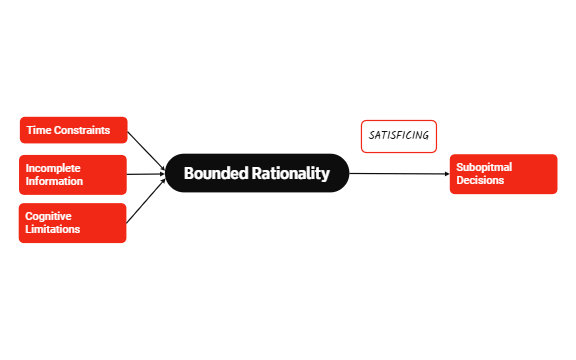
Bounded rationality is a decision-making framework used by economists, psychologists, and managers to understand how individuals make choices under real-world constraints. This mind map template covers five core factors—Time Constraints, Incomplete Information, Cognitive Limitations, Suboptimal Decisions, and SATISFICING—providing a concise overview of Herbert Simon's concept. It explains why people often settle for 'good enough' solutions rather than optimal ones. The template is structured as a radial diagram with the central concept branching into these five key nodes, making it ideal for quick reference or study. Key terms like 'satisficing' and 'cognitive limitations' are explicitly defined within the map.
利用規約Preparing a lecture on behavioral economics or decision theory
Reviewing cognitive biases and decision-making shortcuts before a product strategy meeting
Studying for an exam in organizational behavior or psychology
Open the template in Xmind to explore the five core branches of bounded rationality including time constraints and cognitive limitations.
Double-click the existing branches to add your own notes, real-world examples, or definitions for terms like satisficing.
Adjust the visual style with custom colors and icons before exporting your completed diagram as an image or PDF for sharing.
Bounded rationality is the idea that when people make decisions, their rationality is limited by the information they have, cognitive constraints, and time. Instead of finding the optimal solution, they often 'satisfice'—choose a good enough option.
The template includes five main nodes: Time Constraints, Incomplete Information, Cognitive Limitations, Suboptimal Decisions, and SATISFICING. Each node represents a key factor of bounded rationality, making it easy to grasp the concept at a glance.
Use it as a study aid to memorize the components of bounded rationality, or as a teaching visual to explain Herbert Simon's theory. You can expand each node with examples or definitions.
Yes, the template is free to use and fully editable in Xmind. You can add notes, change colors, or attach images to customize it for your needs.
Satisficing means choosing an option that meets a minimum threshold of acceptability, while optimizing seeks the best possible outcome. Bounded rationality argues that satisficing is more realistic given real-world limits.
あなたのマインドマップ テンプレートを世界中のクリエイターと共有して、作品から収入を得ましょう。

