


'%3e%3cpath%20d='M6.42532%207.40439C6.16072%207.40439%205.94575%207.48708%205.78037%207.65244C5.615%207.80127%205.53231%208.01627%205.53231%208.2974V23.7018C5.53231%2023.9664%205.615%2024.1813%205.78037%2024.3467C5.94575%2024.5122%206.16072%2024.5947%206.42532%2024.5947H8.4842C8.76533%2024.5947%208.98032%2024.5203%209.12916%2024.3715C9.29452%2024.2062%209.3772%2023.9829%209.3772%2023.7018V8.2974C9.3772%208.01627%209.29452%207.80127%209.12916%207.65244C8.98032%207.48708%208.76533%207.40439%208.4842%207.40439H6.42532ZM3.42383%208.09895C3.42383%207.25556%203.67188%206.57753%204.168%206.06487C4.68064%205.55223%205.3504%205.2959%206.17727%205.2959H8.68264C9.52604%205.2959%2010.2041%205.55223%2010.7167%206.06487C11.2294%206.561%2011.4857%207.23075%2011.4857%208.07414V11.7702C11.6841%2011.7206%2011.8991%2011.6958%2012.1306%2011.6958H16.7197H16.9677L16.6949%2010.7532C16.5957%2010.4224%2016.5461%2010.1165%2016.5461%209.83535C16.5461%209.24001%2016.7197%208.72737%2017.0669%208.2974C17.4308%207.85089%2017.9353%207.54495%2018.5801%207.37958L20.9615%206.75943C21.2095%206.69329%2021.4825%206.66022%2021.7801%206.66022C22.425%206.66022%2022.9791%206.84212%2023.4421%207.20595C23.9217%207.56975%2024.2524%208.07414%2024.4343%208.7191L28.4529%2022.5358C28.5356%2022.8667%2028.5769%2023.1643%2028.5769%2023.429C28.5769%2024.0243%2028.3949%2024.5451%2028.0311%2024.9917C27.6839%2025.4382%2027.1877%2025.7442%2026.5428%2025.9094L24.1615%2026.5048C23.8306%2026.5875%2023.5413%2026.6288%2023.2932%2026.6288C22.6813%2026.6288%2022.1356%2026.4469%2021.6561%2026.0832C21.193%2025.7194%2020.8705%2025.2149%2020.6887%2024.5699L19.498%2020.4522V23.9002C19.498%2024.7437%2019.2417%2025.4216%2018.729%2025.9342C18.2329%2026.4469%2017.5714%2026.7032%2016.7445%2026.7032H12.1803C11.4692%2026.7032%2010.8904%2026.5296%2010.4439%2026.1824C9.98082%2026.5296%209.41028%2026.7032%208.73226%2026.7032H6.22688C5.38348%2026.7032%204.70546%2026.4469%204.1928%2025.9342C3.68015%2025.4382%203.42383%2024.7766%203.42383%2023.9498V8.09895ZM12.3787%2013.8043C12.1141%2013.8043%2011.8991%2013.887%2011.7337%2014.0523C11.5684%2014.2012%2011.4857%2014.4162%2011.4857%2014.6973V23.7018C11.4857%2023.9664%2011.5684%2024.1813%2011.7337%2024.3467C11.8991%2024.5122%2012.1141%2024.5947%2012.3787%2024.5947H16.4964C16.7777%2024.5947%2016.9925%2024.5203%2017.1413%2024.3715C17.3068%2024.2062%2017.3895%2023.9829%2017.3895%2023.7018V14.6973C17.3895%2014.4162%2017.3068%2014.2012%2017.1413%2014.0523C16.9925%2013.887%2016.7777%2013.8043%2016.4964%2013.8043H12.3787ZM19.3988%209.33924C18.9522%209.47153%2018.729%209.73614%2018.729%2010.133C18.729%2010.1992%2018.7455%2010.2984%2018.7786%2010.4307L22.673%2023.8506C22.8385%2024.2971%2023.1196%2024.5203%2023.5165%2024.5203C23.6322%2024.5203%2023.7233%2024.5122%2023.7893%2024.4955L25.7242%2023.9498C26.1708%2023.8176%2026.394%2023.553%2026.394%2023.156C26.394%2023.0899%2026.3773%2022.9907%2026.3444%2022.8584L22.4746%209.46327C22.4085%209.24828%2022.301%209.08291%2022.1522%208.96715C22.0199%208.83486%2021.8628%208.76871%2021.6809%208.76871C21.6148%208.76871%2021.5154%208.78524%2021.3833%208.81831L19.3988%209.33924Z'%20fill='%23FF9334'/%3e%3c/g%3e%3cdefs%3e%3cclipPath%20id='clip0_11502_53352'%3e%3crect%20width='32'%20height='32'%20fill='white'/%3e%3c/clipPath%3e%3c/defs%3e%3c/svg%3e)

Graduate students and academic researchers in education, educational technology, or computer science.
Starting a literature review on AI in education for a graduate thesis or research paper.
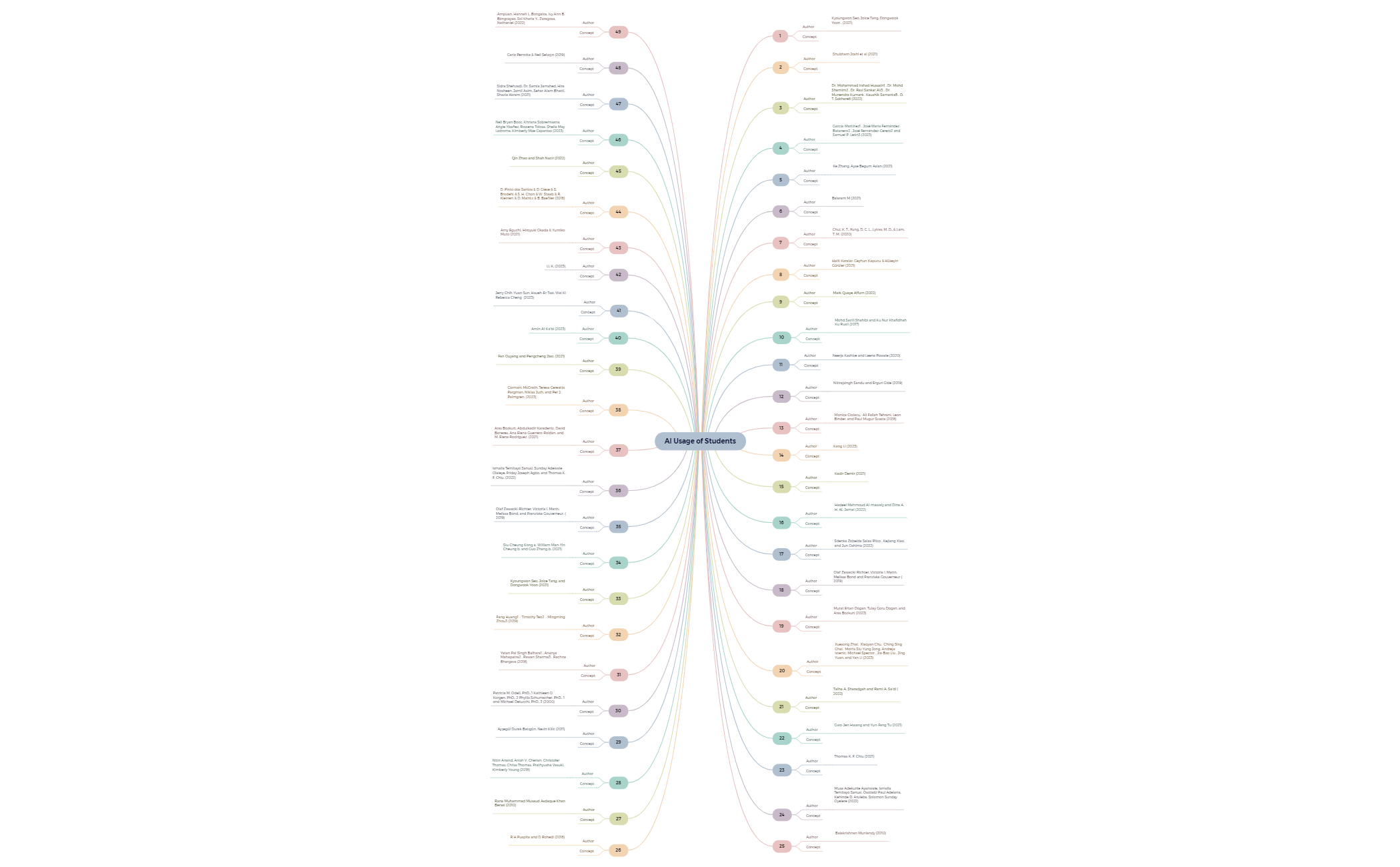
The AI Usage of Students mind map template compiles 49 peer-reviewed research papers (2021–2023) that examine how students leverage artificial intelligence tools in academic settings. Organized as a single-sheet literature review, each numbered branch (1–49) pairs an author citation with a 'Concept' node, creating a structured reference for researchers, educators, and students. Key studies include 'Kyoungwon Seo, Joice Tang, Dongwook Yoon (2021)' and 'Gwo-Jen Hwang and Yun-Fang Tu (2021)', which explore AI-supported learning analytics and adaptive systems. This AI Usage of Students template serves as a curated cheat sheet for understanding the scope of AI in education, covering topics from personalized tutoring to ethical considerations. With 197 total nodes, it offers a dense, citation-rich overview ideal for literature reviews, thesis outlines, or seminar preparation.
Terms and ConditionsStarting a literature review on AI in education for a graduate thesis or research paper.
Preparing a seminar or lecture on the current state of AI tools for student learning.
Evaluating AI tools for adoption in a school or university setting, needing evidence-based insights.
Open the .xmind file to navigate the 49 numbered branches containing peer-reviewed author citations and their corresponding research concepts.
Personalize the template by adding your own research notes or color-coding branches to categorize themes like ethics and personalized learning.
Save your finalized mind map as a PDF, image, or outline to integrate these academic insights into your presentations or papers.
The template contains 49 research papers, each with an author citation and a 'Concept' node summarizing the study's focus. It covers topics like AI in personalized learning, adaptive assessment, ethical concerns, and student engagement.
Open the .xmind file in Xmind, then browse the numbered branches to find relevant studies. You can add your own notes, highlight key findings, or reorganize the papers by theme to build your review outline.
Yes, the template is free to download and fully editable in Xmind. You can modify node text, add new branches, or change the layout to suit your research needs.
Absolutely. The curated list of 49 citations provides a solid foundation for a literature review section. You can expand each concept node with your own analysis and link to full papers.
Themes include AI-powered tutoring systems, learning analytics, student engagement, ethical implications, and the effectiveness of AI tools in higher education and K-12 settings.
Share your mind map templates with creators around the world and start earning from your work.

