




High school and college students writing academic essays.
Starting a new essay assignment and need a clear structure to follow.
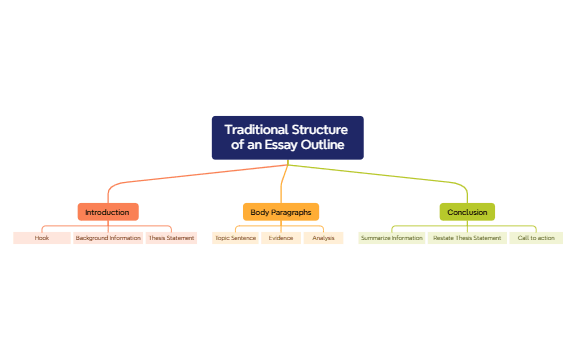
The Traditional Structure of an Essay Outline mind map provides a clear, step-by-step framework for organizing essays, covering the three core sections: Introduction, Body Paragraphs, and Conclusion. With 13 nodes, this template breaks down each section into essential components like 'Hook', 'Thesis Statement', 'Evidence', and 'Call to action'. Ideal for students and writers, this essay outline template ensures logical flow and completeness. The 'Introduction' branch includes 'Background Information' to set context, while 'Body Paragraphs' emphasize 'Analysis' to deepen arguments. This cheat sheet is a practical tool for academic writing.
使用条款Starting a new essay assignment and need a clear structure to follow.
Teaching essay writing fundamentals to a class.
Brainstorming and outlining a blog post or article with a persuasive angle.
Download the .xmind file and open it to explore the predefined branches for the Introduction, Body Paragraphs, and Conclusion.
Replace the placeholder text in nodes like Hook and Thesis Statement with your own ideas, adding or removing sub-nodes to fit your essay's length.
Review your completed essay structure for logical flow and export it as a PDF or image to guide your writing process.
The template includes 13 nodes covering the three main essay sections: Introduction (Hook, Background Information, Thesis Statement), Body Paragraphs (Topic Sentence, Evidence, Analysis), and Conclusion (Summarize Information, Restate Thesis Statement, Call to action).
Open the .xmind file in Xmind, then customize each node. For a persuasive essay, strengthen the 'Thesis Statement' with a clear stance, use 'Evidence' to support claims, and end with a compelling 'Call to action'.
Yes, the template is free to download and fully editable in Xmind. You can add, remove, or rearrange nodes to fit your specific essay requirements.
Start with a 'Topic Sentence' for each paragraph, then add 'Evidence' (quotes, data), followed by 'Analysis' explaining how the evidence supports your thesis. Repeat for each body paragraph.
Absolutely. The structure works for any academic essay. Expand the 'Body Paragraphs' section with additional nodes for multiple arguments, and use 'Background Information' to set up your research context.
把你的思维导图模板分享给全球创作者,从你的作品中获得收益。

