




Senior IT managers and procurement leads
Evaluating a major software vendor contract renewal with significant budget implications
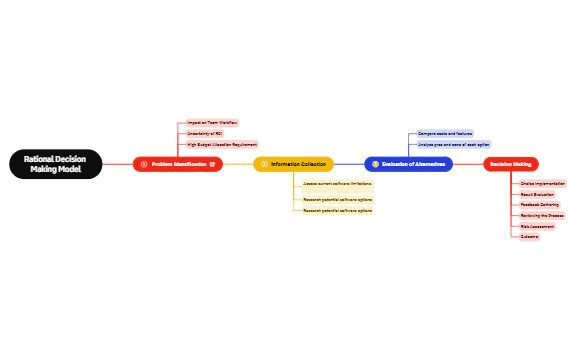
The Rational Decision Making Model mind map template provides senior managers with a structured 6-step framework for making informed, data-driven decisions. Covering problem identification through decision execution, this template includes 19 nodes across key stages such as Problem Identification, Information Collection, Evaluation of Alternatives, and Decision Making. It guides users through assessing 'Impact on Team Workflow', 'Uncertainty of ROI', and 'High Budget Allocation Requirement', then moves to comparing costs and features, analyzing pros and cons, and finally implementing the choice with result evaluation and feedback gathering. Designed for high-stakes business decisions, this rational decision making cheat sheet ensures systematic analysis and reduces bias.
使用条款Evaluating a major software vendor contract renewal with significant budget implications
Deciding whether to allocate a large budget to a new marketing campaign with uncertain ROI
Choosing between multiple strategic initiatives that impact team workflow and resource allocation
Open the .xmind file in Xmind desktop or web application.
Start with the Problem Identification branch: fill in the specific issue, its impact on workflow, ROI uncertainty, and budget requirements.
Move to Information Collection: list current limitations and research potential options under the respective nodes.
In Evaluation of Alternatives, compare costs and features, then analyze pros and cons for each option.
Complete the Decision Making branch by documenting the chosen option, implementation steps, risk assessment, and plan for result evaluation and feedback.
The template includes 19 nodes across 4 main branches: Problem Identification, Information Collection, Evaluation of Alternatives, and Decision Making. It covers steps from assessing impact and ROI to implementing choices and gathering feedback.
Start by identifying the problem (e.g., software limitations), then collect information on options. Evaluate alternatives by comparing costs and features, then make a decision. Use the Decision Making branch to implement, evaluate results, and gather feedback.
Yes, the template is fully editable in Xmind desktop or web. You can add, remove, or modify nodes to fit your specific decision context, such as changing criteria or adding risk assessments.
Use it in a group setting to collaboratively fill each branch. Start with Problem Identification to align on the issue, then assign team members to research options. Discuss pros and cons together before finalizing the decision.
Absolutely. The template provides generic criteria like 'Compare costs and features' and 'Analyze pros and cons'. You can replace these with your own metrics, such as vendor support, scalability, or integration ease.
把你的思维导图模板分享给全球创作者,从你的作品中获得收益。

