


'%3e%3cpath%20d='M9.59961%204H22.3996'%20stroke='%23FF9334'%20stroke-width='1.92'%20stroke-linecap='round'/%3e%3cpath%20d='M12.0001%204V12.8L7.20006%2025.6C6.72006%2026.928%207.68006%2028%209.12006%2028H22.8801C24.3201%2028%2025.2801%2026.928%2024.8001%2025.6L20.0001%2012.8V4'%20stroke='%23FF9334'%20stroke-width='1.92'%20stroke-linecap='round'%20stroke-linejoin='round'/%3e%3cpath%20d='M9.12012%2019.2002H22.8801'%20stroke='%23FF9334'%20stroke-width='1.92'/%3e%3cpath%20d='M12%2024C12.5523%2024%2013%2023.5523%2013%2023C13%2022.4477%2012.5523%2022%2012%2022C11.4477%2022%2011%2022.4477%2011%2023C11%2023.5523%2011.4477%2024%2012%2024Z'%20fill='%23FF9334'/%3e%3cpath%20d='M19.5%2024C20.3284%2024%2021%2023.3284%2021%2022.5C21%2021.6716%2020.3284%2021%2019.5%2021C18.6716%2021%2018%2021.6716%2018%2022.5C18%2023.3284%2018.6716%2024%2019.5%2024Z'%20fill='%23FF9334'/%3e%3cpath%20d='M16%2026C16.5523%2026%2017%2025.5523%2017%2025C17%2024.4477%2016.5523%2024%2016%2024C15.4477%2024%2015%2024.4477%2015%2025C15%2025.5523%2015.4477%2026%2016%2026Z'%20fill='%23FF9334'/%3e%3c/g%3e%3cdefs%3e%3cclipPath%20id='clip0_11502_53328'%3e%3crect%20width='32'%20height='32'%20fill='white'/%3e%3c/clipPath%3e%3c/defs%3e%3c/svg%3e)

Undergraduate biology or nutrition students
Preparing for a biochemistry exam on protein structure and function
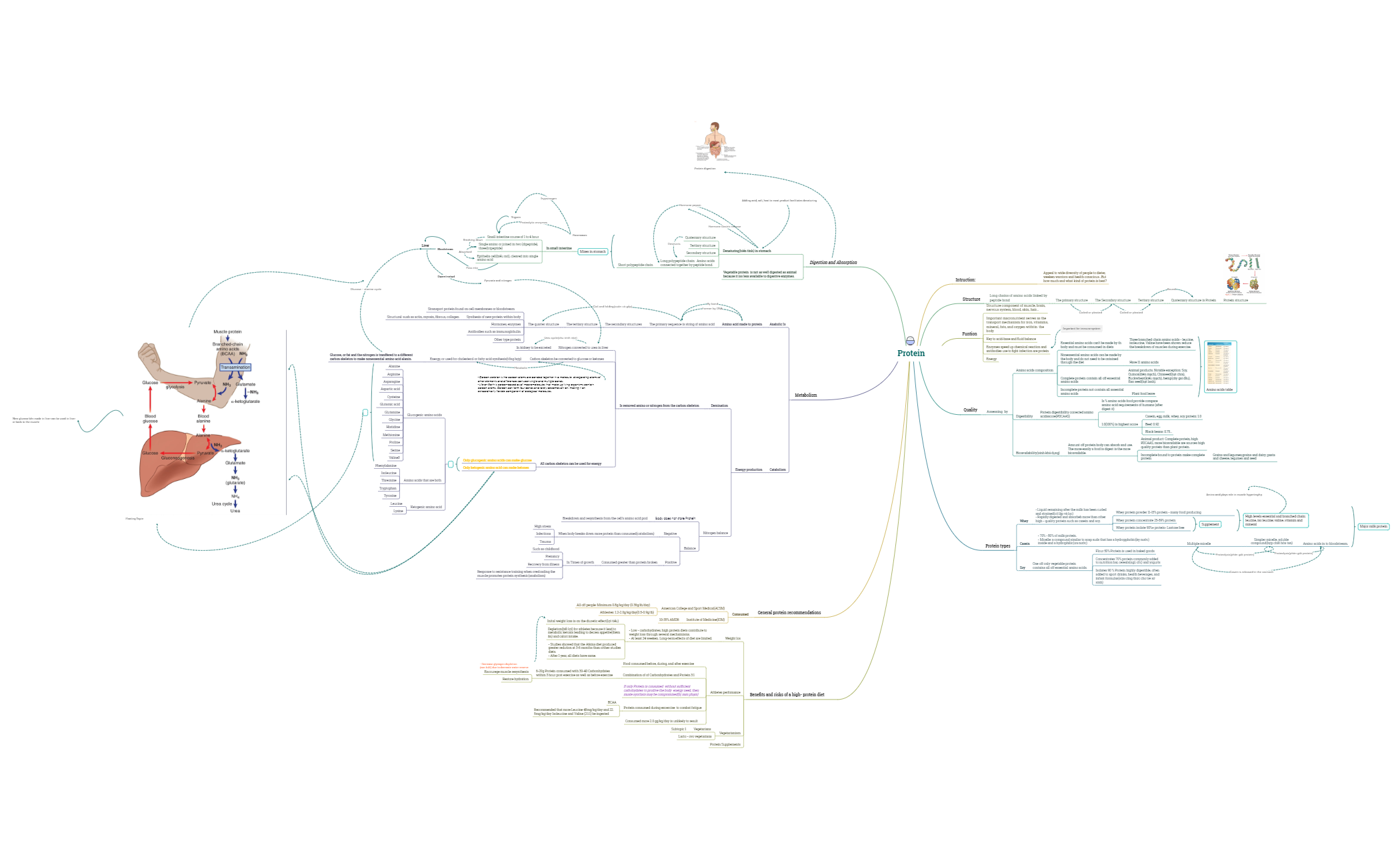
This Protein mind map template provides a comprehensive breakdown of protein structures, functions, and their significance in biological processes, covering over 190 nodes across topics such as amino acid composition, protein types (Whey, Casein, Soy), and metabolism. Designed for students and professionals in life sciences, it includes detailed sections on 'Structure' (primary, secondary, tertiary, quaternary), 'Quality' (PDCAAS score, bioavailability), and 'General protein recommendations' (ACSM guidelines: 0.8 g/kg/day for all, 1.2-2.0 g/kg/day for athletes). The template also explores 'Benefits and risks of a high-protein diet', including weight loss mechanisms and athletic performance. With its structured layout, this Protein cheat sheet serves as a complete reference for understanding protein digestion, absorption, and the role of amino acids in muscle hypertrophy.
使用條款Preparing for a biochemistry exam on protein structure and function
Designing a sports nutrition plan and need to compare protein sources
Writing a research paper on protein metabolism and need a visual framework
Launch the .xmind file to navigate through the comprehensive branches covering protein structures, types, and metabolic functions.
Expand the collapsed sub-nodes to read specific details and personalize the map by adding your own research notes or images.
Save your customized protein cheat sheet as a PDF or image file to share your biological insights with others.
It covers protein functions, structure, quality assessment, types (Whey, Casein, Soy), metabolism, digestion, absorption, and dietary recommendations with over 190 nodes.
Open the .xmind file in Xmind, then explore branches like 'Structure' or 'Metabolism' to visualize amino acid chains and metabolic pathways. Customize with your own notes.
Yes, the Xmind template is fully editable. You can add, remove, or rearrange nodes, and export it as an image or PDF for printing.
PDCAAS stands for Protein Digestibility Corrected Amino Acid Score, a method for evaluating protein quality based on amino acid requirements and digestibility.
Absolutely. The 'Amino acids table' node under 'Quality' can be expanded with your own data, such as food sources or daily requirements.
The mind map uses a central 'Protein' root with major branches like 'Funtion', 'Structure', 'Quality', 'Protein types', and 'Metabolism', making it easy to navigate.
把你的心智圖範本分享給全球創作者,從你的作品中獲得收益。

