




High school or college biology students
Preparing for a biology exam on plant physiology
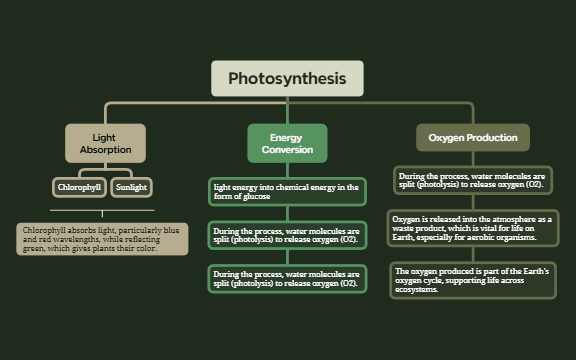
The Photosynthesis mind map template breaks down the process by which plants convert sunlight into chemical energy, covering 13 nodes across three core branches: Light Absorption, Energy Conversion, and Oxygen Production. It details how chlorophyll absorbs blue and red wavelengths while reflecting green, how light energy is transformed into glucose, and how water molecules are split via photolysis to release oxygen. This Photosynthesis cheat sheet is ideal for biology students, educators, and anyone studying plant physiology. Key nodes include 'Chlorophyll', 'Sunlight', and 'light energy into chemical energy in the form of glucose'. The template provides a concise, visual overview of the photosynthetic process, making complex concepts easy to grasp.
Conditions d'utilisationPreparing for a biology exam on plant physiology
Designing a lesson plan for teaching photosynthesis
Reviewing the basics of photosynthesis for a research project
Open the .xmind file in Xmind (desktop, web, or mobile app).
Explore the three main branches: Light Absorption, Energy Conversion, and Oxygen Production.
Click on any node to read its description or add your own notes.
Customize the template by adding new nodes, changing colors, or inserting images to suit your study needs.
Export the mind map as an image, PDF, or presentation for sharing or printing.
The template covers three main branches: Light Absorption (chlorophyll, sunlight), Energy Conversion (glucose production, photolysis), and Oxygen Production (oxygen release, oxygen cycle). It contains 13 nodes total.
Open the .xmind file in Xmind, then explore each branch to understand the process. You can add notes, images, or links to deepen your knowledge. Use it as a study guide or revision aid.
Yes, the template is fully editable in Xmind. You can customize nodes, add details, or export it as an image or PDF for printing.
Review the three main branches sequentially: Light Absorption, then Energy Conversion, then Oxygen Production. Use the visual layout to connect concepts like chlorophyll, photolysis, and glucose.
Absolutely. The template provides a clear structure for lectures or handouts. You can project it on a screen or share it digitally with students.
Partagez vos modèles de cartes mentales avec des créateurs du monde entier et commencez à gagner avec votre travail.
