




Academic researchers and graduate students in psychology or education
Designing a quantitative study on the impact of parenting styles on college students' stress levels.
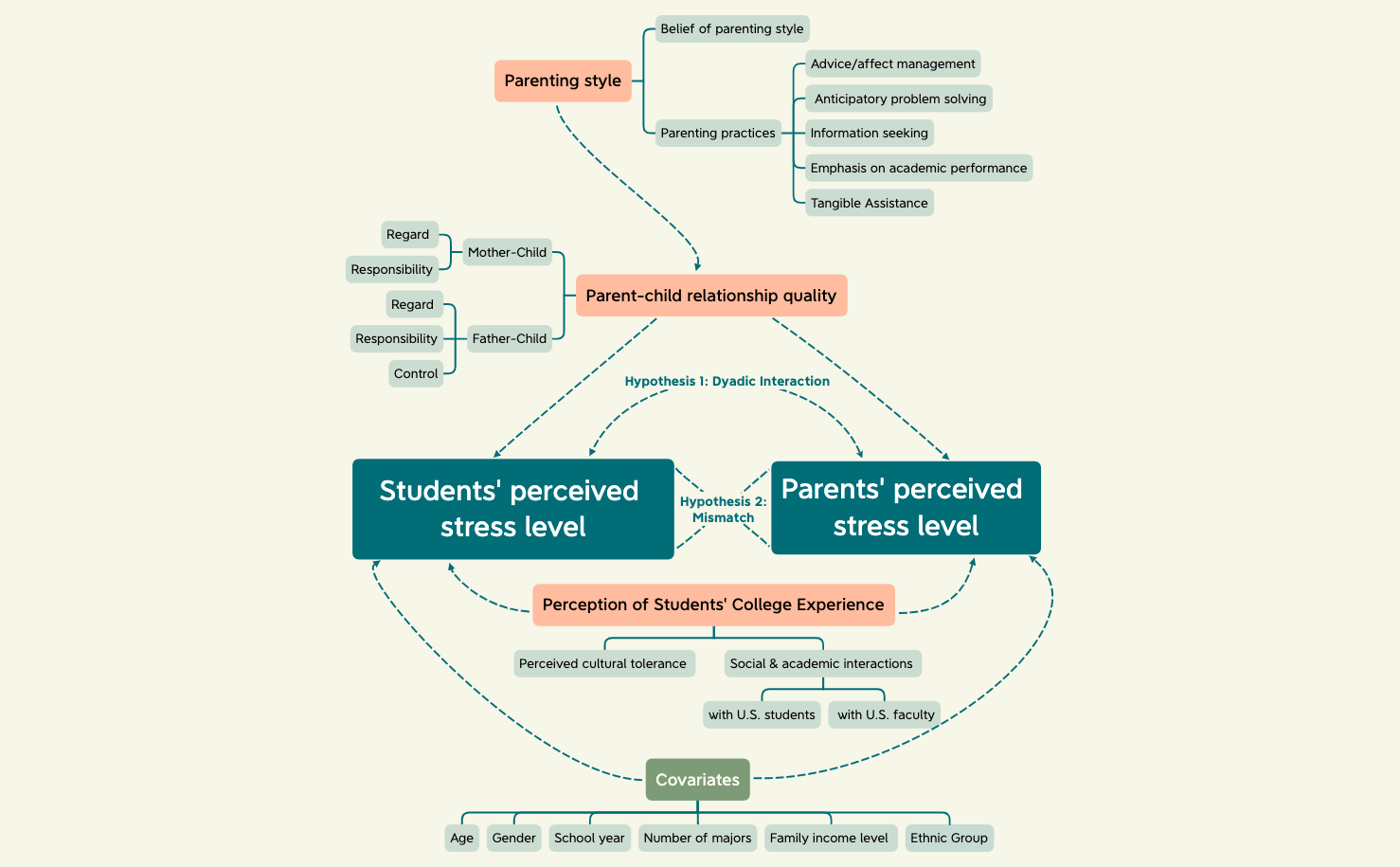
This mind map template, 'Students' perceived stress level', provides a structured framework for analyzing how parenting styles and perceived stress levels interact among college students and their parents. It covers 30 nodes across five major branches, including 'Perception of Students' College Experience', 'Parent-child relationship quality', 'Parenting style', 'Parents' perceived stress level', and 'Covariates'. Key variables such as 'Perceived cultural tolerance', 'Mother-Child Regard', and 'Advice/affect management' are explicitly mapped to support hypothesis testing. The template is ideal for researchers designing studies on family dynamics and academic stress, offering a ready-to-use cheat sheet for variable identification and relationship modeling.
使用條款Designing a quantitative study on the impact of parenting styles on college students' stress levels.
Preparing a research proposal or thesis outline that examines parent-child dynamics and academic adjustment.
Teaching a course on family systems or developmental psychology and needing a visual framework for discussion.
Launch the template in Xmind to explore the five major branches covering parenting styles and student stress levels.
Replace the placeholder nodes with your specific data points and add child nodes to capture detailed measurement items.
Complete your relationship modeling and export the map as an image or PDF for use in your research documentation.
The template includes 30 nodes organized into five main branches: Perception of Students' College Experience, Parent-child relationship quality, Parenting style, Parents' perceived stress level, and Covariates. Each branch contains specific variables like 'Perceived cultural tolerance', 'Mother-Child Regard', and 'Advice/affect management'.
Open the .xmind file in Xmind, then customize each branch by adding your own data or hypotheses. For example, under 'Parenting style', you can expand 'Parenting practices' to include specific behaviors relevant to your study. Use the 'Covariates' section to control for demographic factors.
Yes, the template is free to download and fully editable in Xmind (desktop or web). You can add, remove, or rename nodes to fit your research framework.
This branch captures the quality of relationships between students and their parents, broken down into 'Mother-Child' and 'Father-Child' dimensions. Each includes 'Regard', 'Responsibility', and 'Control' to assess different aspects of the relationship.
Absolutely. The 'Covariates' branch lists common demographic variables like 'Age', 'Gender', and 'Family income level'. You can modify these or add new ones by editing the node text directly in Xmind.
把你的心智圖範本分享給全球創作者,從你的作品中獲得收益。

