


'%3e%3cpath%20d='M9.59961%204H22.3996'%20stroke='%23FF9334'%20stroke-width='1.92'%20stroke-linecap='round'/%3e%3cpath%20d='M12.0001%204V12.8L7.20006%2025.6C6.72006%2026.928%207.68006%2028%209.12006%2028H22.8801C24.3201%2028%2025.2801%2026.928%2024.8001%2025.6L20.0001%2012.8V4'%20stroke='%23FF9334'%20stroke-width='1.92'%20stroke-linecap='round'%20stroke-linejoin='round'/%3e%3cpath%20d='M9.12012%2019.2002H22.8801'%20stroke='%23FF9334'%20stroke-width='1.92'/%3e%3cpath%20d='M12%2024C12.5523%2024%2013%2023.5523%2013%2023C13%2022.4477%2012.5523%2022%2012%2022C11.4477%2022%2011%2022.4477%2011%2023C11%2023.5523%2011.4477%2024%2012%2024Z'%20fill='%23FF9334'/%3e%3cpath%20d='M19.5%2024C20.3284%2024%2021%2023.3284%2021%2022.5C21%2021.6716%2020.3284%2021%2019.5%2021C18.6716%2021%2018%2021.6716%2018%2022.5C18%2023.3284%2018.6716%2024%2019.5%2024Z'%20fill='%23FF9334'/%3e%3cpath%20d='M16%2026C16.5523%2026%2017%2025.5523%2017%2025C17%2024.4477%2016.5523%2024%2016%2024C15.4477%2024%2015%2024.4477%2015%2025C15%2025.5523%2015.4477%2026%2016%2026Z'%20fill='%23FF9334'/%3e%3c/g%3e%3cdefs%3e%3cclipPath%20id='clip0_11502_53328'%3e%3crect%20width='32'%20height='32'%20fill='white'/%3e%3c/clipPath%3e%3c/defs%3e%3c/svg%3e)

Undergraduate or graduate chemical engineering students
Preparing for a chemical engineering exam on industrial gas production and C1 chemistry.
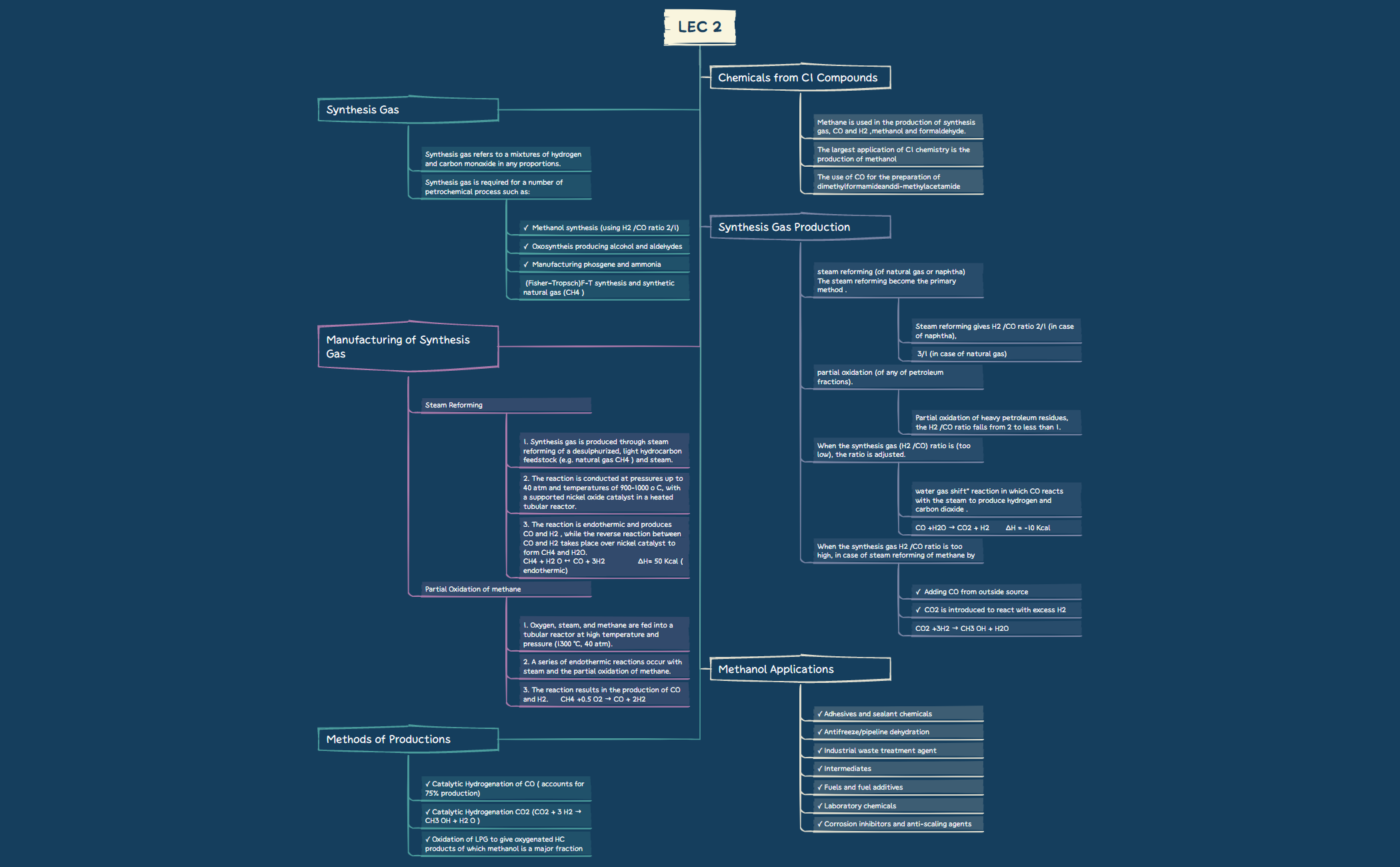
This LEC 2 mind map template covers the production and applications of synthesis gas (syngas), a mixture of hydrogen and carbon monoxide, with 46 nodes organized across 7 major branches. It details steam reforming and partial oxidation methods, methanol synthesis, and C1 chemistry, including specific reactions like the water gas shift (CO + H2O → CO2 + H2) and methanol production via catalytic hydrogenation of CO. The template is ideal for chemical engineering students and professionals studying syngas manufacturing processes and downstream products such as methanol, formaldehyde, and ammonia. Key nodes include 'Steam Reforming', 'Partial Oxidation of methane', and 'Methanol Applications'.
Termos e condiçõesPreparing for a chemical engineering exam on industrial gas production and C1 chemistry.
Designing a lecture or study module on syngas manufacturing processes for petrochemical courses.
Reviewing process options for syngas production during a plant design or optimization project.
Open the .xmind file to explore the seven major branches detailing syngas production methods like steam reforming and partial oxidation.
Personalize the 46 nodes by adding specific chemical reactions, highlighting key C1 chemistry concepts, or attaching your own research materials.
Utilize the collapse feature for self-quizzing on methanol applications before exporting your final map as a PDF or image for sharing.
Synthesis gas (syngas) is a mixture of hydrogen and carbon monoxide used in petrochemical processes like methanol synthesis, oxosynthesis, and Fischer-Tropsch synthesis. It is a key intermediate for producing fuels and chemicals.
The template covers steam reforming (of natural gas or naphtha) and partial oxidation of petroleum fractions. It also explains how to adjust the H2/CO ratio using the water gas shift reaction or by adding CO2.
Methanol applications include adhesives, antifreeze, industrial waste treatment, intermediates, fuels, laboratory chemicals, and corrosion inhibitors. The template also notes that methanol is produced via catalytic hydrogenation of CO or CO2.
If the ratio is too low, the water gas shift reaction (CO + H2O → CO2 + H2) is used. If too high, CO from an external source or CO2 is added to react with excess hydrogen.
Steam reforming is conducted at pressures up to 40 atm and temperatures of 900-1000°C using a supported nickel oxide catalyst in a heated tubular reactor. The reaction is endothermic.
Yes, you can open the .xmind file in Xmind and edit any node, add new branches, or adjust the layout to fit your study or presentation needs.
Compartilhe seus modelos de mapas mentais com criadores ao redor do mundo e comece a ganhar com seu trabalho.

