


'%3e%3cpath%20d='M6%2019.2002H26M8.6%2019.2002L10.2%2028.2002H21.8L23.4%2019.2002'%20stroke='%2352AA6F'%20stroke-width='2.25'%20stroke-linecap='round'%20stroke-linejoin='round'/%3e%3cpath%20d='M16%2019.2002V11.2002'%20stroke='%2352AA6F'%20stroke-width='2.25'%20stroke-linecap='round'/%3e%3cpath%20d='M16%2016C8%2013.8564%208%2010.2%208%207C11.2%207%2014.4%208.6%2016%2013.4'%20stroke='%2352AA6F'%20stroke-width='1.92'%20stroke-linejoin='round'/%3e%3cpath%20d='M16%2012.5C20.5%2012.5%2024%208.2%2024%205C20%205.00016%2016.5%207%2016%2012.5Z'%20stroke='%2352AA6F'%20stroke-width='1.92'%20stroke-linejoin='round'/%3e%3c/g%3e%3cdefs%3e%3cclipPath%20id='clip0_11502_53598'%3e%3crect%20width='32'%20height='32'%20fill='white'/%3e%3c/clipPath%3e%3c/defs%3e%3c/svg%3e)

Managers and executives who need to avoid cognitive biases and make evidence-based choices.
Preparing for a complex business decision with multiple stakeholders and conflicting data.
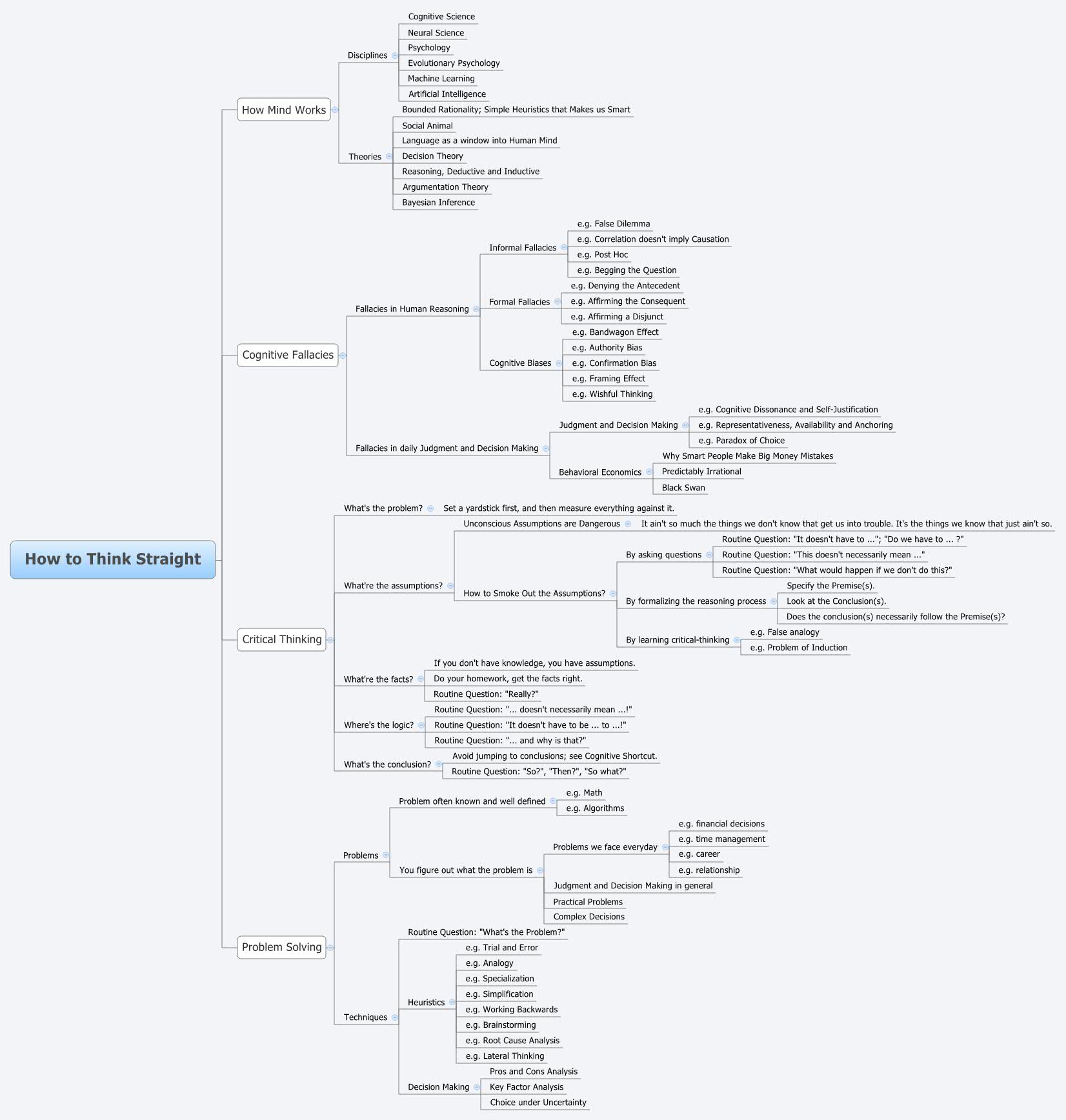
The 'How to Think Straight' mind map template, designed for students, professionals, and lifelong learners, covers 101 nodes across four major branches: How Mind Works, Cognitive Fallacies, Critical Thinking, and Problem Solving. This comprehensive thinking template explores disciplines and theories of the mind, catalogs fallacies in human reasoning and daily judgment, and provides a structured framework for critical analysis—asking 'What's the problem?', 'What're the assumptions?', 'What're the facts?', 'Where's the logic?', and 'What's the conclusion?'—alongside practical problem-solving techniques. It serves as both a cognitive bias cheat sheet and a critical thinking guide, helping users identify reasoning errors and improve decision-making. The mind map is organized as a radial diagram with color-coded branches, making it easy to navigate and customize in Xmind.
Terms and ConditionsPreparing for a complex business decision with multiple stakeholders and conflicting data.
Studying for a critical thinking exam or writing an argumentative essay that requires logical analysis.
Facilitating a team workshop on problem-solving and decision-making skills.
Open the template in Xmind and browse the four main branches covering the mind, fallacies, critical thinking, and problem solving.
Expand the 101 nodes to study detailed theories and customize the map by adding your own reasoning examples or new subtopics.
Use the structured critical thinking framework to solve problems and then export your final analysis as an image or PDF.
The template includes 101 nodes organized into four main branches: How Mind Works, Cognitive Fallacies, Critical Thinking, and Problem Solving. It covers disciplines, theories, fallacies, critical thinking questions, and problem-solving techniques.
Start by exploring the Cognitive Fallacies branch to identify biases, then apply the Critical Thinking questions—like 'What're the facts?' and 'Where's the logic?'—to analyze a situation. Finally, use the Problem Solving techniques to find solutions.
Yes, the template is free to download and fully editable in Xmind (desktop, web, or mobile). You can add your own examples, notes, or reorganize branches to suit your needs.
Review the 'Fallacies in Human Reasoning' and 'Fallacies in daily Judgment and Decision Making' nodes. For each fallacy, create a real-life example as a child node to deepen understanding and retention.
Absolutely. The 'Techniques' node under Problem Solving can be expanded with your preferred methods (e.g., SWOT, root cause analysis). Simply add new subtopics or modify existing ones in Xmind.
Share your mind map templates with creators around the world and start earning from your work.

