


'%3e%3cpath%20d='M6.42532%207.40439C6.16072%207.40439%205.94575%207.48708%205.78037%207.65244C5.615%207.80127%205.53231%208.01627%205.53231%208.2974V23.7018C5.53231%2023.9664%205.615%2024.1813%205.78037%2024.3467C5.94575%2024.5122%206.16072%2024.5947%206.42532%2024.5947H8.4842C8.76533%2024.5947%208.98032%2024.5203%209.12916%2024.3715C9.29452%2024.2062%209.3772%2023.9829%209.3772%2023.7018V8.2974C9.3772%208.01627%209.29452%207.80127%209.12916%207.65244C8.98032%207.48708%208.76533%207.40439%208.4842%207.40439H6.42532ZM3.42383%208.09895C3.42383%207.25556%203.67188%206.57753%204.168%206.06487C4.68064%205.55223%205.3504%205.2959%206.17727%205.2959H8.68264C9.52604%205.2959%2010.2041%205.55223%2010.7167%206.06487C11.2294%206.561%2011.4857%207.23075%2011.4857%208.07414V11.7702C11.6841%2011.7206%2011.8991%2011.6958%2012.1306%2011.6958H16.7197H16.9677L16.6949%2010.7532C16.5957%2010.4224%2016.5461%2010.1165%2016.5461%209.83535C16.5461%209.24001%2016.7197%208.72737%2017.0669%208.2974C17.4308%207.85089%2017.9353%207.54495%2018.5801%207.37958L20.9615%206.75943C21.2095%206.69329%2021.4825%206.66022%2021.7801%206.66022C22.425%206.66022%2022.9791%206.84212%2023.4421%207.20595C23.9217%207.56975%2024.2524%208.07414%2024.4343%208.7191L28.4529%2022.5358C28.5356%2022.8667%2028.5769%2023.1643%2028.5769%2023.429C28.5769%2024.0243%2028.3949%2024.5451%2028.0311%2024.9917C27.6839%2025.4382%2027.1877%2025.7442%2026.5428%2025.9094L24.1615%2026.5048C23.8306%2026.5875%2023.5413%2026.6288%2023.2932%2026.6288C22.6813%2026.6288%2022.1356%2026.4469%2021.6561%2026.0832C21.193%2025.7194%2020.8705%2025.2149%2020.6887%2024.5699L19.498%2020.4522V23.9002C19.498%2024.7437%2019.2417%2025.4216%2018.729%2025.9342C18.2329%2026.4469%2017.5714%2026.7032%2016.7445%2026.7032H12.1803C11.4692%2026.7032%2010.8904%2026.5296%2010.4439%2026.1824C9.98082%2026.5296%209.41028%2026.7032%208.73226%2026.7032H6.22688C5.38348%2026.7032%204.70546%2026.4469%204.1928%2025.9342C3.68015%2025.4382%203.42383%2024.7766%203.42383%2023.9498V8.09895ZM12.3787%2013.8043C12.1141%2013.8043%2011.8991%2013.887%2011.7337%2014.0523C11.5684%2014.2012%2011.4857%2014.4162%2011.4857%2014.6973V23.7018C11.4857%2023.9664%2011.5684%2024.1813%2011.7337%2024.3467C11.8991%2024.5122%2012.1141%2024.5947%2012.3787%2024.5947H16.4964C16.7777%2024.5947%2016.9925%2024.5203%2017.1413%2024.3715C17.3068%2024.2062%2017.3895%2023.9829%2017.3895%2023.7018V14.6973C17.3895%2014.4162%2017.3068%2014.2012%2017.1413%2014.0523C16.9925%2013.887%2016.7777%2013.8043%2016.4964%2013.8043H12.3787ZM19.3988%209.33924C18.9522%209.47153%2018.729%209.73614%2018.729%2010.133C18.729%2010.1992%2018.7455%2010.2984%2018.7786%2010.4307L22.673%2023.8506C22.8385%2024.2971%2023.1196%2024.5203%2023.5165%2024.5203C23.6322%2024.5203%2023.7233%2024.5122%2023.7893%2024.4955L25.7242%2023.9498C26.1708%2023.8176%2026.394%2023.553%2026.394%2023.156C26.394%2023.0899%2026.3773%2022.9907%2026.3444%2022.8584L22.4746%209.46327C22.4085%209.24828%2022.301%209.08291%2022.1522%208.96715C22.0199%208.83486%2021.8628%208.76871%2021.6809%208.76871C21.6148%208.76871%2021.5154%208.78524%2021.3833%208.81831L19.3988%209.33924Z'%20fill='%23FF9334'/%3e%3c/g%3e%3cdefs%3e%3cclipPath%20id='clip0_11502_53285'%3e%3crect%20width='32'%20height='32'%20fill='white'/%3e%3c/clipPath%3e%3c/defs%3e%3c/svg%3e)

Philosophy students and exam candidates
Preparing for a metaethics exam that covers Stevenson's emotivism and the debate over the 'vital' sense of 'good'.
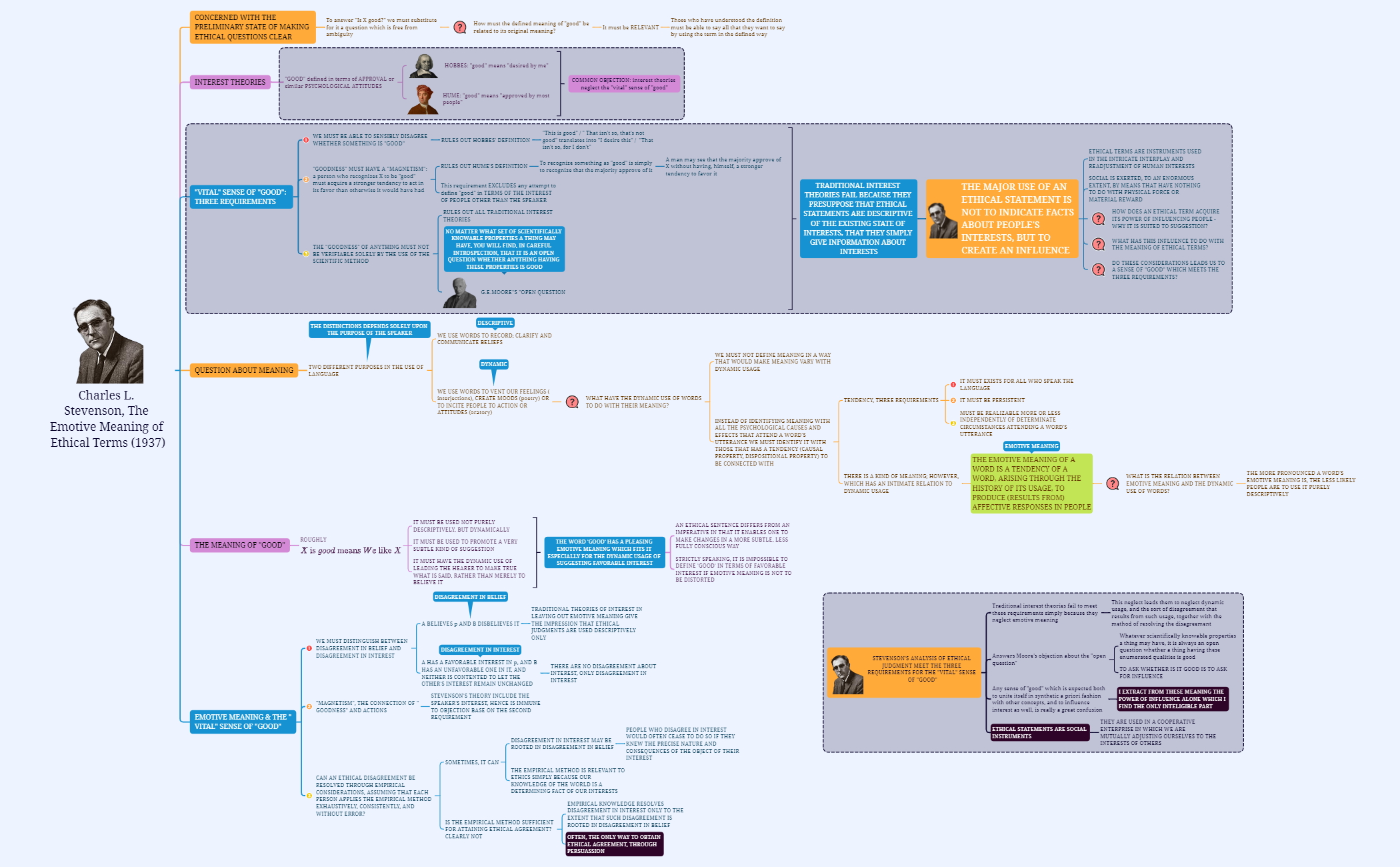
Charles L. Stevenson's 1937 paper 'The Emotive Meaning of Ethical Terms' is dissected in this 79-node mind map, which systematically unpacks his critique of traditional interest theories and his defense of emotivism. The template covers Stevenson's three requirements for the 'vital' sense of 'good'—including that 'goodness' must have 'magnetism'—and contrasts them with Hobbes' and Hume's definitions. It also explores the distinction between 'disagreement in belief' and 'disagreement in interest', showing how ethical terms function as social instruments. This Hempel 1-3 mind map template serves as a concise cheat sheet for students and philosophers studying metaethics, providing a structured overview of Stevenson's arguments against scientific verifiability and his resolution of Moore's 'open question'.
NutzungsbedingungenPreparing for a metaethics exam that covers Stevenson's emotivism and the debate over the 'vital' sense of 'good'.
Writing a term paper on non-cognitivist theories and need a structured comparison of Stevenson with Hobbes and Hume.
Teaching a course on 20th-century ethical theory and want a visual aid to explain the three requirements and the open question.
Open the .xmind file and expand the central branches to explore Stevenson's critique of interest theories and the vital sense of good.
Customize the template by adding your own notes, highlighting key quotes, or linking to related metaethical thinkers like Ayer or Hare.
Save your finalized mind map as an image, PDF, or markdown file to use as a study cheat sheet or presentation handout.
The 'vital' sense refers to the ethically significant meaning of 'good' that must allow disagreement, have magnetism (motivating action), and not be verifiable solely by science. Stevenson argues traditional interest theories fail to capture this sense.
Traditional theories define 'good' descriptively (e.g., 'desired by me'), while Stevenson emphasizes emotive meaning—ethical terms are used dynamically to influence attitudes, not just describe facts.
G.E. Moore argued that for any definition of 'good', it remains an open question whether that thing is good. Stevenson replies that asking 'Is it good?' is asking for influence, not a factual check, so the open question is resolved by recognizing emotive meaning.
Sometimes, when disagreement in interest is rooted in disagreement in belief. But often empirical methods are insufficient; persuasion is needed to resolve deeper clashes of interest.
Magnetism means that recognizing something as 'good' must give a person a stronger tendency to act in its favor. This requirement rules out definitions like Hume's that rely on majority approval.
Yes, the Xmind template is fully editable—you can add, remove, or rearrange nodes. It is available as a free download from the Xmind template marketplace.
Teilen Sie Ihre Mindmap-Vorlagen mit Erstellern weltweit und verdienen Sie mit Ihrer Arbeit.

