


'%3e%3cpath%20d='M9.59961%204H22.3996'%20stroke='%23FF9334'%20stroke-width='1.92'%20stroke-linecap='round'/%3e%3cpath%20d='M12.0001%204V12.8L7.20006%2025.6C6.72006%2026.928%207.68006%2028%209.12006%2028H22.8801C24.3201%2028%2025.2801%2026.928%2024.8001%2025.6L20.0001%2012.8V4'%20stroke='%23FF9334'%20stroke-width='1.92'%20stroke-linecap='round'%20stroke-linejoin='round'/%3e%3cpath%20d='M9.12012%2019.2002H22.8801'%20stroke='%23FF9334'%20stroke-width='1.92'/%3e%3cpath%20d='M12%2024C12.5523%2024%2013%2023.5523%2013%2023C13%2022.4477%2012.5523%2022%2012%2022C11.4477%2022%2011%2022.4477%2011%2023C11%2023.5523%2011.4477%2024%2012%2024Z'%20fill='%23FF9334'/%3e%3cpath%20d='M19.5%2024C20.3284%2024%2021%2023.3284%2021%2022.5C21%2021.6716%2020.3284%2021%2019.5%2021C18.6716%2021%2018%2021.6716%2018%2022.5C18%2023.3284%2018.6716%2024%2019.5%2024Z'%20fill='%23FF9334'/%3e%3cpath%20d='M16%2026C16.5523%2026%2017%2025.5523%2017%2025C17%2024.4477%2016.5523%2024%2016%2024C15.4477%2024%2015%2024.4477%2015%2025C15%2025.5523%2015.4477%2026%2016%2026Z'%20fill='%23FF9334'/%3e%3c/g%3e%3cdefs%3e%3cclipPath%20id='clip0_11502_53328'%3e%3crect%20width='32'%20height='32'%20fill='white'/%3e%3c/clipPath%3e%3c/defs%3e%3c/svg%3e)

Science teachers and curriculum designers
Preparing a middle school science lesson on microorganisms and disease prevention
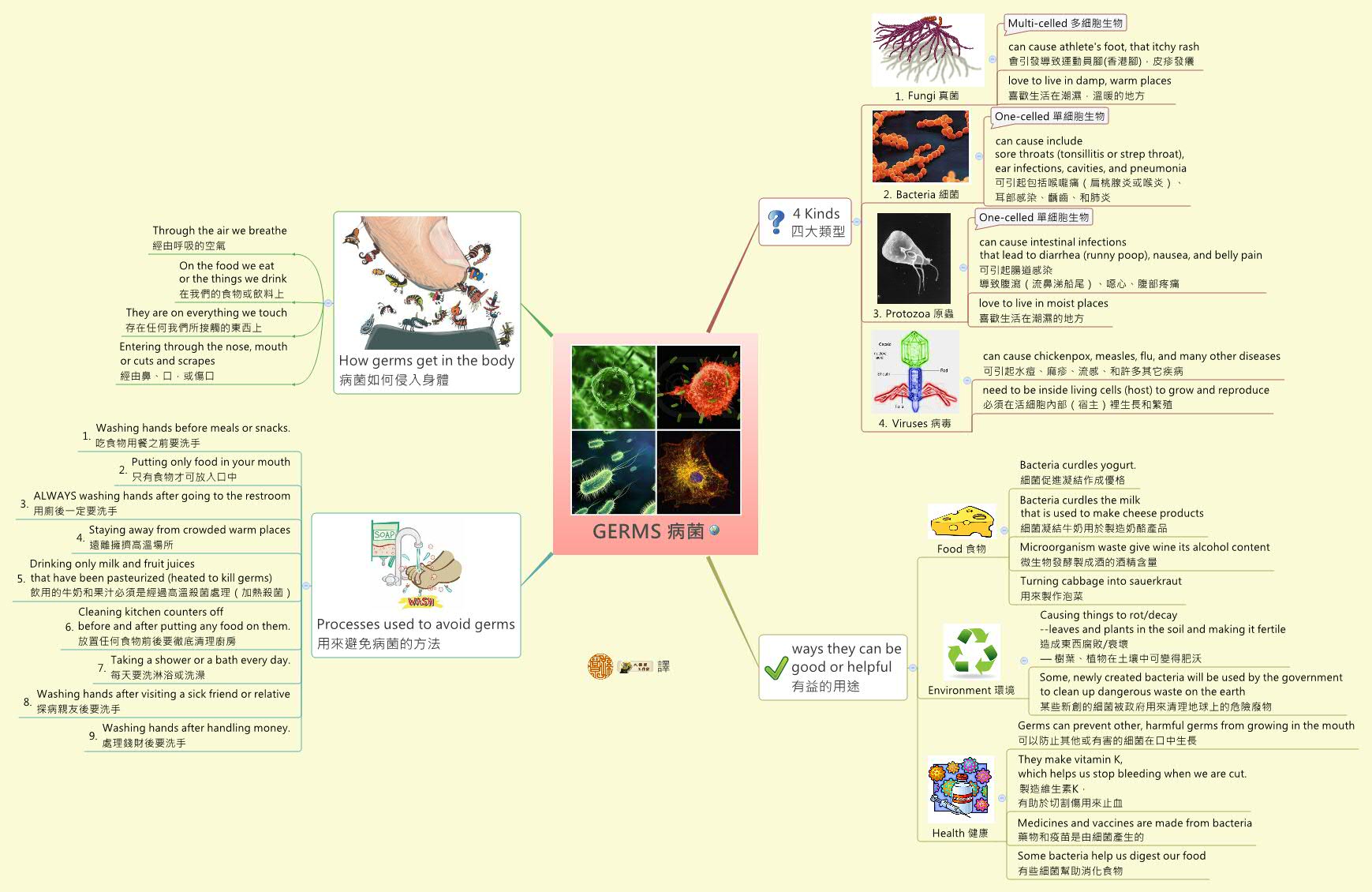
The GERMS 病菌 mind map template provides a comprehensive overview of germs, covering 4 major types (Fungi, Bacteria, Protozoa, Viruses), their beneficial uses, transmission routes, and prevention strategies. With 46 nodes across a single sheet, it is designed for health education in K-12 or academic settings. Key branches include '4 Kinds 四大類型' detailing each microorganism's characteristics and diseases, and 'ways they can be good or helpful 有益的用途' highlighting roles in food, environment, and health. The template also outlines 'How germs get in the body 病菌如何侵入身體' and 'Processes used to avoid germs 用來避免病菌的方法', making it a practical study aid for understanding microbiology and hygiene.
Conditions d'utilisationPreparing a middle school science lesson on microorganisms and disease prevention
Creating a study guide for a health or biology exam covering germ types and hygiene
Developing a public health awareness poster or handout about handwashing and food safety
Launch the template in Xmind to browse the main branches covering the four types of germs, their transmission, and prevention strategies.
Click on specific nodes to read detailed characteristics of microorganisms or expand collapsed branches to reveal all forty-six educational topics.
Customize the content by adding your own examples or images before exporting the final mind map as a PDF or image for sharing.
The template covers 4 types of germs (Fungi, Bacteria, Protozoa, Viruses), their beneficial uses, how they enter the body, and prevention methods. It has 46 nodes organized into 5 main branches.
Open the .xmind file in Xmind, then explore each branch. You can customize nodes by adding local examples or images. Use it as a visual aid for lessons on microbiology and hygiene.
Yes, the Xmind template is fully editable. You can add, remove, or modify nodes. Export it as an image or PDF for printing or sharing.
It organizes the four main types of germs—Fungi, Bacteria, Protozoa, and Viruses—each with descriptions and examples of diseases they cause, aiding in comparative study.
Absolutely. You can edit the 'Processes used to avoid germs' branch to add specific hygiene practices relevant to your audience, such as hand sanitizer use or mask-wearing.
Use it for teaching about germs in science class, preparing health presentations, or as a study guide for exams on microbiology. It's suitable for students and educators.
Partagez vos modèles de cartes mentales avec des créateurs du monde entier et commencez à gagner avec votre travail.

