




Game designers and creative technologists
Brainstorming new game concepts that integrate smart lighting and IoT devices.
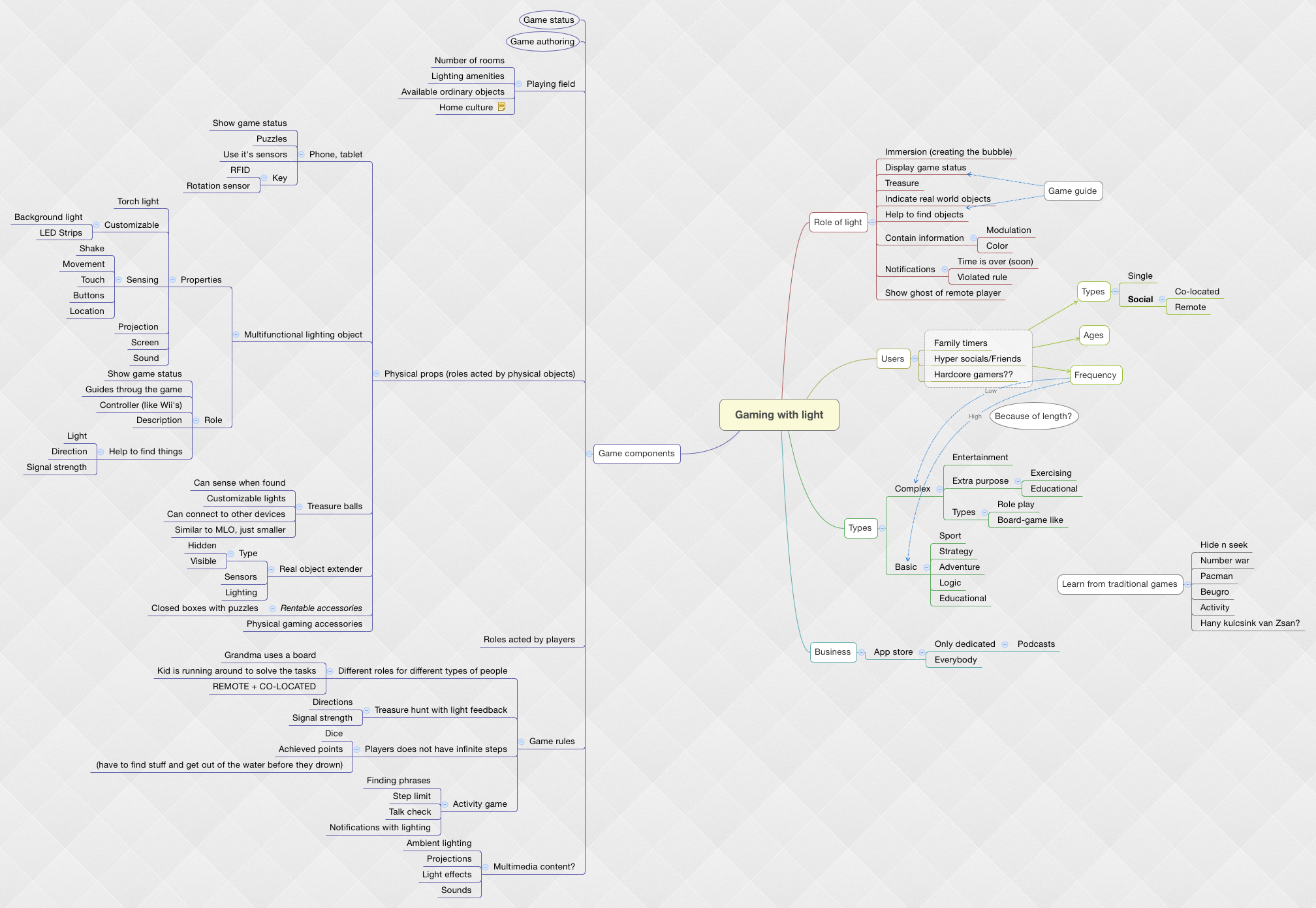
The 'Gaming with light' mind map template, with 131 nodes across a single sheet, explores how lighting technology can transform game design. It covers the role of light in creating immersion, displaying game status, and acting as treasure, while detailing user segments like 'Family timers' and 'Hyper socials/Friends'. The template maps game types from 'Complex' (with subcategories like 'Role play' and 'Board-game like') to 'Basic' (including 'Sport', 'Strategy', and 'Educational'), and examines business models via app stores. Key components include 'Physical props' such as 'Treasure balls' and 'Multifunctional lighting object', along with game rules like 'Treasure hunt with light feedback' and 'Players does not have infinite steps'. This 'Gaming with light' template is a comprehensive cheat sheet for designers and researchers exploring light-based interactions in gaming.
Conditions d'utilisationBrainstorming new game concepts that integrate smart lighting and IoT devices.
Mapping out user segments and game mechanics for a location-based or augmented reality game.
Analyzing how light can be used for notifications, status display, and treasure mechanics in multiplayer games.
Download the .xmind file and open it to explore the core branches covering lighting roles, user segments, and game types.
Add your own game ideas and define specific physical props or rules within the existing nodes to tailor the design to your project.
Refine the structure by deleting unnecessary branches and export your final mind map as a PDF or image to share with your team.
The template includes 131 nodes covering the role of light, user types, game types, business models, game components, game guides, frequency, ages, and lessons from traditional games like Hide n seek and Pacman.
Open the .xmind file in Xmind, then explore branches like 'Role of light' to understand design principles, and 'Game components' to map physical props and rules. Customize nodes to fit your game concept.
Yes, the template is free to download and fully editable in Xmind. You can add, remove, or modify nodes to suit your project needs.
The template covers 'Complex' games (entertainment, extra purpose like exercising, role play, board-game like) and 'Basic' games (sport, strategy, adventure, logic, educational).
It includes 'Playing field' (number of rooms, lighting amenities), 'Physical props' (phone/tablet, multifunctional lighting object, treasure balls, real object extender, rentable accessories), 'Roles acted by players', and 'Game rules'.
Absolutely. The 'Types' branch includes 'Educational' under both 'Complex' and 'Basic', and the 'Role of light' branch covers 'Contain information' via modulation and color, ideal for learning scenarios.
Partagez vos modèles de cartes mentales avec des créateurs du monde entier et commencez à gagner avec votre travail.

