




Game designers and analysts
Analyzing the game design and monetization of Fallout Shelter for a postmortem or case study.
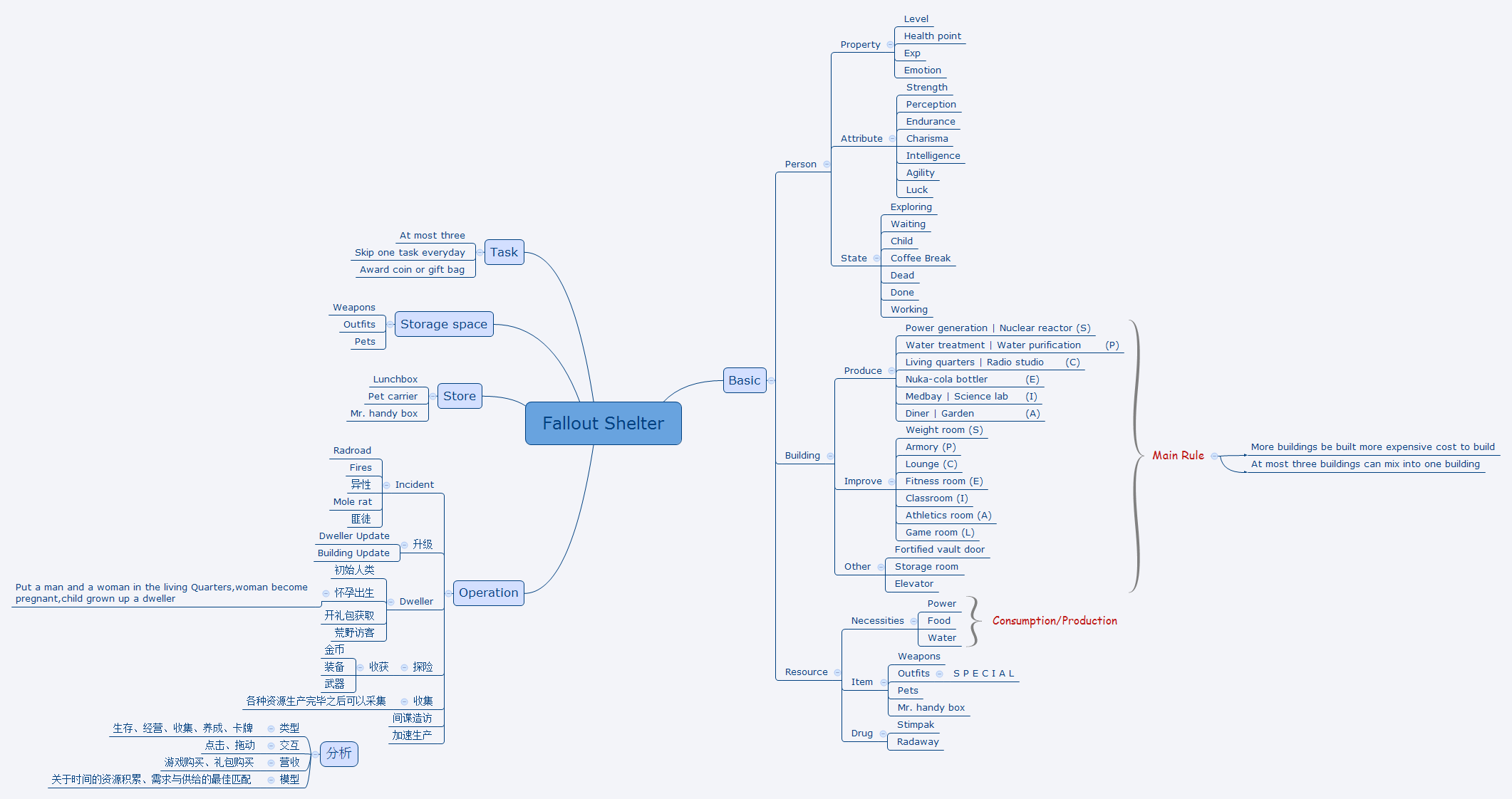
The Fallout Shelter mind map template offers a comprehensive breakdown of the mobile game's core mechanics across 108 nodes, covering Basic, Operation, Store, Storage space, and Task systems. Designed for game analysts and strategy enthusiasts, this Fallout Shelter cheat sheet organizes key elements like Person, Building, and Resource under Basic, while Operation details Incident, Dweller, and 探险 (exploration). The template also includes a 分析 (analysis) branch with 类型, 交互, 营收, and 模型, providing a structured framework for understanding game design and monetization. This Fallout Shelter template is ideal for deconstructing gameplay loops, resource management, and player progression.
使用條款Analyzing the game design and monetization of Fallout Shelter for a postmortem or case study.
Planning a strategy guide for new players to optimize shelter operations and resource management.
Comparing Fallout Shelter's mechanics with other mobile survival games for competitive analysis.
Open the template in Xmind to browse the six main branches covering game mechanics like Basic, Operation, and Analysis.
Click any of the 108 nodes to add your own notes, icons, or sub-nodes to reflect your specific gameplay strategy.
Save your finalized game breakdown as an image or PDF to share your resource management insights with others.
The template covers 108 nodes across six branches: Basic (Person, Building, Resource), Operation (Incident, 升级, Dweller, 探险, 收集, etc.), Store (Lunchbox, Pet carrier, Mr. handy box), Storage space (Weapons, Outfits, Pets), Task (At most three, Skip one task everyday), and 分析 (类型, 交互, 营收, 模型).
Use the 分析 branch to evaluate game types, player interactions, revenue streams, and monetization models. Cross-reference with Operation and Store to identify how incidents and loot boxes drive engagement and spending.
Yes, the .xmind file is fully editable. You can add custom notes, icons, or reorganize branches to fit your analysis needs. It works on Xmind desktop and web.
The Task branch shows that tasks are limited to three at a time, one can be skipped daily, and rewards include coins or gift bags. This helps understand daily engagement loops.
Absolutely. The Storage space branch lists Weapons, Outfits, and Pets as default categories. You can add new item types or subcategories to track inventory more granularly.
Operation includes Incident, 升级 (upgrades), Dweller management, 探险 (exploration), 收集 (collection), 间谍造访 (spy visits), and 加速生产 (rush production). Each node can be expanded with specific strategies.
把你的心智圖範本分享給全球創作者,從你的作品中獲得收益。

