


'%3e%3cpath%20d='M9.59961%204H22.3996'%20stroke='%23FF9334'%20stroke-width='1.92'%20stroke-linecap='round'/%3e%3cpath%20d='M12.0001%204V12.8L7.20006%2025.6C6.72006%2026.928%207.68006%2028%209.12006%2028H22.8801C24.3201%2028%2025.2801%2026.928%2024.8001%2025.6L20.0001%2012.8V4'%20stroke='%23FF9334'%20stroke-width='1.92'%20stroke-linecap='round'%20stroke-linejoin='round'/%3e%3cpath%20d='M9.12012%2019.2002H22.8801'%20stroke='%23FF9334'%20stroke-width='1.92'/%3e%3cpath%20d='M12%2024C12.5523%2024%2013%2023.5523%2013%2023C13%2022.4477%2012.5523%2022%2012%2022C11.4477%2022%2011%2022.4477%2011%2023C11%2023.5523%2011.4477%2024%2012%2024Z'%20fill='%23FF9334'/%3e%3cpath%20d='M19.5%2024C20.3284%2024%2021%2023.3284%2021%2022.5C21%2021.6716%2020.3284%2021%2019.5%2021C18.6716%2021%2018%2021.6716%2018%2022.5C18%2023.3284%2018.6716%2024%2019.5%2024Z'%20fill='%23FF9334'/%3e%3cpath%20d='M16%2026C16.5523%2026%2017%2025.5523%2017%2025C17%2024.4477%2016.5523%2024%2016%2024C15.4477%2024%2015%2024.4477%2015%2025C15%2025.5523%2015.4477%2026%2016%2026Z'%20fill='%23FF9334'/%3e%3c/g%3e%3cdefs%3e%3cclipPath%20id='clip0_11502_53328'%3e%3crect%20width='32'%20height='32'%20fill='white'/%3e%3c/clipPath%3e%3c/defs%3e%3c/svg%3e)

Data scientists and biomedical researchers
When preparing a dataset for machine learning model training on Parkinson's gait analysis.
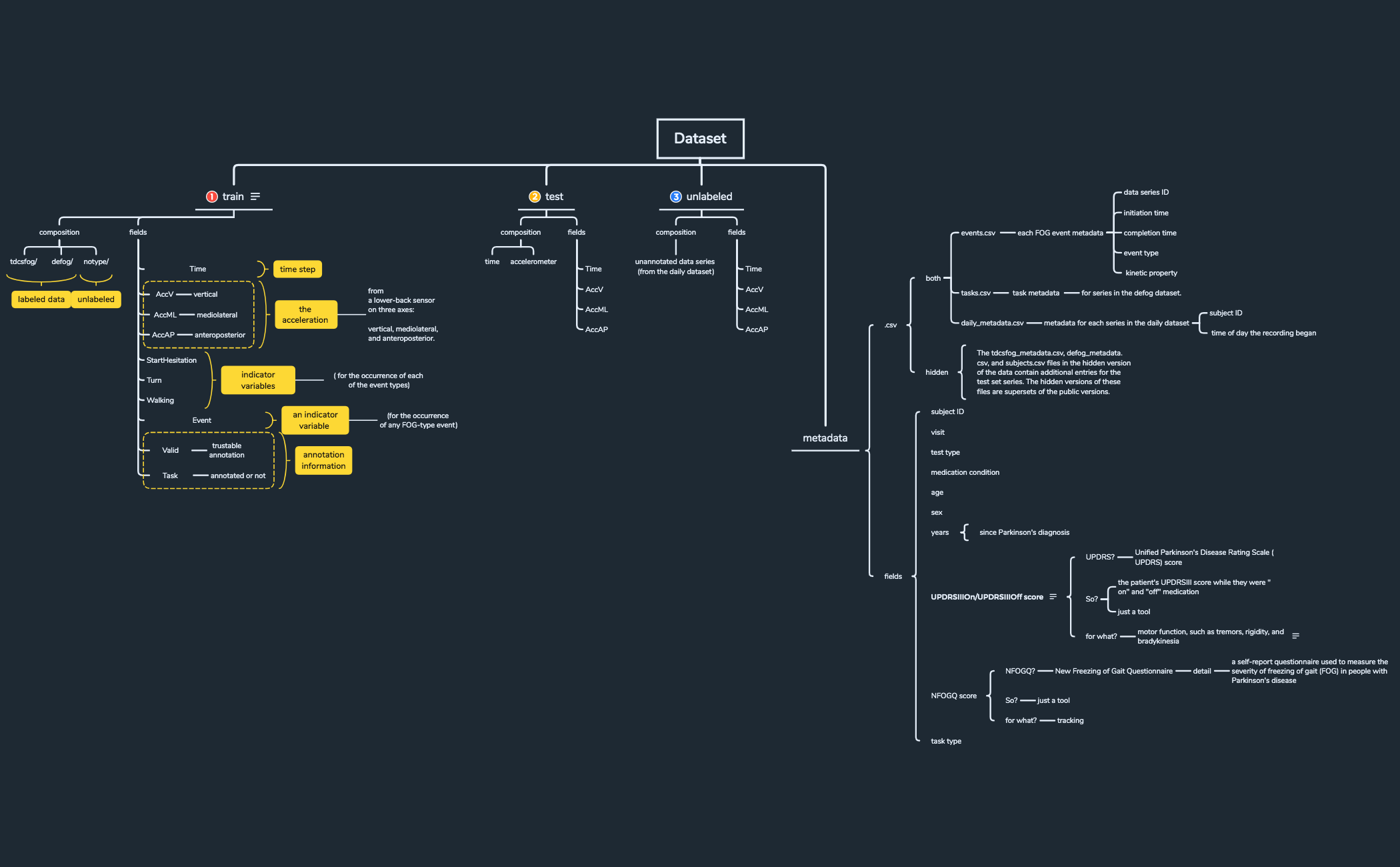
The Dataset mind map template provides a structured breakdown of 95 nodes covering the composition and fields of train, test, unlabeled, and metadata subsets, specifically for Parkinson's disease gait analysis data. This Dataset template organizes key components such as 'AccV' (vertical acceleration), 'StartHesitation', and 'UPDRSIIIOn/UPDRSIIIOff score', making it a practical Dataset cheat sheet for researchers and data scientists. The template visually separates labeled and unlabeled data, annotation information, and metadata files like 'events.csv' and 'daily_metadata.csv', offering a clear overview of data organization and management for biomedical signal processing.
Terms and ConditionsWhen preparing a dataset for machine learning model training on Parkinson's gait analysis.
During data exploration to understand the structure of labeled and unlabeled acceleration data.
When documenting dataset schema for a research paper or data repository submission.
Launch the .xmind file to navigate the four main branches covering train, test, unlabeled, and metadata subsets.
Modify existing node names like AccV or UPDRS scores and add new sub-nodes to match your specific research requirements.
Save your finalized dataset structure as an image or PDF to serve as a visual cheat sheet for your data science team.
The template covers 95 nodes across train, test, unlabeled, and metadata subsets, detailing fields like acceleration axes (AccV, AccML, AccAP), event indicators, and clinical scores (UPDRS, NFOGQ).
It is structured into four main branches: train (with subfolders tdcsfog/, defog/, notype/), test, unlabeled, and metadata (including .csv files and subject information).
Yes, you can edit node labels, add new branches, or modify field descriptions directly in Xmind to fit your specific dataset or research project.
Yes, it is specifically designed for gait analysis data from Parkinson's patients, including fields like StartHesitation, Turn, Walking, and UPDRS scores.
The template lists events.csv, tasks.csv, daily_metadata.csv, and hidden files like tdcsfog_metadata.csv and defog_metadata.csv for additional test set entries.
Share your mind map templates with creators around the world and start earning from your work.

