




Product managers and design teams
During early-stage product ideation when multiple concepts need to be narrowed down to a few viable options.
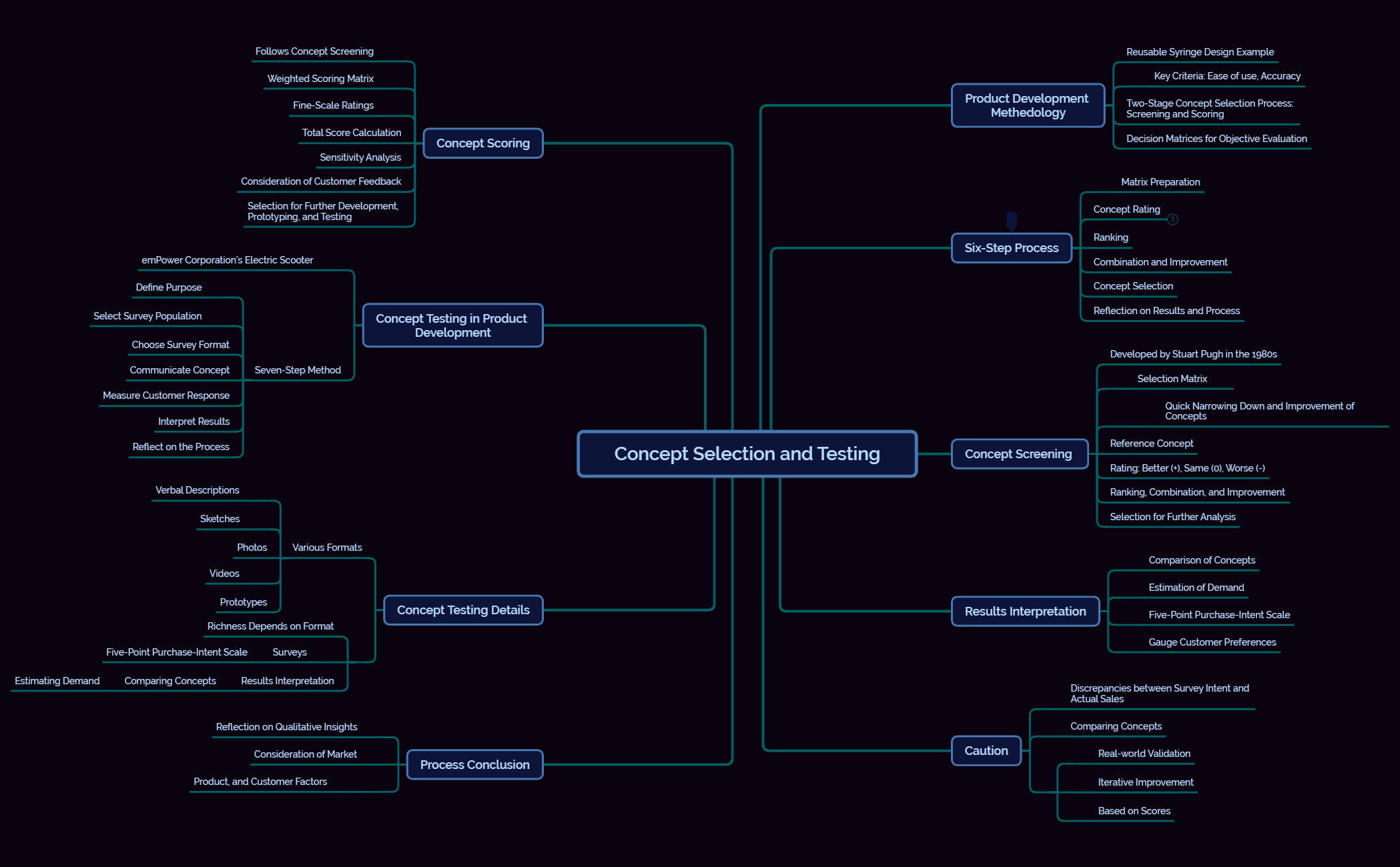
The Concept Selection and Testing mind map template provides a structured framework for evaluating product concepts using decision matrices, covering a two-stage process of screening and scoring. Developed with the Reusable Syringe Design Example, it includes 100 nodes across key branches like Product Development Methodology, Six-Step Process, Concept Screening (originated by Stuart Pugh in the 1980s), and Concept Scoring. This template helps teams objectively rate concepts using criteria such as 'Better (+), Same (0), Worse (-)' and calculate total scores with sensitivity analysis. It is ideal for product managers, engineers, and innovation teams seeking a repeatable method for concept selection and testing.
利用規約During early-stage product ideation when multiple concepts need to be narrowed down to a few viable options.
Before committing resources to prototyping, to objectively compare concepts using scoring criteria.
When conducting customer feedback sessions to test concept appeal and interpret results.
Launch the .xmind file to explore the structured branches covering the Six-Step Process and Concept Screening methodology.
Replace the syringe design examples with your own product data and use the screening branch to rate concepts against a reference.
Assign weights within the Concept Scoring branch to calculate total scores and perform sensitivity analysis for your final decision.
The template covers product development methodology, a six-step process, concept screening (Pugh method), concept scoring, and concept testing. It includes 100 nodes with branches for results interpretation, caution notes, and process conclusion.
Use the Concept Screening branch to compare concepts against a Reference Concept using ratings: Better (+), Same (0), or Worse (-). Then rank, combine, and improve concepts before selecting the best ones for further analysis.
Concept Screening is a quick pass using a reference concept and simple ratings to eliminate weak ideas. Concept Scoring uses weighted criteria, total score calculation, and sensitivity analysis for more detailed evaluation.
Yes, you can edit the node labels to change criteria, weights, and ratings. Xmind allows you to add or remove branches to adapt the matrix to your specific product development needs.
Yes, the template's structured process (rating, ranking, combination, selection) aligns with agile decision-making. It helps teams quickly evaluate and iterate on concepts during sprint planning or product discovery.
あなたのマインドマップ テンプレートを世界中のクリエイターと共有して、作品から収入を得ましょう。

