




Human-computer interaction researchers and usability testers.
Planning a within-subjects experiment comparing augmented reality (AR) and virtual reality (VR) visualization conditions.
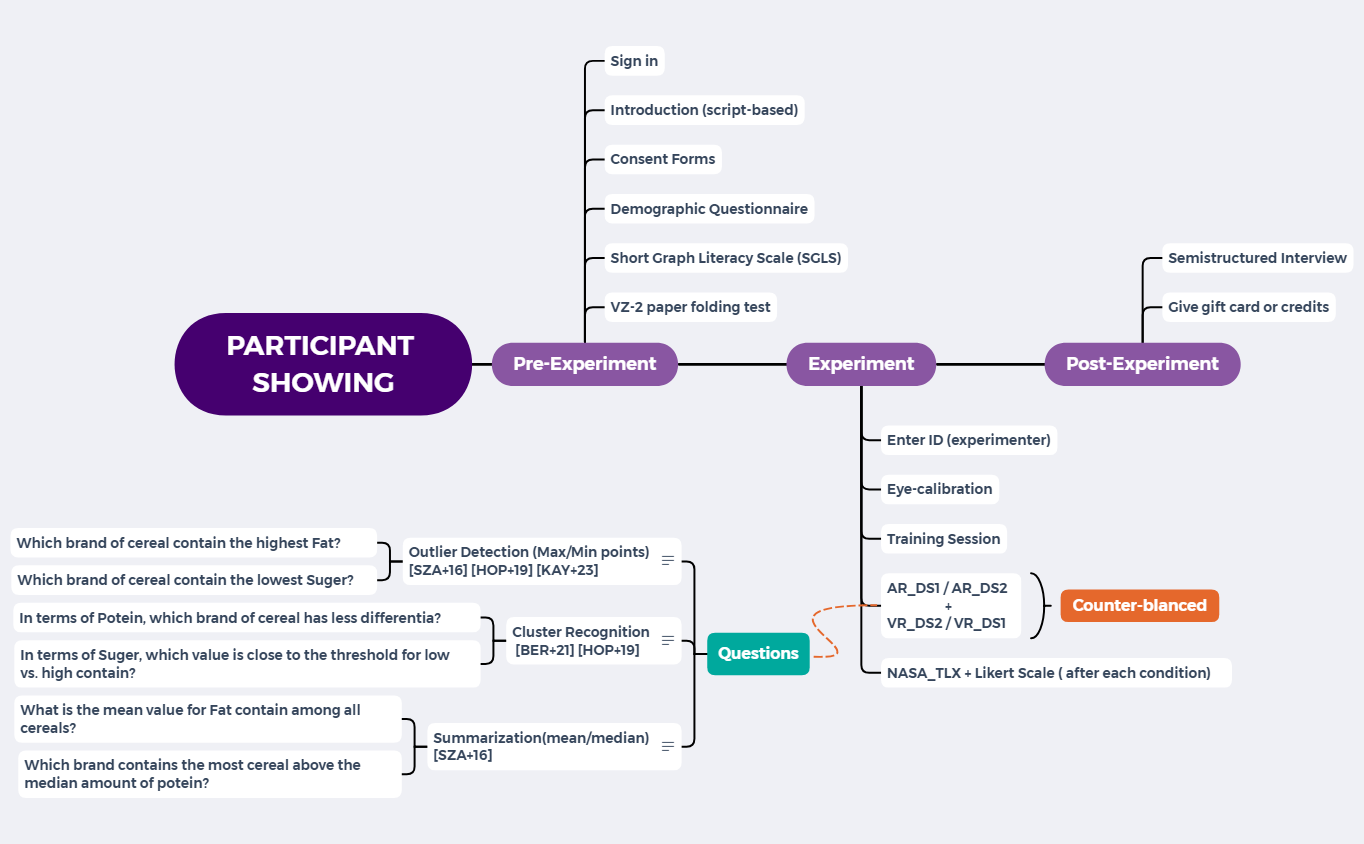
The Comparison Experiment Procedure mind map template provides a structured framework for conducting controlled experiments, covering 28 nodes across participant showing, pre-experiment, experiment, and post-experiment phases. Designed for researchers in human-computer interaction or psychology, this template includes specific instruments such as the 'Short Graph Literacy Scale (SGLS)', 'VZ-2 paper folding test', and 'NASA_TLX + Likert Scale' for workload assessment. The experiment phase features counterbalanced conditions 'AR_DS1 / AR_DS2 + VR_DS2 / VR_DS1', while the post-experiment phase includes a 'Semistructured Interview'. This template serves as a comprehensive checklist and workflow guide for experimental procedures.
Terms and ConditionsPlanning a within-subjects experiment comparing augmented reality (AR) and virtual reality (VR) visualization conditions.
Designing a structured study session for a lab experiment that requires counterbalanced presentation of stimuli.
Conducting a user study that includes pre-test questionnaires, task performance, and post-test interviews.
Download the .xmind file and open it to explore the four main branches covering pre-experiment, experiment, and post-experiment phases.
Modify the node text to match your specific research parameters, including condition names like AR_DS1 and specific assessment scales.
Add or remove nodes to fit your experimental design and use the final map as a comprehensive checklist during your study.
The template includes 28 nodes organized into four phases: Pre-Experiment (sign-in, consent, demographic questionnaire, SGLS, VZ-2 test), Experiment (eye-calibration, training, counterbalanced conditions, NASA-TLX), Post-Experiment (interview, compensation), and Questions (outlier detection, cluster recognition, summarization).
Open the .xmind file in Xmind. Follow the phases sequentially: start with Pre-Experiment tasks, then run the Experiment branch (including counterbalanced conditions), proceed to Post-Experiment, and finally use the Questions branch to guide data analysis.
Yes, the template is fully editable in Xmind. You can modify node names, add or remove steps, and adjust the counterbalancing order to fit your specific experiment design.
The SGLS is a validated questionnaire that measures participants' ability to interpret graphical data. It is administered during the Pre-Experiment phase to assess baseline graph literacy.
Yes, the template can be adapted for online studies. Replace in-person steps like 'Eye-calibration' with remote alternatives, and use digital consent forms and questionnaires.
Share your mind map templates with creators around the world and start earning from your work.

