




Undergraduate physics students
Preparing for a quantum physics exam that covers wave-particle duality and measurement theory.
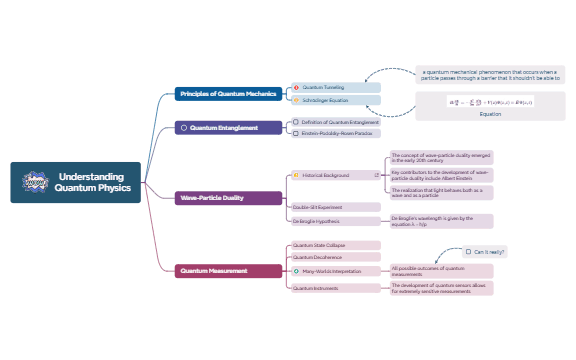
The Cognitive Goals mind map template, titled 'Understanding Quantum Physics,' offers a structured exploration of 25 nodes across five core branches: Principles of Quantum Mechanics, Quantum Entanglement, Wave-Particle Duality, Quantum Measurement, and Equation. It covers key concepts such as 'Quantum Tunneling,' 'Einstein-Podolsky-Rosen Paradox,' and 'Double-Slit Experiment,' making it an ideal study aid for students and researchers. The template organizes complex quantum principles into digestible subtopics, including 'Historical Background' and 'Many-Worlds Interpretation,' providing a comprehensive overview of foundational and advanced ideas. This 'Understanding Quantum Physics' mind map serves as both a learning roadmap and a quick reference for quantum mechanics, quantum entanglement, and measurement theory.
使用條款Preparing for a quantum physics exam that covers wave-particle duality and measurement theory.
Designing a lecture on quantum entanglement and the EPR paradox for a graduate seminar.
Reviewing key quantum mechanics concepts before a research meeting on quantum computing.
Open the .xmind file in Xmind (desktop or web version).
Browse the main branches: Principles of Quantum Mechanics, Quantum Entanglement, Wave-Particle Duality, Quantum Measurement, and Equation.
Click on any node to read its description or add your own notes. For example, expand 'Double-Slit Experiment' to review its details.
Customize the template by adding new subtopics, changing colors, or attaching images to nodes.
Export the completed mind map as an image, PDF, or share it with classmates or colleagues.
The template includes 25 nodes covering five main branches: Principles of Quantum Mechanics, Quantum Entanglement, Wave-Particle Duality, Quantum Measurement, and Equation. Key topics include Quantum Tunneling, Schrödinger Equation, Double-Slit Experiment, and the Many-Worlds Interpretation.
Open the .xmind file in Xmind, then expand each branch to review concepts like 'Einstein-Podolsky-Rosen Paradox' or 'Quantum Decoherence.' Use it as a visual study guide to connect ideas and test your understanding of quantum mechanics.
Yes, the template is fully editable in Xmind. You can add notes, change colors, or reorganize nodes. It can also be exported as an image or PDF for printing.
It explains that all possible outcomes of quantum measurements actually occur, each in a separate branching universe. This interpretation is contrasted with quantum state collapse.
Absolutely. The 'Equation' branch is a placeholder where you can add mathematical formulas, such as the Schrödinger equation or De Broglie wavelength formula, using Xmind's equation editor or as text notes.
把你的心智圖範本分享給全球創作者,從你的作品中獲得收益。
