




Game developers and programmers
Designing a Chinese chess game engine from scratch
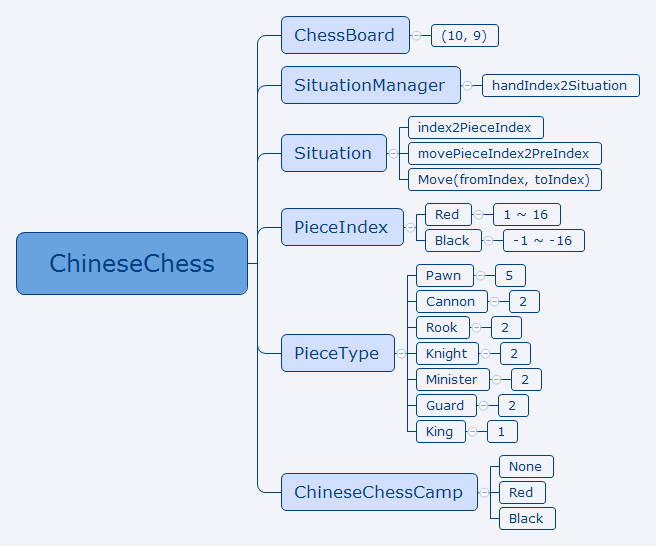
The ChineseChess mind map template provides a structured overview of the game's core components, covering the board, piece types, and game state management. Designed for developers and chess enthusiasts, this template includes 33 nodes organized into 6 branches: ChessBoard (10x9 grid), SituationManager, Situation, PieceIndex (Red 1~16, Black -1~-16), PieceType (Pawn, Cannon, Rook, Knight, Minister, Guard, King with counts), and ChineseChessCamp (None, Red, Black). It serves as a cheat sheet for understanding Chinese chess data structures and logic, making it ideal for building game engines or learning the rules. The template's layout visually maps the relationship between pieces, positions, and moves, such as the 'Move(fromIndex, toIndex)' function and 'handIndex2Situation' manager.
NutzungsbedingungenDesigning a Chinese chess game engine from scratch
Learning the rules and piece types of Chinese chess
Creating educational materials about Chinese chess data structures
Launch the template in Xmind to review the six main branches covering the board grid, piece types, and game state management.
Expand specific nodes like PieceType or SituationManager to examine data structures and add your own custom game rules or move validation logic.
Save your modified mind map and export it as an image or PDF to serve as a cheat sheet for your development team.
The template covers the chessboard, piece types (Pawn, Cannon, Rook, Knight, Minister, Guard, King), piece indices for Red and Black, game state management, and camp definitions. It has 33 nodes across 6 main branches.
It is organized into six top-level branches: ChessBoard, SituationManager, Situation, PieceIndex, PieceType, and ChineseChessCamp. Each branch details a specific aspect of Chinese chess, such as board dimensions or piece counts.
Yes, you can edit the template in Xmind by adding or modifying nodes, changing piece counts, or expanding the game logic. The template is fully editable to suit your project needs.
It represents a move action in the game, taking the starting position (fromIndex) and destination (toIndex) to update the board state. This is part of the Situation branch for tracking moves.
Red pieces are assigned positive indices from 1 to 16, while Black pieces use negative indices from -1 to -16. This numeric system helps differentiate camps and identify pieces programmatically.
Yes, the template provides a foundational data structure including board, pieces, moves, and state management. Developers can use it as a reference or starting point for implementing game logic.
Teilen Sie Ihre Mindmap-Vorlagen mit Erstellern weltweit und verdienen Sie mit Ihrer Arbeit.

