


'%3e%3cpath%20d='M9.59961%204H22.3996'%20stroke='%23FF9334'%20stroke-width='1.92'%20stroke-linecap='round'/%3e%3cpath%20d='M12.0001%204V12.8L7.20006%2025.6C6.72006%2026.928%207.68006%2028%209.12006%2028H22.8801C24.3201%2028%2025.2801%2026.928%2024.8001%2025.6L20.0001%2012.8V4'%20stroke='%23FF9334'%20stroke-width='1.92'%20stroke-linecap='round'%20stroke-linejoin='round'/%3e%3cpath%20d='M9.12012%2019.2002H22.8801'%20stroke='%23FF9334'%20stroke-width='1.92'/%3e%3cpath%20d='M12%2024C12.5523%2024%2013%2023.5523%2013%2023C13%2022.4477%2012.5523%2022%2012%2022C11.4477%2022%2011%2022.4477%2011%2023C11%2023.5523%2011.4477%2024%2012%2024Z'%20fill='%23FF9334'/%3e%3cpath%20d='M19.5%2024C20.3284%2024%2021%2023.3284%2021%2022.5C21%2021.6716%2020.3284%2021%2019.5%2021C18.6716%2021%2018%2021.6716%2018%2022.5C18%2023.3284%2018.6716%2024%2019.5%2024Z'%20fill='%23FF9334'/%3e%3cpath%20d='M16%2026C16.5523%2026%2017%2025.5523%2017%2025C17%2024.4477%2016.5523%2024%2016%2024C15.4477%2024%2015%2024.4477%2015%2025C15%2025.5523%2015.4477%2026%2016%2026Z'%20fill='%23FF9334'/%3e%3c/g%3e%3cdefs%3e%3cclipPath%20id='clip0_11502_53328'%3e%3crect%20width='32'%20height='32'%20fill='white'/%3e%3c/clipPath%3e%3c/defs%3e%3c/svg%3e)

Sports science or kinesiology students
Preparing for an exercise physiology exam covering cardiovascular responses to training
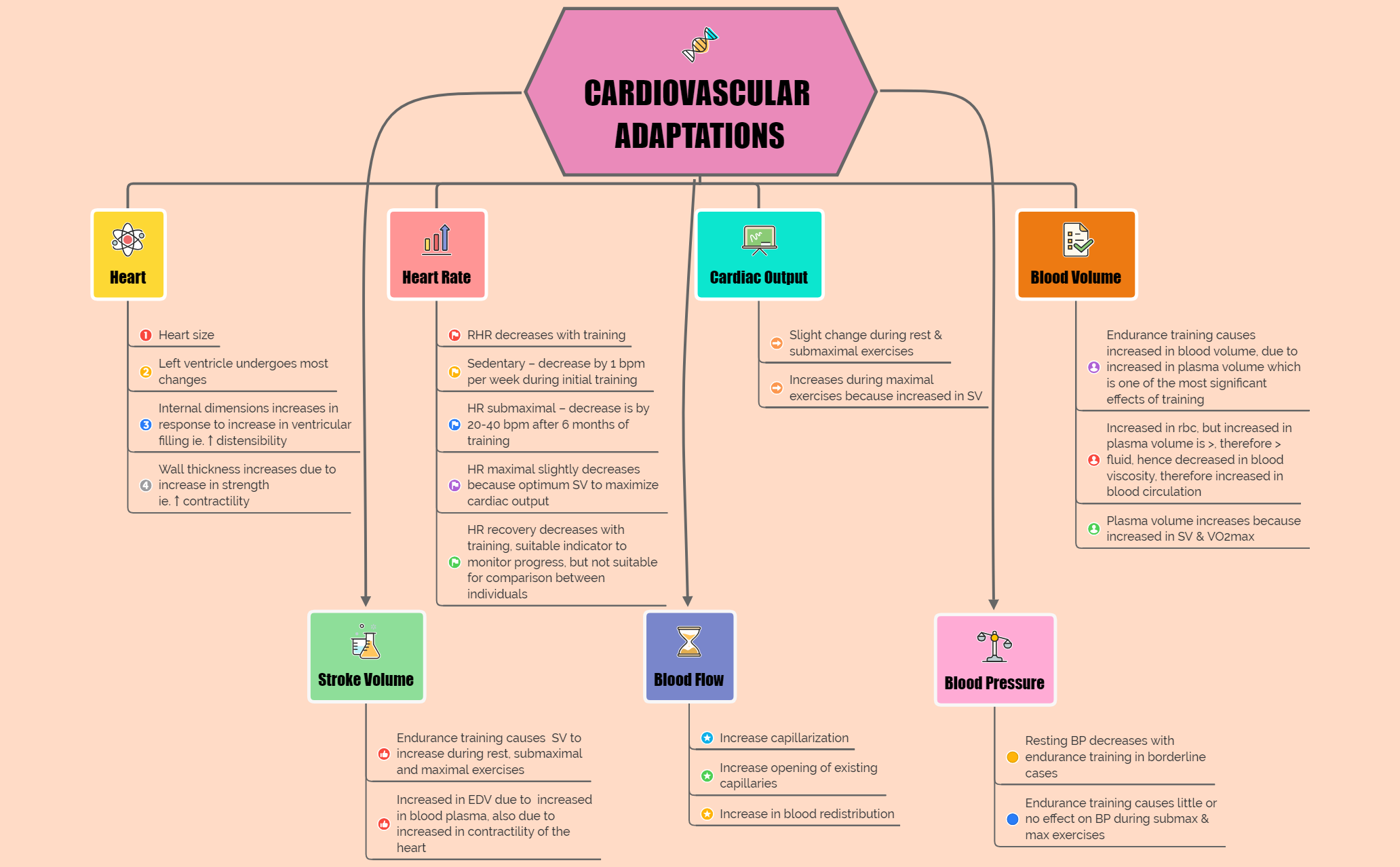
The CARDIOVASCULAR ADAPTATIONS mind map template covers 7 key physiological responses to endurance training, including Heart, Heart Rate, Cardiac Output, Blood Volume, Blood Flow, Stroke Volume, and Blood Pressure. It details how resting heart rate decreases by 1 bpm per week during initial training and how maximal stroke volume increases due to enhanced contractility and plasma volume expansion. The template also explains that blood volume increases primarily from plasma volume expansion, reducing blood viscosity and improving circulation. This Xmind template serves as a concise cheat sheet for students, coaches, and healthcare professionals studying exercise physiology.
Terms and ConditionsPreparing for an exercise physiology exam covering cardiovascular responses to training
Designing an endurance training program and needing to understand physiological adaptations
Writing a research review on cardiovascular changes with exercise
Launch the template in Xmind to review the seven key physiological responses including heart rate, stroke volume, and blood pressure.
Replace the example physiological values with your own research findings and add new nodes for related topics like VO2max or lactate threshold.
Save your completed cardiovascular adaptation map as a PDF or image file to use as a study guide or professional presentation.
The template covers 7 main branches: Heart, Heart Rate, Cardiac Output, Blood Volume, Blood Flow, Stroke Volume, and Blood Pressure, with detailed sub-nodes explaining physiological changes from endurance training.
Open the .xmind file in Xmind, then expand each branch to review key concepts like 'RHR decreases with training' or 'Increased capillarization'. Customize by adding your own notes or diagrams.
Yes, the template is fully editable in Xmind. You can modify text, add icons, or export as PDF or image for printing.
HR recovery is a suitable indicator to monitor training progress, but the template notes it is not suitable for comparison between individuals.
Yes, you can edit any node in Xmind. The template provides general effects (e.g., resting BP decreases in borderline cases), and you can add specific data.
Share your mind map templates with creators around the world and start earning from your work.

